Experiments·Transcript-backed
bifilar coil pulse: Papa Bale's Pulse Motors
bifilar coil pulse — Watch me tinker with my electric type pulse motor builds. From monopole magnet setups and 369 coil designs to transistor triggering…
Long-form · Full audio · Best on YouTube
Watch the complete video: bifilar coil pulse: Papa Bale's Pulse Motors
Watch the full long-form video on YouTube — that's where the full bench audio, runtime, and experiments live.
Preview embed · full runtime is better on YouTube
Prefer the full player? Better audio, runtime, and next-video queue on YouTube.
▶ Open full on YouTubeJump to the discussion · full video on YouTube
Hear it on the bench
Each link opens “bifilar coil pulse: Papa Bale's Pulse Motors” on YouTube at the first time that topic comes up in the captions. Stay on YouTube for the complete runtime.
See it on the bench · full runtime on YouTube
What to watch for
- ▸Monopole magnet setup using steel strips on neodymium magnets creates a south-dominant field with north only very close in, enabling V-gate style pull then push once spinning.
- ▸The 369 build uses three 16ga coils (~300 turns each), three 20ga coils on soft iron, a 26ga trigger coil, and nine rotor magnets; all drive coils wired in series.
- ▸Trigger coil position is critical - small movements in/out or side-to-side dramatically change speed; must be adjustable.
- ▸Running at 12V slows RPM but increases charging current to the battery; lowering to 10V speeds it up but reduces charge rate.
- ▸Pickup coil shows ~765 ohms (half is ~382); moved closer to rotor it adds noticeable drag yet helps demonstrate battery charging.
- ▸These electric type motors need an initial spin; they won't self-start but can run for extended periods once moving.
Watch the full long-form video on YouTube — that's where the full bench audio, runtime, and experiments live.
Experiment notes (read while you watch)
Notes support the video — for the full-length run with complete bench audio, stay on YouTube.
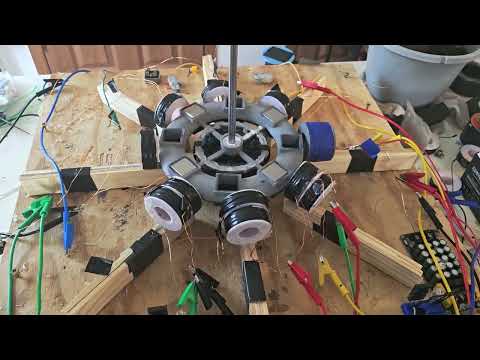
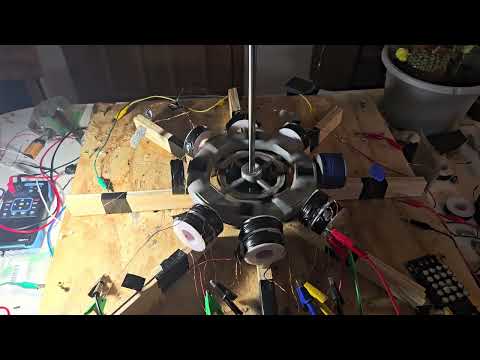
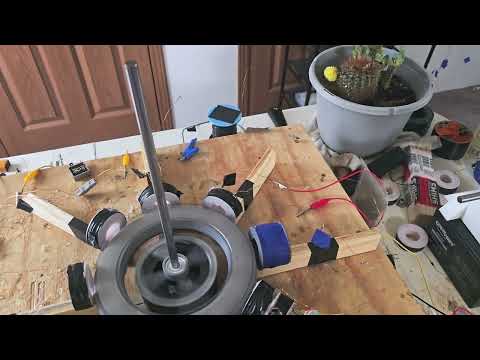
Hands-on shop footage of electric type pulse motor experiments. I show a monopole-style magnet rotor that runs on momentum plus V-gate pull/push, then move to the 369 design with mixed gauge coils, transistor switching, adjustable trigger coil, and a pickup coil that demonstrates charging effects on a battery.
Key takeaways
- Monopole magnet setup using steel strips on neodymium magnets creates a south-dominant field with north only very close in, enabling V-gate style pull then push once spinning.
- The 369 build uses three 16ga coils (~300 turns each), three 20ga coils on soft iron, a 26ga trigger coil, and nine rotor magnets; all drive coils wired in series.
- Trigger coil position is critical - small movements in/out or side-to-side dramatically change speed; must be adjustable.
- Running at 12V slows RPM but increases charging current to the battery; lowering to 10V speeds it up but reduces charge rate.
- Pickup coil shows ~765 ohms (half is ~382); moved closer to rotor it adds noticeable drag yet helps demonstrate battery charging.
- These electric type motors need an initial spin; they won't self-start but can run for extended periods once moving.
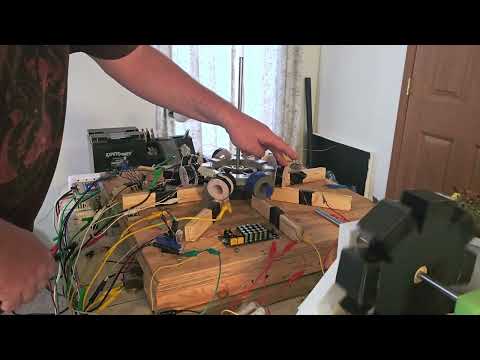
Real bench time with two different electric type pulse motor setups. First a 14-inch rotor with 12 neodymium magnets yoked with steel strips for a monopole-like south field. Then the 369 version with mixed coils, transistor, and pickup. Curious measurements, audible speed changes, and honest observations only from what I saw on the bench that day.
From the spoken experiment
The following notes stay close to what was said in the video about electric type:
> What's going on? Wow, that's kind of bright, isn't it? All right, so let me show you what I got out here. All right, there's my brother. >> What's up, y'all? Um, so what I did here to kind of monopole this thing is put some steel strips, magnetic uh, magnetize right around this whole thing. So now in between there's no north anymore, right? So it's just it's monopolled. Oh, there it goes in between. Oh, there it is right there. That's weird. Maybe the battery's dying in the in the device. But anyway, um what I've got here is a north face, south face, north, south So it comes in north south. All these are south facing and pretty much you get a north magnetic field where they're touching or I mean a south my fault. It's all south. It's all blue. It's all south. You get close to the magnet you got your north field. But in between it's all south up until you get really close. There it is. Bu…
Builder checklist
- Confirm trigger/sensor timing before chasing higher voltage
- Watch heat on coils and transistors during longer runs
- Record voltage and behavior at each change (one variable at a time)
Related on this site
Related on this site
- Pulse Motors for Beginners: Start Here — Beginner-friendly entry point that matches the curious DIY tone and explains basics before jumping into monopole and 369 builds
- How to Wind Coils for a Pulse Motor (Step by Step) — Directly supports the 300-turn 16ga and 20ga coil details shown on the bench
- Which Transistor for Your Pulse Motor? — The video clearly shows a transistor doing the switching; this link gives more detail on common choices like 2N3055 or TIP31
- Can a Pulse Motor Charge Batteries? What Experiments Show — Matches the exact battery voltage and charge-rate observations I made at 7 V, 10 V, and 12 V
- Pulse Motor Rotor Design: Magnets, Materials and Balance — Covers the 14-inch rotor with 12 neodymium magnets and steel yoking I tested
- I Finally Got My Pulse Motor Running (Reed Switch) — Similar first-person success story with a different triggering method; good related watch
---
*Generated from video transcript (hash `25c4db8c3e16…`).*
Full transcript (29,067 chars · en)
What's going on? Wow, that's kind of bright, isn't it? All right, so let me show you what I got out here. All right, there's my brother. >> What's up, y'all? Um, so what I did here to kind of monopole this thing is put some steel strips, magnetic uh, magnetize right around this whole thing. So now in between there's no north anymore, right? So it's just it's monopolled. Oh, there it goes in between. Oh, there it is right there. That's weird. Maybe the battery's dying in the in the device. But anyway, um what I've got here is a north face, south face, north, south So it comes in north south. All these are south facing and pretty much you get a north magnetic field where they're touching or I mean a south my fault. It's all south. It's all blue. It's all south. You get close to the magnet you got your north field. But in between it's all south up until you get really close. There it is. But like you just move out just a little bit and that that north goes away. But it's definitely still there. just up really close within, you know, 10 mm like a Hall effect proximity. So, this one over here is doing the same thing. It's got north on this side, south on this side. So it takes that south. All these are south out. All these magnets on here. I just I put the steel strips to try to like link them together more like link the south make it go all the way around pretty much without the and like out here you can see that it's like stably south. move it in closer and it starts pulsing because the magnets. And then you move it in even closer, you got your north that starts pulsing. Uh, it's a magnetic device. It's a nothing really. It's uh well, it's been moving for quite a while now at this speed. So, I don't know exactly. Still trying to figure that out. But what I did is I yolked basically with uh magnetic material all the south facing magnets so that maybe that material is all south now but it's not. Maybe along the ribbon it is. You know there a lot of south energy there. But with momentum, the momentum that I put into it, it's extended. Now, every time a magnet passes one of these big magnets out here, it is pulled in a Vgate formation. Pulled and then pushed. Here, it's pulled and then pushed. So, that's how it works. You got to move it though. It won't move on its own. It's a 14-inch rotor with 12 neodymium magnets on it. All right, we're going to go into the other room, check out some motors real quick. All right. Hey, what's up? All right, we got our uh 369. So, why I call it the 369 or A369 design is you got three 16 gauge coils, you got three 20 gauge coils, and altogether you have six coils and nine magnets on the rotor. So, let's check this out real fast. And and we got a pickup coil that we can add or take away. Um, it's all hooked up. Let's check out how well this thing jens. Um, we'll put seven volts in to start. Let that warm up for a few seconds. This is the battery. Okay. 129 is what we're going to call it. 12.09. But, you know, we're only putting 7 volts in, so we're not going to be getting much out currently. But I'm going to I'm going to turn it up to 12 once we get going here. Okay, thank you. So once we get it up to 12, it slows down up. Even at 10, it starts slowing down, but the charging goes up. Okay, so we're going to turn it up to its 12vt system. And it simmers down like a lot. You can hear it. But the charging it was at 12.09, right? 1 2 3 4 5. So, I'm going to turn it down now to 10 and it'll start picking up again, but it won't charge as fast. But I think I should leave it on for a little bit so the charge will stick for a little bit. Cuz if I just run it for, you know, 10 minutes, it's going to it's going to shut off. Or when I shut it off, it's going to go right back down to where it started at. It'll like I'm just charging a battery right now. Boom. All right, let's move the pickup coil in. That's pretty good. Nice air gap there now. Bam. [Music] Sorry, I can't respond to like vague questions. Um, what do you want to know? I'll explain the whole thing and how it works. Is that good? [Music] All right. So, all these coils here are linked in series. Okay. Right here is the transistor, which is how it's hooked up. Um, you got 26 gauge trigger coil and 16 gauge coils here. I should turn it off while I try to explain this. Um, so all these coils here are in series. Okay. Uh, these this set of three 16 gauge. There's about 300 turns in each one of these coils. 220 something like that. Uh, and then there's a trigger strand in here of 26 gauge. So you move the coil in a little bit and it'll trigger um the electromagnet is pulsed from the triggering. Okay, it's uh through this every time the magnet passes this coil, it'll trigger um the transistor to close which will complete the circuit basically and all the coils will get lit up and when they get lit up it'll push them it'll push the motor. Okay, so you got your 16 gauge coils and then you got 20 gauge coils which is two layers of 20 gauge on soft iron cores. Uh those coils over there have an extremely potent powerful magnetic field. Um it's not very big though. It's just when I put the green paper on top of it, it's like white. Okay. It's it's very powerful. And that's I believe one of the reasons why the rotor goes as fast as it does when I get the trigger coil in the right position. You notice how when I moved it over here just a little bit like that, it started going a lot faster. But it's good to be able to move it. And being able to move it is important in this instance because you got to move it back once you get it in the right position. So, it's got to be able to move in and out and then side to side. Thank you. Thank you. Uh really appreciate that. Um, now this pickup coil here is pretty cool. Uh, right now it's uh depicting the amount of ohms. There's 765 ohms, give or take. And when you divide that in two, it's 382 ohms, give or take. Uh, so there's there's two double the resistance needed in in this pickup coil. And I've only I got four strands in there, but somehow one of the strands got caught up. It was a 38 gauge strand. So I got three 32 gauge strands linked in series. And then I've got a 38 gauge strand, which is right here. And I I don't know what to do with it. But if I cut it, that would probably be the best idea. or like melt it and then uh yeah, get a connection right in the middle of that. Um it won't be a full connection, but it'll add a little bit of length on which will increase the amount of voltage generated. I get I've gotten almost 200 volts of AC electricity off of this coil and this rotor. I think that's awesome. uh PLA um iron. Uh no, it's not iron infused. It's just regular PLA. And we do still have 12.12 volts in the battery still. And we only had it running for like 4 minutes. But we got this one with the six coils. And we got this one over here. It's got one coil. of it's a trifiler coil. So, it's got uh 18 and 20 gauge. [Music] We're already generating 103 volts. 108 111. Look at that. Just climb, dude. That's pretty awesome. Now, see that sound is uh this 20 gauge coils with it's got like four times the amount of core material. And then the pesos, these little discs down here, they're buzzing. All right. H. So, I mean, finding the true effective voltage for this system for charging, you got to turn it up. you have to turn it up to 12. If you're going to charge a 12volt battery, you're better off putting 12 volts in. Um, that's just one thing. Uh, and then wow. I got to take it easy real quick. I just I know that the system should be balanced. And if it's not balanced, you'll know right away. cuz I was just running it for a few minutes and it didn't go up at all because it was at uh seven volts instead of 12. But it goes a lot faster at a lower voltage. I mean it goes tremendously fat. I think 5 volts might actually be its true effective voltage rate cuz this coil will get up to like 205 volts no I just try to give the best explanation that I can. Uh, do I dedicate my life to it? No. No. I got I got I'd say I put a lot of effort in. But I mean, anybody that wants to do anything well has to put effort in. Um, and I wouldn't say that I necessarily do it well. I have a very rudimentary style that uh I it fits me very well. Um there are probably I know for a fact people out there that that can make it nice and tight like real nice package nice and tight and that's good and I appreciate that. I watch that stuff and I give it a like. This fits my hands. my hands, they shake a lot. Um, you know, I I the size is good for me. I'm like 6'3 and tiny things don't work with me anymore. I mean, I used to be able to do the small the fine motor really good, but I can't do it anymore. So, it's it's bigger now. Look at that. that that you know I asked I'm like I when I painted it I have no idea what it what it was or you know what it was supposed to be. I was like it's an eclipse and a friend of mine was like no that's that's not an eclipse. Um but uh it could be like a star or uh you know something radiant. Definitely could be a combination of radiant light and reflective light uh representation now that I think of it. Uh what was going through my head is like um harvesting when when people harvest light like uh for energy and transfer transform it into a usable energy type like AC or DC like a solar panel something like that. um that solar panel should be able to harvest not just you know sunlight but all light and not and they can a lot of them can but I'm telling you like to a to a to a degree where you can harvest moonlight reflective light um that would be awesome. that that would be truly awesome. Then you wouldn't have to worry about any of it except you know rain and clouds and whatever for that instance. But then you know you just make a lightning gathering device you know hook it up to the same thing. You know, if it's just chilling there making electricity, then yeah, man, you hook it up. So when it's raining outside, it it shocks the the crap out of that thing and produces energy when it's raining, too. That's what you do. It's like there's going to be there's going to be no reason in the future. um like there's tons of reasons now why things can't happen but I think a lot of that's going to be melted away and I think that uh pe uh companies that can do these things are going to be judged on a lot more than just their bottom line because the bottom line is going to change and might change for the worse but it depends really going to be dependent on what's going on you know Um, and then there's like the the abundance theory which I find to be very interesting where things the marginal cost of making things is so low that everybody gets a free one like a house and a car or you know like a a passport to a robo taxi you know or whatever it is you know you get a free free this and a free that just for being a citizen of this planet eventually. That would be great. That would be awesome. And do I know if that's going to happen? I don't know if it's going to boil down exactly like that, but I I do think there's going to be an attempt in the near future um to eradicate certain problems like homelessness. They're going to end up having better cribs than than I than I have. And that's cool, man. That's cool. In my mind, that's good. Um, I'm happy with what I have. All right. So, we got the eight mag rotor over here, and it's spoked. you know, it's got spokes on it and it's got the 18 gauge wire and the 20 gauge wire in series and then it's got a 32 gauge trigger. It's on like uh this transistor right here. It's a Toshiba. And I'll turn that one on to like nine real quick just so we can get a glimpse at it. Nice breeze. Thanks, Hunter. Yeah, man. Um, definitely chose all one hole to jump down and it uh has led this this far so far. Um, yeah, I would agree with you. I've come quite a ways, but without changing my style too much, you know, it I I would consider it definitely a papa bail thing the way I do it with all the clips and the wires and everything, but it all works out in the end. You know, if I ever learn how to solder, it'll uh it'll look different. But it's like I went through a whole starter roll of solder and I couldn't even get one connection down. So, I'm like frustrated with that. And I think it's because I my I don't have a good clamping system uh to hold everything in place. All right. So, yeah, we're going to head out here real quick and we're going to see. Oh, it's still moving in the same direction. That's so cool. But it's going really slow. Let's see if we move this plate in if we can get it to go any any harder. You know, I think we might have to move it out or pump it in and out. I mean, that would work, I think, if we pumped it in and out, but I'm not going to do that. There we go. Let's move it back out where it was, and it's going to stop in a little bit. But yeah, it's a momentum extendum is what I call it. So, it's like an extension of your momentum. And I'll show you how much I'm going to put in. Okay. how much momentum I'm going to put in this thing. That's it right there. That's all it needs. And that'll go until I'm done. Heck yeah, man. That's sweet. Now the Utron Utron Utron. Let me talk about that for a minute while we charge up the battery real quick. One, two, three, four. One, two, three, four. There we go. All right. So, the Utron I got to I got to print two new halves that is going to be able to hold this rotor in the middle of it. Okay. So, there's four permanent mags on there in here inside of this and there'll be four inside of the new ones, but there'll be room for that in the middle of that. So, it's going to be a counter rotating device. um self-contained, but it's going to be it has to be on the shaft. So, it's not like you can take it somewhere with you unless you can set that shaft up. So, but yeah, it'll be awesome. Oh, look at that. It's charging like a like a magic trick, dude. That's awesome. Yeah, this rotor's been around for ages. I bought it for this um purposefully just for this. So uh I've only made rotors. I made stands for coils. I made bobbins. Um let me think what else could I have made? That's pretty much it. You know, different style, different shapes. Um, but the bobbins and the rotor are pretty much what I've used the printer for. Haven't seen any other reason to use it or have any skills really. I just use Tinkercad. I built this table if you can't tell. Um, yeah. So, I mean that's where all the quarter inch stuff comes from is like the poles, the pegboard, the bearings, it all kind of goes together to make what I got here. And it all kind of was like a circle, like a cycle almost. It all it's all fits together. It's all the way it is because of, you know, the board and the shaft and the bearings and it all just came together. But, uh, the having the pegboard gave some direction. Um, I I used to like uh I made these levitation discs like big toid just a plastic disc like this and then put uh bar magnets around the edge and I would make toid big toids or specially sized toid magnets. Um, and I would like experiment with gluing the magnets on in different formations and cross formations and have multiple discs and seeing if putting pressure on the top and putting pressure on the bottom would make it levitate better or worse, all that stuff. And I found that uh having pressure on both sides works okay, but it adds more friction. It just it's a thing, man. Uh so it won't spin for as long, but it'll probably be more stable than say if you just had it floating there. But like I was saying earlier, this coil right here has got 764 ohms when the rotor isn't moving. So, and you divide that in half, it's like uh 382 ohms times two. So, that's pretty neat. Um, yeah, it's pretty close. All right. So, I might have been a little off with that momentum extendum, but we're going to check it out. Still moving at about the same speed. Let's check it out. It's a little little slower, but you know, I just nudged it literally. And I think having those strips on there really affects the magnetic field to a point where it's kind of uh what do you call it? Just there's no gap really. But there is a gap. There's literally gaps in the steel plating. But I think it it links at least three magnets together each each strip. Awesome. So I put forth the proposition uh earlier that this painting could have been uh an experiment that's going on today. Um an RAV uh I think it's called like a radiant arc vortex. And when I saw it, I was like, "Damn, that looks really kind of like what I did." And that might be an explanation for what it is. Cuz, you know, I'm like, "It's an eclipse, but it's not an eclipse. It's uh something else." He's like, "That's not an eclipse." I was like, "Yeah, man. You're probably right. I don't know what it is. And now maybe I do. And that was four years ago. See, you got to hear when you hear those pesos clicking. And that's when you know you got a good connection with your uh trigger coil. 104 volts 111 120 140. Woo! 150. It's amazing. I want to let it rip, man. But I have a feeling that there's going to be something that that happens that I'm not going to like. I have to put more tape on it to feel good about that. My kids are home. Sweet. All right. I love just love how that energy tapers off. So, what I think I can do with the energy from this pickup coil is run one of my paperclipip switches to run another wheel. Maybe the big wheel that's out there. Um, this the thing is it's got to be done through like a a paperclipip switch. I don't Well, maybe if we funnel it through this all the energy off the pickup coil and put it through that and we hook that up to a transistor to run at the other wheel. So, we're gonna run with the energy off of this thing, >> this cat bank down here, it gets really choppy when it slows down cuz those coils in the back are like straight up core material and they're right up on there pretty much. So, it's better for me to stop it. All right. Um, yeah, that's going to be uh definitely an experiment for a later live stream. I'll have that all set up with the the second wheel on the transistor. That would be great. And then it would be able to go at a speed that's uh well, I mean, I can get the paperclip switch going pretty fast, actually. Man, that could be really good. Especially the big wheel, man. I got that going really good. But yeah, I can't do it on that wheel. But you get the the magnet, the paper clip right up on there and it will knock on that copper just like a read switch. So that'll be interesting. see if I can run a transistor because it roughly I would say it costs it's going to cost more per closing of the circuit with the transistor than it will with the paperclip cuz I can turn the paper clip all the way up to 12 volts and and it doesn't draw 50 milliamps. Not even. But I'm thinking it's going to do like 300 with the transistor and it's going to do it fast. I don't know if it's this coil is producing energy like that. We'll have to find out. All right. All right. So, yeah, I want to put forth a question. Um, these bobbins on this rotor, it all happens to fit really, really well together. But I need to know what gauge wire I'm going to be putting in here. So I was thinking 20 and 32. Make them all by fers like that size. See, I got the 20 gauge. I do have a degree actually. That's my name. Don't wear it out. Oh man. I think that we'll either make it 20 and 32 or 20 and 26. This is 26 right here. And all these rest of these are 32. Or we can make it 32 and 32. That would be awesome. But, um, honestly, the 32 gauge is going to want to be the one that weighs the most if we fill it out all the way. So, it might end up being 32, just all 32. Maybe not even doubling up the 32s, but making it all one strand of 32 and linking them in series. And I'm looking to get the the biggest uh you know, no core material. We're not looking to uh generate. This isn't for generation of any kind. Um the Utron that I'm building, it's I'm not going to be generating with it. What I'm going to be doing is I'm going to turn it into a counterrotating device and it should be able to uh self is going to be self-contained. So all I have to do is spin it and the mechanism inside should you know perpetuate that spinning motion as long as there's juice in the batteries. You can't really see it, but the shaft is a little bent. It's a little bent, and I didn't notice it until after I, you know, shafted the rotor. So, that sucks. But, uh, yeah, that's what's going on there. Ow, dude. Yeah, that that was good. Awesome. So, this this thing over here, man, it spins very well. Has very good bearings on it. Hybrid bearings. And with it being able to spin like that with just, you know, me spinning it, having this the rotor on the in the inside here. Let me uh let me try and get this off. All right. So, we got three big Neos in there. And then we're going to hollow out the rest of this and get the rotor. Fits in there really good. I had a a magnet chilling on the top there. And I I I've hooked this up just to see if it would fit. And it's like perfect. Look at how close the the clearances. That'll spin nice in there. It'll be It'll have the torque it needs everything being that close. Oh, wow man. And it all fit together like magic. And as soon as I get the right I think I only got one chance at this, honestly. So, we're going to we're going to hollow it down about an inch and a half. And then we're going to hollow out the center the size of the magnet. And we're going to put the magnet in the hole. And we're going to rest the rotor in there. And then we're going to hollow out the the other side. We're going to print two new ones with the hollowess. And then that rotor should fit right in there. The bachelor's in business administration with a major in accounting. What you got, man? Oh yeah, man. We're going to be starting our new segment uh later on this week. So, please, I'm encouraging all ye trolls to participate. We're calling it the trollinoxipy. And we're going to we're Yeah, we're going we're going to perform the medical procedure ourselves. >> The trollinosty. >> What's some dialogue? >> This is going to be based on your comment solely. So bring it bring them in. You know anybody that wants to troll, bring them on in because we're going to make a public example of them. Yes. That's what the whole skit's about. It's like, you know, we're going to make fun of it. >> You got to make up a word for it. I'm gonna I can't really make up a word. >> Maybe >> it's a little pulse motor. Um And I know my my heart like has a capacity to be a troll sometimes. I mean, normally I'm not I'm I'm really not a troll. Like if I drop shade on something that you're doing, I will tell you why I'm doing it. So that literally takes me out of the realm of being a troll. [Music] But I understand that urge to say, "Hey, man, don't waste my time." yada yada yada. I want my my I want my time back. I've That's the one I've heard before. I want my I want my 15 seconds back. Sorry, pal. That's kind of the dumbest thing I've ever heard. And then it just after hearing it so many times, it's like can you I mean, if you're going to do it, can you be original about it? Sick of, you know, hearing the same thing over and over and over again. cuz you're It's not right. Yeah, we crossed some sort of threshold right there. Amen. I just cut the power. That's That's what happened there. But I heard my ears start ringing there. Awesome. So, yeah, I think that as long as you wrap the coils correctly, uh as uniform as possible, uh having more core material than copper is actually a really good thing for for power. Um, I would advise doing more than one of those coils though, like having a series set of those coils like like I do right here, cuz pumping anything through that is probably going to blow up whatever you have. Um, so you need more more copper honestly to make it work better. But each one of those, I mean, I'm telling you, man, that the the acute strength of those electromagnets are are beyond anything else that I have. No sir, I don't believe in that. I do not believe in the word free. Honestly, this is not a free energy device. It's a It can charge a battery. That much I do know. Can charge a battery. It can run another pulse motor. Um, but as for having more come out than is put in, I can't even make that happen with a pickup coil. It doesn't really happen. Not in a usable way. Not Not in a way that you can like turn it back onto the same wheel. Like if you're putting it into a different mechanism, it'll work fine. The minute you try and turn it all back into your same thing is when you got problems. Yeah. I don't believe in any of that stuff, man. I literally only believe in what I can do. I can make this wheel move pretty fast. And I believe that the electromagnetism coming out of those coils in the back there is stronger than anything I've ever done. But even with that, the cost is not free. I mean, I my paperclip switch over here is tremendously efficient, but it's not free. Um, you know, I can put it all the way up to 12 on this on this power supply right here and it'll still read zeros across the board for the amperage. It doesn't mean zero amps. What it means is it's less than 100 milliamps, which is very good. Um, if you got it less than 100 milliamps, you're doing it right. >> There's a pole. >> Okay. >> Um, If you would buy a 3D printed rotor online, would you want to buy it in stock inventory or submit your own design? >> Oh, okay. >> So, that's what that comes. >> Okay. Yeah. Um me, I'd do my own. I mean, I would like a stock rotor to mess around with, like maybe a milled one or something like that, but I'm I'm happy with building my own. Um, but yeah, I'm limited by, you know, PLA itself. It's very versatile, but uh, like the generation capabilities of this rotor would be way more if it was pure aluminum. Just saying. Way more. No, I I agree that it's not about how much you generate though. It's it's about how much you put in. It really is. It's always going to be like that. Um yeah, man. I' I've gotten higher numbers on the other side, but it's it's not about those numbers. At least that's what I've been led to believe that it's not about those numbers. It's more about the cost it took to get those numbers. Even if it's very minuscule, it just means that it's more efficient. And I don't know, um, I put forth another proposition that if you put a penny into a machine and it gives you $100 back, does it make it a it make it both more valuable penny but less valuable $100. I agree. I agree, man. And I I'm totally saying I've gotten insane numbers before. I've gotten up to 500 AC volts off of two pickup coils. All that, you know, and just off of something like this. This little coil right here. 500, dude. Like, yeah, that's No, it's not small fries. I've actually been shocked by something like that before. It's It's interesting feeling getting shocked by one of these things, >> but I I honestly feel like in order to get that zap, you're going to have to get the the B the BMF directly in into your I don't even know what it was that shocked me, but I was definitely trying to hook up a back electric motor force connection. I don't understand what you're >> I don't understand what what the uh aggressiveness is all about. >> That's That's uh tone it back now, man. It's like, good grief. Um, all this uh generation power coming off of this 369 design is actually coming right through the bedini extension. That's what I call it. It's a extension from the collector. Goes straight from the collector. That's actually going through this cap bank and then into the battery. So, and it it it charges this battery 100th like every three and a half seconds. So, it's it's good. And that's a battery that this is a uh 12vt 20 amp hour 20our battery. So, it's not it's not a deep cycle battery. I don't have that kind of money. Maybe when they're free I'll get one. >> No, it is on the list though to get a deep cycle battery. I just needed to get the two and they were a good price. Like 47 bucks for two. So yeah, that's where I went with that. And they've done good for me so far. No problems. They charge when I want them to charge. Yeah, like I said, man, I don't like that aggressive behavior. It really kind of rubs me and it's because that I have a truly aggressive side and I don't like that being provoked by any kind of uh yeah, attitude problems. So, that's what we're narrowing it down to. We're trying to keep it like within an hour, about an hour long. So, I really appreciate everybody coming out tonight. Let me flip this real quick. Yeah, I really appreciate everybody coming out tonight and being cool. Um, yeah. So, everybody that has, you know, something negative to say, please in the comments, you will be uh All right, but everybody else, man, have a great night. Please subscribe. Bye now.
Keep watching · longer sessions
More long-form bench runs
Queue up the next long-form bench run on YouTube — longer sessions keep the workshop free for everyone.
 Long-form
2 circuits running a third room still for some growth/expansion.
Papa Bale here with a messy bench update.
 Long-form
M.P.H.'s pulse motor labs EP:2 Skin deep
I fire up two circuits at once, chase meter spikes, and retell the day a three magnet rotor one literally exploded at speed.
 Long-form
Amp Funnel Coil: Pulse Motor Labs EP:1
Eight-magnet eight-coil pulse motor lab — amp funnel coil wiring, pickup coils, and give-and-take battery measurements.
 Long-form
MPH pulse motor lab
Real bench time with motor rotor magnets on a pulse motor rotor.
One path · free first
Watch free → subscribe → optional membership
Notes stay free. The full experiment lives on YouTube. Membership is optional when you want Discord and exclusives — not required to learn.
- 2
Subscribe free + turn on alerts
Hit Subscribe, then the 🔔 bell so you catch the next experiment.
Subscribe free + 🔔 - 3
Optional: join for $2.99/mo
Members-only videos, Discord, and live shoutouts — cancel anytime.
Join $2.99/mo
Longer sessions · ad-supported free library
Not done yet? Queue the next long-form run
Queue up the next long-form bench run on YouTube — longer sessions keep the workshop free for everyone.
- 1▶ Watch full on YouTube
Start: Shocking Truth About Pulse Motors
Notes & transcript on site - 2▶ Watch full on YouTube
2 circuits running a third room still for some growth/expansion.
Notes & transcript on site - 3▶ Watch full on YouTube
M.P.H.'s pulse motor labs EP:2 Skin deep
Notes & transcript on site - 4▶ Watch full on YouTube
Bifilar Pancake Coil Build for Pulse Motor Generator
Notes & transcript on site