Experiments·
On and Off Switch for My Low-Volt Pulse Motor (Graphite Balance)
Watch me tweak a low-volt pulse motor with graphite for balance and a simple on and off switch. See the bumpy maglev Utron spin at 36V, why 48V falls short, and the small changes that smooth things out. Real bench measurements and DIY lessons only.
Long-form · Full audio · Best on YouTube
Watch the complete video: On and Off Switch for My Low-Volt Pulse Motor (Graphite Balance)
Watch the full long-form video on YouTube — that's where the full bench audio, runtime, and experiments live.
See it on the bench · full runtime on YouTube
What to watch for
- ▸36V runs the Utron smoother than 48V on this maglev setup
- ▸Two ferrite donut magnets in the center plus two on the base give workable repulsion but still shake at speed
- ▸Graphite and balance tweaks plus stronger N52 magnets improve consistency over square ones
- ▸Reed switch with 9V battery and dual coils is the next step once the rotor shrinks to fit
- ▸Magnets sticking during disassembly makes repeated adjustments tricky
- ▸Around 400 RPM achieved but balance remains the biggest hurdle
Watch the full long-form video on YouTube — that's where the full bench audio, runtime, and experiments live.
Experiment notes
Papa Bale gets a Utron spinning on a makeshift maglev with donut magnets, tests voltages from 12V to 48V, swaps in better magnets for smoother motion, and shows how a simple on and off switch plus graphite balance helps the low-volt pulse motor settle down around 400 RPM. Shaking, balance issues, and future reed switch plans are all on the bench.
Key takeaways
- 36V runs the Utron smoother than 48V on this maglev setup
- Two ferrite donut magnets in the center plus two on the base give workable repulsion but still shake at speed
- Graphite and balance tweaks plus stronger N52 magnets improve consistency over square ones
- Reed switch with 9V battery and dual coils is the next step once the rotor shrinks to fit
- Magnets sticking during disassembly makes repeated adjustments tricky
- Around 400 RPM achieved but balance remains the biggest hurdle
Papa Bale here in the workshop. I pulled out the Utron again and finally got it floating on a maglev setup using donut magnets. The ride is bumpy but it's spinning. I tested voltages live: 12V, 24V, 36V all worked, but 48V didn't perform as well so I settled on 36V. The shaking is ridiculous and I doubt I can eyeball a perfect fix. There's space for a little magnet in the center so I'm thinking three small ones pushing off the energy in the middle of a double or quadruple stack instead of the magnet face itself.
I tried gluing a magnet on the outside but that made it rockier. The bearings slide because the hole is a little big so maglev was the workaround. New 10mm inner neo rings are on the way and should help. The Utron doesn't spin great as a plain rotor; it seems to like aluminum and eddy currents for real speed. I keep trying to fit a motor inside but the dimensions are always just off. I've got the rotor here that needs shrinking so a 9V battery and reed switch with four coils (two and two) can go in the middle.
I also played with the side discs and square N52 magnets. They move okay but I swapped to different magnets with more surface area, orienting north-south as needed for smoother consistent motion. Sometimes the on and off switch works right away, sometimes it needs coaxing. The middle one gets going fast at 12V once the top magnets are stronger. Balance is still the main issue with those donuts inside.
Excited to build a ferrocell with the 3.75 inch round glass I have while I wait for better parts. Scotch tape should still work even if it's not square. Overall it's floating and spinning at about 400 RPM but the unbalance is obvious. Small changes like graphite for balance and a clean on and off switch make noticeable differences on this low-volt pulse motor.
Related on this site
- Pulse Motor Rotor Design: Magnets, Materials and Balance — Directly supports discussion of donut magnets, balance issues, and rotor shrinking for reed switch fit
- I Finally Got My Pulse Motor Running (Reed Switch) — Matches the exact next-step plan mentioned with 9V battery and reed switch
- Magnetic Levitation with Six Donut Magnets — Similar maglev experiment using donut magnets that parallels the current Utron setup
- How to Build a Pulse Motor: Parts, Coil Placement & First Spin — Offers beginner parts and coil advice that aligns with the four-coil (two and two) plan
---
*Generated from video transcript (hash `b69d86ae25a0…`).*
Full transcript
Hello, ladies and gentlemen. What's up? It's Papa Bale. Welcome to the channel. So, I have whipped out my Utron. And we got it going on a maglev. We got it I have better maglevs coming in the mail. So, right now it's kind of a bumpy ride, but it is floating there. Took a while because of the you know the the dimensions to for it to be right. So, what I ended up doing was putting two of the donut magnets inside the Utron bounce off the ones that are down there on the bottom. And 1 12 V, 2 12 V, 3 12 V, 36 V. I tried the 48. It doesn't work as well as 36. So, I'm going to stop here. Look at how fast that's going. But, you can see how the maglev has to be improved. Everything is just shaking ridiculously. The shaking. Everything is shaking. Um I doubt very very highly that I'll be able to eyeball it. So, there's got to be a a different different way to do it. I have an idea cuz there's space in there for a little magnet. I'm putting like the three little ones in there. And then have it push off the center of the double stack or and quadruple stack. Instead of pushing off the magnet itself, just push off this the energy in the center. Wow, that's going to be awesome. But, yeah, man, I just I wish I would have nailed it because you can't really just take it apart over and over again. The magnets get caught in the top of the Utron. So, when you lift it up, they're just hanging there and they're more than likely to latch onto something like another magnet. So, you got to be really careful when you undo this. So, here we go again. Wow, man. It's so [snorts] much shaking. In my opinion, the Utron never spin spun very well as a mo- a rotor. Not as a rotor. It's got to have a Well, it's got to be aluminum and work with eddy currents uh to go really fast, I would assume. Uh I I keep on trying to put a motor in the middle, like inside of it. Uh I just I you know, I get the dimensions oh just like just enough off so that so that it doesn't fit. I've got the rotor that I've been working with right here. I need to shrink it a little bit. And then it'll go right in the middle. Like a 9-V battery and a reed switch with the four coils or uh two and two two two two. Yeah, look at that baby spin. That's that's maglev. I tried gluing a magnet on the outside of it, but that was even more rocky. Now there it Now I just got glue on there. I hope there's like some alcohol that'll take that off. Mhm. So there's a little hole or like a just a place where these magnets could go. So good. So I mean I would say so smooth, but and I would have not even bothered doing the maglev at all and have it be dead center on the pole, but uh the hole is a little big for the bearings, so they just slide right up. Can't really put any pressure on them. That's why I decided to maglev it. But I got some little neo neo rings coming. Uh 10 mm inner inner sanctum. And they should do better, I would hope. I would hope. See you can push down, it'll bounce back. So neat. I got another utron, same size, but the inner part of it is more for a sphere, a small sphere. The the height of some of these things is so awkward. It's hard to get the coils up to where they need to be without, you know, just totally printing something new. I don't have all that material, and it's not all that cheap for me, so you know. That's great that it's cheap for you. Maybe you should be in my shoes. But this is awesome, man. This is I finally got a maglev. And I hope the new ones work just as easily as this one does. About 400 RPMs. You can tell that it's very unbalanced with those uh donuts in there. Oh, I'm going to be making a ferrocell. There's my glass. It's like 1 and 3/4 in. Uh or uh 3 and 3/4 in. My bad. And it's round. So, I don't know. I'm going to work with what I get what I got. You know, they they mentioned different sizes, but I'm pretty sure they're just dishing out all the same size glass here. Um cuz I've seen like some of the stuff that's been done with it, and it's all the same size. It's all the same size. I'd love to get my hands on some 6x7 glass uh that's square or rectangular. And then I could just tape it. But with the the round, the tape doesn't go But it would still work. I'm pretty sure that Scotch tape will still work. Wow, man. I'm I'm excited a little bit. I mean, it's terrible how it how it bounces all over the place, but it is floating, finally. And it took two in the middle. I put two of the donut uh ferrite donuts in the middle. And two on the bottom. And they repel each other quite nicely. Leave just enough room between that glue and the magnet to scoot along. Yeah, I don't know. I want to take one of them out of there so that uh but I don't think it'll have enough magnetism then. And another thing Whoa. My bad. Another thing that I wanted to show you is this. See, so you got the two discs on the side, right? And then from the side spawns the discs that go up. Like so. See, they move pretty good. I'm going to change I'm going to change the the magnets. See how they're little square? They're N52s, but they're not really doing what I want them to do. Going to change them to these magnets. And I will orientate them as need be, you know, north, south, whatever I need, I'll do. And I think that'll that'll give enough surface area for it to move a little smoother. I mean, it's working pretty good, but you know, it's got to be moving consistently. So, it's got to be motorized, and then that's when the problem start. Here, let's just turn it on real quick. And I don't know, sometimes it works. Sometimes it doesn't. >> There it goes. I think it's going. All the top machine and then we need the stronger magnets to get that top one going right. And then there's going to be another top one right here and right there and then it'll sneak around and connect on that pole. And then this side will do the same thing around the front here. See that? With 12 volts that middle one's going to get going really fast. And having the other magnets will give a little bit more weight. Cuz that I mean it wants to go but it's just not strong enough. But those those three that are lined up on the bottom, they work very well. So cool. All right. Well, thank you very much, ladies and gentlemen. Peace out. Have a wonderful night. Bye now.
Keep watching · longer sessions
More long-form bench runs
Queue up the next long-form bench run on YouTube — longer sessions keep the workshop free for everyone.
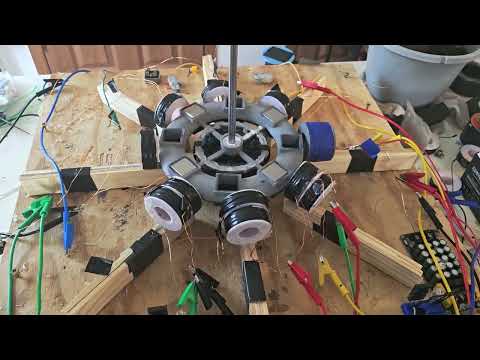 Long-form
2 circuits running a third room still for some growth/expansion.
Papa Bale here with a messy bench update.
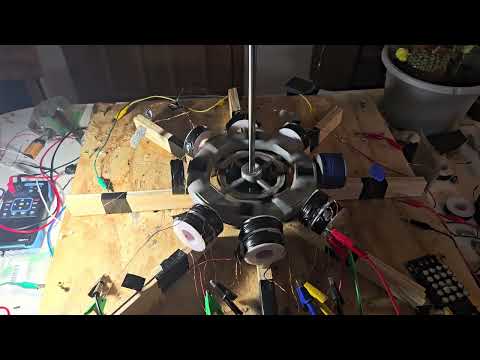 Long-form
M.P.H.'s pulse motor labs EP:2 Skin deep
I fire up two circuits at once, chase meter spikes, and retell the day a three magnet rotor one literally exploded at speed.
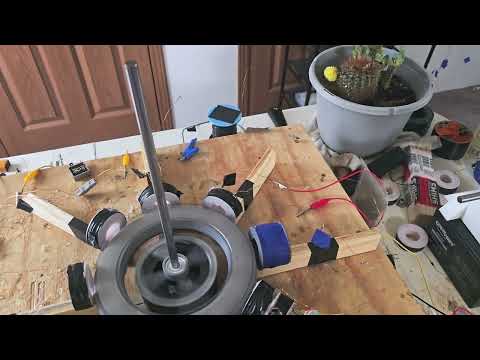 Long-form
Amp Funnel Coil: Pulse Motor Labs EP:1
Eight-magnet eight-coil pulse motor lab — amp funnel coil wiring, pickup coils, and give-and-take battery measurements.
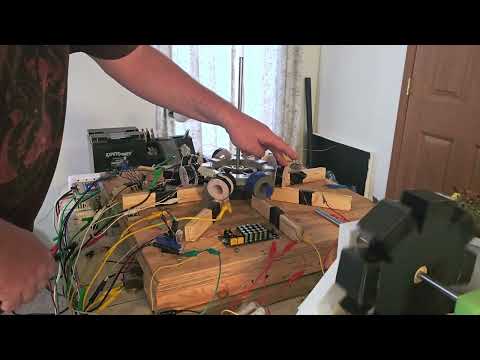 Long-form
MPH pulse motor lab
Real bench time with motor rotor magnets on a pulse motor rotor.
One path · free first
Watch free → subscribe → optional membership
Notes stay free. The full experiment lives on YouTube. Membership is optional when you want Discord and exclusives — not required to learn.
- 2
Subscribe free + turn on alerts
Hit Subscribe, then the 🔔 bell so you catch the next experiment.
Subscribe free + 🔔