Experiments·Transcript-backed
puls energieernte: Pulse Motor Experiments: Magnets, Coils
Watch Papa Bale run a 12-magnet north-south pulse motor on 3 volts while charging a vape pen battery through a cap bank. Real bench measurements, bifila…
Long-form · Full audio · Best on YouTube
Watch the complete video: puls energieernte: Pulse Motor Experiments: Magnets, Coils
Watch the full long-form video on YouTube — that's where the full bench audio, runtime, and experiments live.
Preview embed · full runtime is better on YouTube
Prefer the full player? Better audio, runtime, and next-video queue on YouTube.
▶ Open full on YouTubeJump to the discussion · full video on YouTube
Hear it on the bench
Each link opens “puls energieernte: Pulse Motor Experiments: Magnets, Coils” on YouTube at the first time that topic comes up in the captions. Stay on YouTube for the complete runtime.
See it on the bench · full runtime on YouTube
What to watch for
- ▸The 12-magnet north-south rotor runs smoothly on 3 V and roughly 150 mA with almost no added resistance.
- ▸A bifilar 24/32 gauge coil (trigger + drive) feeds a cap bank that converts and passes DC straight to the battery under charge.
- ▸North-south configuration appears to help the battery voltage creep upward during operation.
- ▸Dual-drive coil tests on separate batteries are planned next to compare power output.
- ▸Utron rotor plans include a serpentine equatorial coil triggered by electromagnet pulses plus aluminum tape strips for possible electrostatic energy.
- ▸The whole setup is treated as a conceptual toy for proving and debunking ideas rather than a finished free-energy device.
Watch the full long-form video on YouTube — that's where the full bench audio, runtime, and experiments live.
Experiment notes (read while you watch)
Notes support the video — for the full-length run with complete bench audio, stay on YouTube.
Papa Bale runs a 12-magnet north-south pulse motor on a 3-volt supply drawing about 150 mA while charging a vape pen battery through a cap bank. He tests bifilar drive coils, discusses dual-battery setups, and shares plans for an Utron rotor with serpentine coil and aluminum tape for electrostatic pickup.
Key takeaways
- The 12-magnet north-south rotor runs smoothly on 3 V and roughly 150 mA with almost no added resistance.
- A bifilar 24/32 gauge coil (trigger + drive) feeds a cap bank that converts and passes DC straight to the battery under charge.
- North-south configuration appears to help the battery voltage creep upward during operation.
- Dual-drive coil tests on separate batteries are planned next to compare power output.
- Utron rotor plans include a serpentine equatorial coil triggered by electromagnet pulses plus aluminum tape strips for possible electrostatic energy.
- The whole setup is treated as a conceptual toy for proving and debunking ideas rather than a finished free-energy device.
In the workshop today I had the 12-magnet north-south rotor spinning on the bench. The bifilar coil (24 gauge drive, 32 gauge trigger) is hooked to a simple circuit running from a 3-volt supply at about 150 mA. That’s roughly 0.45 watts and the motor turns with basically no extra resistance except the coil’s own.
The output goes through a cap bank that acts like an AC-to-DC converter before feeding the battery we’re charging. Right now that battery is a vape pen cell. Voltage on the cap bank side is creeping upward as the rotor spins. I’m curious how long it stays energized compared with a single-polarity rotor.
I also showed the dual-drive coil setup. One strand on output 2, the other on output 1, each tied to its own battery. I’ve only tried this with power supplies so far; running both strands on 12-volt batteries from a 3-volt start will need some resistance or it’ll spike hard. That test is next.
Over on the Utron rotor I’m planning a serpentine coil around the equator plus aluminum tape strips. The idea is to let the electromagnet pulses induce current in the serpentine winding and maybe pick up electrostatic charge off the tape. We just want clean readings while it spins. Should be fun to see if the triggered coils create more output than the permanent magnets alone.
Everything here is a workbench experiment. It proves concepts, debunks others, and keeps me learning. Come along for the ride.
Related on this site
Related on this site
- Can a Pulse Motor Charge Batteries? What Experiments Show — Directly matches the vape pen battery charging demonstration and cap bank behavior shown in the transcript.
- Pulse Motor Rotor Design: Magnets, Materials and Balance — The 12-magnet north-south rotor configuration and Utron rotor plans are the core of the bench work.
- How to Wind Coils for a Pulse Motor (Step by Step) — Transcript details the bifilar 24/32 gauge and 20-gauge 830-turn coils used on both rotors.
- Understanding Back EMF in Pulse Motors — Energy harvesting discussion and serpentine coil induction tie into back-EMF collection concepts.
- I Finally Got My Pulse Motor Running (Reed Switch) — Similar first-person success style and title format; complements the current running motor footage.
---
*Generated from video transcript (hash `3acf5bff1d33…`).*
Full transcript (5,199 chars · en)
Hello ladies and gentlemen. What's up? It's Papa Bale and welcome to the channel. So, uh currently I am you, uh using this 12 magnet rotor. Uh it's a north south configuration with a 24 gauge 32 gauge bifiler coil uh trigger strand and drive. It's hooked up to this circuit right here. Uh it's being powered by this power supply. So, this is a DC buck converter. Uh, takes the AC from the wall, changes it to DC. It's using about 200 milliamps, 12 volts. Um, it is charging this battery right here through this cap bank. It's it's more like a converter from AC to DC. DC can flow through it, but the ultimate outcome is going to be DC. Um, go straight to the battery here. And this is the value. We're charging the battery currently. Uh, and we've got my dual drive coil over here. And I'm using just one of the drives right now. Currently, I was thinking about hooking this coil up to two batteries and two circuits and having, you know, the one the one drive we're going to do one and two drive. Okay, the one drive is uh connected to number two output and two drive is connected to number one output. So, batteries. So, there's two batteries and one is basically charging the other, which is, you know, it's it's not going to go anywhere, but I would like to see what kind of power comes out of having those two strands, two circuits active at the same time using batteries. I'd love to see that. So far, I've only done it with power supplies with 3 volts in. This is 3 volts in, by the way. 3 volts and about 100 milliamps. So, uh.3 watts, 150 milliamps. Okay, so that that's what this one is running on. And that's phenomenal, man. Look at look at look at the response here. There is no resistance on this circuit currently. except for the resistance in the coil which is very little. But for doing like what I was discussing about the two batteries, you don't want resistance. It's not something you want. This is a a toy, a conceptual toy. It proves concepts. It debunks concepts. it. You know, it's an experiment. I love it. And that that's it. That's a 20 gauge at 830 turns and a 32 gauge trigger at the same. And then I'm going to hook up the other drive and we're going to see what it does. Um I might have to put some resistance on it because this is 3 volts and I only have 12volt batteries. So that that's going to be a tremend tremendous increase in voltage. I'm going to have to see how that's going to react. Anyway, that's pretty cool. That's what's on the docket for this pulse motor over here. Now, this pulse motor, I just mag leed this this rotor, and I think it it's working rather well for generating electricity. It's not going that fast because the current is only 200 milliamps. Um, but as it stacks, the electricity stacks in the battery and its capacitance, I think it'll stay energized longer than if it wasn't north south. That's just my opinion. I don't know if that's true or not, but I think it it it's going to end up being true. Um, the north south configuration is better for generation. And as you can see, it's trying to creep up to uh it's creeping up. You know what I mean? These cap banks are great. The AC/DC cat banks are really awesome. Take the AC, turn it into DC. Take the DC and just flush it right through. So, you're going to hook a battery directly to the AC side of this and it'll come out the DC side, you know, DC. You don't need to do that, but you can. That's what I'm saying. Uh, so yeah, we're having lots of fun here. Uh, got tons of things we want to do. I'm going to go take a look at my other rotor real quick. I will be right back. Okay, so this is my Utron rotor. Um, I've had several suggestions on what I can do to uh gather energy off of it. Uh, I think two things that I'm going to do is I'm going to create uh like a a band that's going to go around the the equator that I'm going to put a serpentine coil on and it's going to go up and down like this around the equator. And then on top of that, I'm going to put aluminum tape um in strips. And then I'm going to have a strip on each coil uh and see if we can't get electrostatic energy off of it. Um uh so the the serpentine coil, the way that's going to work is okay, the permanent magnet is on the inside. It's a big one. There's four big permanent magnets in here. It's going to trigger the coil out here and then this electromagnetic pulse is going to trigger the serpentine coil which will be connected by brushes uh to uh um just we're just going to get a we want a reading. That's what we want to get a reading off of this thing while it's spinning. So, uh, and off of the serpentine coil, no less, to see if actually triggering these coils when they pound and push the permanent magnets. Um, can they also when they're pounding trigger, you know, create electricity in the serpentine coil? That would be great because I know the permanent magnets won't be able to do it if I build it this way. Um, but will the electromagnets when triggered be able to do it? I think so. Honestly, I think that'll work just fine. But I I can't wait to do it, you know, just have some fun. All right, so thank you very much. Peace out. Have a wonderful night. Please subscribe. Bye now.
Keep watching · longer sessions
More long-form bench runs
Queue up the next long-form bench run on YouTube — longer sessions keep the workshop free for everyone.
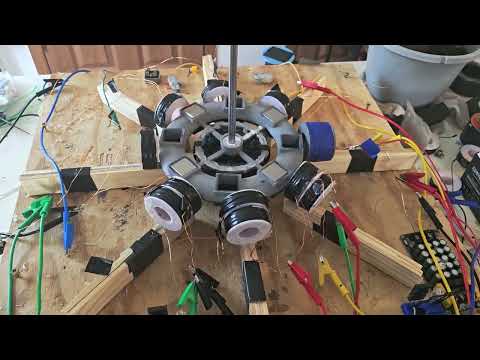 Long-form
2 circuits running a third room still for some growth/expansion.
Papa Bale here with a messy bench update.
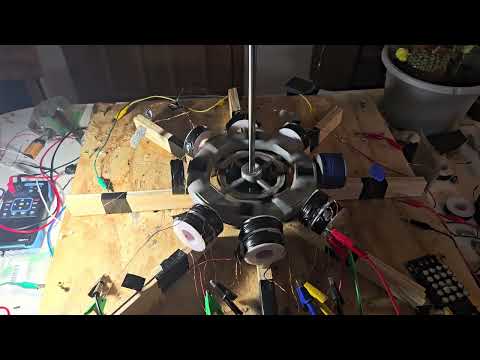 Long-form
M.P.H.'s pulse motor labs EP:2 Skin deep
I fire up two circuits at once, chase meter spikes, and retell the day a three magnet rotor one literally exploded at speed.
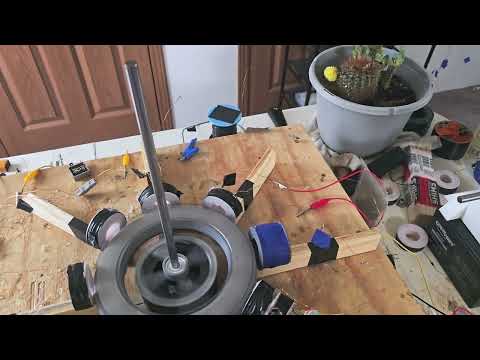 Long-form
Amp Funnel Coil: Pulse Motor Labs EP:1
Eight-magnet eight-coil pulse motor lab — amp funnel coil wiring, pickup coils, and give-and-take battery measurements.
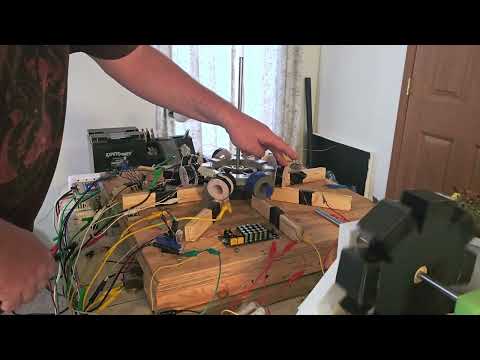 Long-form
MPH pulse motor lab
Real bench time with motor rotor magnets on a pulse motor rotor.
One path · free first
Watch free → subscribe → optional membership
Notes stay free. The full experiment lives on YouTube. Membership is optional when you want Discord and exclusives — not required to learn.
- 2
Subscribe free + turn on alerts
Hit Subscribe, then the 🔔 bell so you catch the next experiment.
Subscribe free + 🔔 - 3
Optional: join for $2.99/mo
Members-only videos, Discord, and live shoutouts — cancel anytime.
Join $2.99/mo
Longer sessions · ad-supported free library
Not done yet? Queue the next long-form run
Queue up the next long-form bench run on YouTube — longer sessions keep the workshop free for everyone.
- 1▶ Watch full on YouTube
Start: Shocking Truth About Pulse Motors
Notes & transcript on site - 2▶ Watch full on YouTube
2 circuits running a third room still for some growth/expansion.
Notes & transcript on site - 3▶ Watch full on YouTube
M.P.H.'s pulse motor labs EP:2 Skin deep
Notes & transcript on site - 4▶ Watch full on YouTube
Bifilar Pancake Coil Build for Pulse Motor Generator
Notes & transcript on site