Experiments·Transcript-backed
Eddy Currents Pulse Motor: Stationary Aluminum Disc Tests
Papa Bale spins magnets under a stationary aluminum disc in this eddy currents pulse motor experiment. See the small voltages from pickup coils, what happens without the disc, and why the results are encouraging for a contactless setup.
Long-form · Full audio · Best on YouTube
Watch the complete video: Eddy Currents Pulse Motor: Stationary Aluminum Disc Tests
Watch the full long-form video on YouTube — that's where the full bench audio, runtime, and experiments live.
Preview embed · full runtime is better on YouTube
Prefer the full player? Better audio, runtime, and next-video queue on YouTube.
▶ Open full on YouTubeJump to the discussion · full video on YouTube
Hear it on the bench
Each link opens “Eddy Currents Pulse Motor: Stationary Aluminum Disc Tests” on YouTube at the first time that topic comes up in the captions. Stay on YouTube for the complete runtime.
See it on the bench · full runtime on YouTube
What to watch for
- ▸Stationary aluminum disc with spinning magnets underneath produces measurable voltage in nearby coils, likely from eddy currents rather than direct magnet influence.
- ▸Removing the disc or adding a plastic spacer increases voltage output (up to ~3V), showing the aluminum was yoking the magnets and affecting the field.
- ▸Coils made from 32 and 26 gauge wire in series, placed at the edge of the disc, gave higher readings (1.5V) but magnets play a bigger role when not fully yoked.
- ▸The setup acts as a contactless dynamo with the disc remaining mostly steady, though output is weak for practical generation.
- ▸Using a Fate magnet rotor on three poles instead of six and flipping drive coil orientation fixed running issues and improved consistency.
- ▸Results count as a small win for eddy current demonstration even if voltages stayed low at 0.007V in some configurations.
Watch the full long-form video on YouTube — that's where the full bench audio, runtime, and experiments live.
Experiment notes (read while you watch)
Notes support the video — for the full-length run with complete bench audio, stay on YouTube.
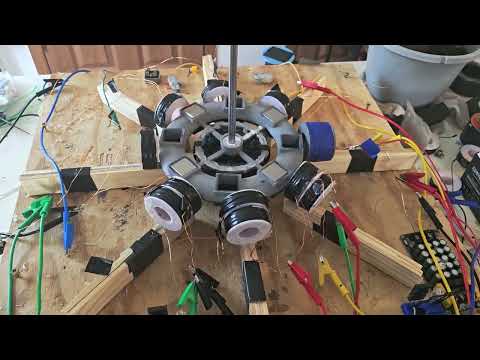
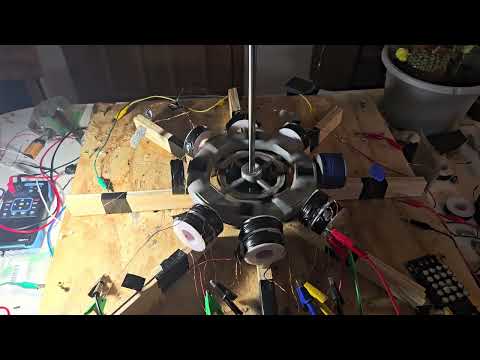
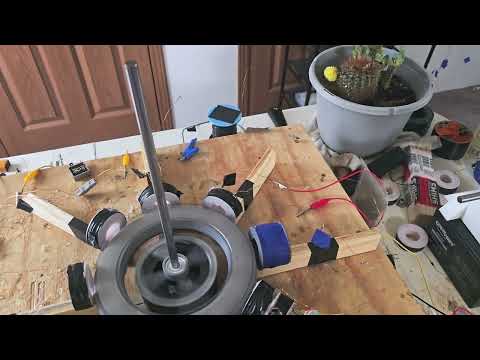
I built an axial flux style pulse motor with a stationary aluminum disc on top and two pickup coils positioned just in range of the eddy current fields. We measured small voltages (around 0.7-1.5V) and tested what happens when the disc is removed or replaced with plastic. The setup uses different gauge wires in series, a bridge rectifier, and shows encouraging signs that eddy currents are at work even if the output is modest.
Key takeaways
- Stationary aluminum disc with spinning magnets underneath produces measurable voltage in nearby coils, likely from eddy currents rather than direct magnet influence.
- Removing the disc or adding a plastic spacer increases voltage output (up to ~3V), showing the aluminum was yoking the magnets and affecting the field.
- Coils made from 32 and 26 gauge wire in series, placed at the edge of the disc, gave higher readings (1.5V) but magnets play a bigger role when not fully yoked.
- The setup acts as a contactless dynamo with the disc remaining mostly steady, though output is weak for practical generation.
- Using a Fate magnet rotor on three poles instead of six and flipping drive coil orientation fixed running issues and improved consistency.
- Results count as a small win for eddy current demonstration even if voltages stayed low at 0.007V in some configurations.
In this eddy currents pulse motor test I tried something different from the usual spinning disc generators. I kept the aluminum disc stationary on top of an axial flux style rotor and let the magnets spin underneath it. Two coils sat just outside the main magnetic field but inside the eddy current influence. We measured small voltages and swapped in a plastic spacer to compare. The aluminum clearly yoked the magnets, changing the output. Even though the numbers stayed modest I walked away feeling encouraged about the concept.
Related on this site
- Pulse Motor Rotor Design: Magnets, Materials and Balance — The transcript discusses switching to a Fate magnet rotor that runs on three poles instead of six and how magnet placement affects the eddy current interaction.
- Best Wire Gauge for Pulse Motor Coils (AWG Guide) — Multiple wire gauges (32, 26, 22, 20) are mentioned for both pickup and drive coils, matching the wire gauge experiments covered in that post.
- How to Wind Coils for a Pulse Motor (Step by Step) — The pickup coils are hand-wrapped 32 and 26 gauge in series; the drive is a tri-coil of mixed gauges, directly relating to coil winding choices.
- I Finally Got My Pulse Motor Running (Reed Switch) — Similar first-person experimental style and the title style matches the requested YouTube-like tone; also references getting the motor to run after flipping coils.
---
*Generated from video transcript (hash `b176f8c07767…`).*
Full transcript (7,082 chars · en)
hello ladies and gentlemen what's up it's Papa Bale and welcome to the channel currently we're looking at what it's an axal flux motor but on top of it is we got a stationary aluminum disc and we got two coils what I consider to be just out of range of the magnetic fields but just in range of the Edie current fields and we get very small voltage almost a volt off of uh these two coils in series so I would definitely assume that that is not from the magnets um but we're going to find out so stay tuned uh I'm going to remove the aluminum disc and put that little 16th of an inch of plastic down where the aluminum disc is and put the magnet wire on top of that and see what we get so it's roughly uh 7 and A2 or you know 3/4 of a volt all right so I'll be right back all right I feel like we're going to be generating way more um because we lost the eight a quarter of an inch on the on the aluminum disc and the air gap for that so let me make make sure this thing will Spin and we'll hook up the power oh yeah we're already getting way more so I don't know how do we compensate for well and the aluminum is yoking the permanent magnets so I'm pretty sure that that was all Edie current um so well let's run it like this just for you know damn so wow this is like really that might have been from the magnets I don't know we get about 3 volts from the magnets at an eighth of an inch closer but that's what we're trying to do instead of spinning the disc and making a whole new AC build we're going to try and spin the magnets and make the disc steady and I don't know if these uh magnets are the right ones I got an idea though that might actually work for this I got a rotor of Fate magnets um six position but they go really close to the shaft there it is all right it looks like one of my Clips I'm using the magnetically inclined Clips so that's like not good all right so this will go in the middle on there and I think because of the big magnets it will spin on three instead of six which will be dope so we'll lift this up and we'll get our wrench I heard a joke about that I really don't like these nuts they're like hex nuts the size of just very small okay so we'll put this all right so that's on there like that and that'll give us more you know right under the disc here like Waka you know bow down should be pretty dope I want to try it all right I'll be right back all right so we removed the blue thing and we're generating like uh a little bit more than half a volt through the Yol so I would say that's that's where we're at especially with these coils uh I think it's pretty good it's 32 and 26 gauge probably work better if we were spinning the disc but you know right here we're keeping the disc pretty steady I mean it is set to spin so it'll spin a little tiny bit uh but that as you can see the blue tape they're the aluminum disc is steady and we're generating the eddy current through uh the magnets moving which is the easiest way for me to do it right now see that that's straight through there and those are just resting on top so this is definitely a good setup to you know maybe not to generate cuz it's looking pretty weak but definitely to uh for for it to work you know it is showing about 7 of a volt uh these coils are 32 gauge and 26 gauge Byer coils that I just wrapped in in series in series and we're still only getting like a 7 but I think it's good cuz I don't know it's going through a bridge rectifier cuz it is ac voltage I was going to charge a capacitor with that but then I was thinking maybe it's just from the magnets um you know it's energy getting through the aluminum but that's a quarter inch of aluminum so I don't know but I know the more that I drag these coils to the edge like over the edge The More Voltage you get so we get like 1.5 you know more you get more but that's definitely the magnets are playing a part in all that more of a part because there's nothing yoking the magnetic you know force and that's kind of what you're getting here all right well I think that is pretty awesome I don't know if it's if you can really call it educational but I think it's solid data so like 50 completely yolked so Eddie currents of like uh5 dang don't know what I'm doing wrong maybe I'm using the wrong kind of wire maybe I'm using the wrong format bobing you know starting with the wrong shape that could be the thing but anyway I think it's a when for me I mean if those are not if if that's electricity and it's not being generated by the magnets uh directly that's a that's a win and here's my circuit the light is on through a resistor I'm not quite sure how big it is I found it lying on the table and this one goes through 20 and 22 gauge I believe through a huge coil like it's it's a lot of turns of a lot of different wires well it's a Trier coil you got a 32 gauge you got a 22 gauge and you got a 20 gauge I'm pretty sure that's what it is for the drive oh no the 32 gauge is the trigger coil and I've been having a Dandy with that I had to flip-flop everything just to get it to run yesterday and then I finally figured it out and it was that the drive was not coherent with what was going on it was like the way I had to drive it was facing the T table all the power was going to the table so when I flipped it around all the power was going where it needed to go and everything worked out I know that's dumb isn't it all right well I think I think this is a win I do I mean it's a very little win I might definitely do something else with those coils but uh I guess it's a contactless Dynamo because none of that stuff is touching each other okay so that's all good and that disc is steady I was trying to get it to you know the magnet to interact with the disc more by putting the this one in there and I might be able to do that again but the readings suck they just sucked I mean I turned it on in 007 .007 like [Music] 07 yeah you got the joke that's funny so this is like pickup C coil pickup coil for Eddie current and I can I can see how this is not generating a lot of current for one um it's permanent magnets but I could see how you could generate some this is on the very edge of the magnet like right this the magnet goes to about right here depth of that disc so to get it right in the middle of magnet you need to put it out here like this and moving this thing around is not a sin I mean it's it helps out a great deal figuring out where the actual swirl is happening I like to go right by the coil and it's usually not there actually it's kind of like right after the coil or 22° after the coil that's that's 22 that's terrible there you go that's just after the coil and kind of hanging off the edge so so the coil I'm talking about is down down here it's kind of lined up just after the coil making for some pretty good numbers there granted that's just one volt 1.5 volts but I'm thinking that energy could charge a cap pretty quick if it is what I think it is all right well thank you very much peace out have a good day please subscribe hit the like button notification Bell peace out
Keep watching · longer sessions
More long-form bench runs
Queue up the next long-form bench run on YouTube — longer sessions keep the workshop free for everyone.
 Long-form
2 circuits running a third room still for some growth/expansion.
Papa Bale here with a messy bench update.
 Long-form
M.P.H.'s pulse motor labs EP:2 Skin deep
I fire up two circuits at once, chase meter spikes, and retell the day a three magnet rotor one literally exploded at speed.
 Long-form
Amp Funnel Coil: Pulse Motor Labs EP:1
Eight-magnet eight-coil pulse motor lab — amp funnel coil wiring, pickup coils, and give-and-take battery measurements.
 Long-form
MPH pulse motor lab
Real bench time with motor rotor magnets on a pulse motor rotor.
One path · free first
Watch free → subscribe → optional membership
Notes stay free. The full experiment lives on YouTube. Membership is optional when you want Discord and exclusives — not required to learn.
- 2
Subscribe free + turn on alerts
Hit Subscribe, then the 🔔 bell so you catch the next experiment.
Subscribe free + 🔔 - 3
Optional: join for $2.99/mo
Members-only videos, Discord, and live shoutouts — cancel anytime.
Join $2.99/mo
Longer sessions · ad-supported free library
Not done yet? Queue the next long-form run
Queue up the next long-form bench run on YouTube — longer sessions keep the workshop free for everyone.
- 1▶ Watch full on YouTube
Start: Shocking Truth About Pulse Motors
Notes & transcript on site - 2▶ Watch full on YouTube
2 circuits running a third room still for some growth/expansion.
Notes & transcript on site - 3▶ Watch full on YouTube
M.P.H.'s pulse motor labs EP:2 Skin deep
Notes & transcript on site - 4▶ Watch full on YouTube
Bifilar Pancake Coil Build for Pulse Motor Generator
Notes & transcript on site