Experiments·Transcript-backed
Using Pancake Coil Pulse Motor Test – Real Numbers
Watch me using pancake coil on a closed-loop pulse motor setup. Real measurements at 75-111kHz, output volts, mA readings, rotor speed behavior and why we're not at over unity yet. Honest bench results from the workshop.
Long-form · Full audio · Best on YouTube
Watch the complete video: Using Pancake Coil Pulse Motor Test – Real Numbers
Watch the full long-form video on YouTube — that's where the full bench audio, runtime, and experiments live.
Preview embed · full runtime is better on YouTube
Prefer the full player? Better audio, runtime, and next-video queue on YouTube.
▶ Open full on YouTubeJump to the discussion · full video on YouTube
Hear it on the bench
Each link opens “Using Pancake Coil Pulse Motor Test – Real Numbers” on YouTube at the first time that topic comes up in the captions. Stay on YouTube for the complete runtime.
- ▶ Watch at 0:25pancake coil over unityprimary
“…or over unity. Either one would be nice. But we are just using a pancake coil…”
- ▶ Watch at 6:39house neodymium 1long-tail
“…So, it's supposed to house a neodymium…”
- ▶ Watch at 6:39neodymium 1. 1.26-inlong-tail
“…So, it's supposed to house a neodymium a 1. 1.26-in…”
- ▶ Watch at 0:25coil overlong-tail
“…or over unity. Either one would be nice. But we are just using a pancake coil…”
See it on the bench · full runtime on YouTube
What to watch for
- ▸Pancake coil driven at 75-111kHz produced up to 8.9V DC and 215mA to the motor
- ▸Best stable spot seemed around 75kHz with ~160mA output and rising rotor speed
- ▸Input voltage started at 12.4V and slowly dropped; exact input current hard to read without proper meter placement
- ▸Spherical magnet pocket is 0.03mm too small for the 1.26-in N52 neodymium
- ▸Coil stayed cool, no overheating even after extended runs
- ▸Still not reaching over unity but progress using only parts on hand
Watch the full long-form video on YouTube — that's where the full bench audio, runtime, and experiments live.
Experiment notes (read while you watch)
Notes support the video — for the full-length run with complete bench audio, stay on YouTube.
I hooked the pancake coil to a signal generator on a single battery, closed the loop and chased higher output voltage and current while watching input. We saw output climb to almost 9V and 215mA at certain frequencies but input draw kept us below unity. The spherical magnet housing also got a quick mention.
Key takeaways
- Pancake coil driven at 75-111kHz produced up to 8.9V DC and 215mA to the motor
- Best stable spot seemed around 75kHz with ~160mA output and rising rotor speed
- Input voltage started at 12.4V and slowly dropped; exact input current hard to read without proper meter placement
- Spherical magnet pocket is 0.03mm too small for the 1.26-in N52 neodymium
- Coil stayed cool, no overheating even after extended runs
- Still not reaching over unity but progress using only parts on hand
I spent the afternoon using pancake coil on the bench again, this time closed-loop on one battery. We chased frequency from 111kHz down to 75kHz watching the cap-bank DC output voltage and current. Rotor speed picked up nicely in that range and the coil never got hot. The spherical magnet housing needs a tiny bit more clearance. Overall a solid data run even if true over-unity is still around the corner.
Related on this site
- Best Neodymium Magnets for Pulse Motor Rotors — Directly relates to the spherical N52 magnet and rotor pocket discussion in the transcript
- Pulse Motor Rotor Design: Magnets, Materials and Balance — Covers the 3D printed housing dimensions and magnet clearance mentioned on bench
- 26AWG Litz Wire Coil Pickup with 16AWG Dual Drive: 220mA Output Amazes — Contrasts the 26AWG coil used in other tests versus the pancake coil in this run
- How to Wind Coils for a Pulse Motor (Step by Step) — Useful follow-up for anyone wanting to build their own pancake coil after seeing the frequency sweep results
---
*Generated from video transcript (hash `ab5e8bcdd0ce…`).*
Full transcript (6,449 chars · en)
Hello ladies and gentlemen, what's up? It's Papa Bale and welcome to the channel. So, from my live stream that I did recently till now, I've now hooked up that same system on this one battery. We've closed looped it uh to see how close we actually are to unity or over unity. Either one would be nice. But we are just using a pancake coil and a signal generator. This is the cool part about it right now though. We're using 11 uh 100,000 111,000 113 hertz. So, 111 kilohertz plus 113 hertz. We We got tremendous amounts of speed for how much hertz that is. You know? And so, we're putting that plus, you know, 1240 is what the battery's at. So, putting 1240 in, we're we're putting in a 110 kilohertz to this pancake coil. And then we are running this motor. You can see the the light flashing a little bit, the red lights. If you focus, they're they're blinking. And that means we're spending and engening. There's definitely a discrepancy there. Not so much here though. But this is coming. This is all good. Uh How do I explain this? So, it goes from the battery and we're we're at a loss cycle right now. So, maybe we need to up the hertz. But, that took a while. So, we're not to over unity or unity just yet. But, okay. So, the meter over here is the DC output of this cap bank over here. And this cap bank is hooked up to the coil. The AC side is hooked up to the coil. So, the energy coming off the coil and going to the other side to run the motor is 6 volt 6.92 DC volts. Is what that is right there. So, for 12 volt 3.9 input, I'd say we're still pretty far away from where we need to be. Here we go. See, so I get down rough around 100 kilohertz right now. And you know, we get about seven. So, if we drop it Let's drop it to 100 to start. We get to like 731, right? 732. Um let's drop it to 80. Or 90 first. You can see that that's steadily going up. The voltage output Here we go, we've reached a plateau. So, we'll go to 85 85 kilohertz. We got 8 volts. See, and it sticks around at the 100 for a while, you know? It's like it's hard to tell whether you're doing the right thing. But, this output is going up. The speed of the rotor is going up. This is staying the same, but I know it's going down. I know it's going down. 85 kHz. Go 80. 80 kHz. 8 8.5 V now. But I think we're starting to spend a little bit more than we're getting. Let's take a look at the DC amp output. It's 150 mA. That's not bad. So, we'll go to 75 kHz. We're generating 159 now. Wow. It's actually pretty good for just, you know, what I'm doing here. 75 looks like a good number. Let's see here. 76. 75. Almost 160. That's brilliant. But you know, we're at 12:38 now. But we got the most amps that we can get, I believe it's going to be right around 160 mA. And this is almost nine. Everything's running smoothly. Man, it's not getting hot. It's pretty nice, but consistent temperature. The coil is, anyway. It's so hard to see how much we're actually spending. I don't have a meter that will tell that to me. Let me think. Let me think. So, we're going in here. I'm trying to think of where I where I connect the multimeter to see how much amps we're spending. So, I would say you would connect it where you're spending. That's right here. Uh so, I would connect it to the collector and the emitter. Cuz I want to I want to see how much is not going into the coil, but going into the transistor since I have the power going into the transistor first. So, the power going into the transistor first means that the power is going to be spent there uh prior to it entering the coil or amplified or whatever's going to happen there. See, so the inside of that is spherical. So, it's supposed to house a neodymium a 1. 1.26-in spherical magnet at N52 strength. But, it's a little it's a little off. It's off by like a millimeter or like three .03 maybe .03 millimeters. Needs to be a little bigger. And then I want it to be able to move around in there a little bit. Just a little bit, though. You know? Oh, we're increasing right now. This meter right here is going up. So, I don't know what that means in the grand scheme of things, but we are definitely going to be picking up in speed on the rotor because that's going up. Will it maintain an upward advancement? I don't know. We'll have to see. But, this dig is going down again. 1238, though. That's where we're at. And this is going up to 8.9. And we're 75 kHz in uh the pancake coil. We're trying to reduce our milliamp spending. Up to less than 160, less than 150. See, we're making 159 milliamps at 75 kHz. So, if we're spending less than that to run this motor, well, we win. That's a win. That's over unity using what I have on me, you know, what I have. Instead of getting what I quote-unquote need, I use what I have to accomplish the same goal. I mean, I'd love to have the money to just get what I need. I love to have a Jarvis to just print me out what I freaking need when I need it. That'd be awesome. That'd be too dope, man. That'd be fly. Huh. But, it looks like we're kind of in a flux period here. We're in between 8.90 and 8.91. In the output, the DC output for the pancake coil. We're 12.37 V in. We're 8.9 DC volts out to run the motor. But, what's coming out of the motor is right here, and we should figure out what that is. I'll be right back. So, I did manage to get our our milliamp output to 215. That's right before we dump it into the battery. So, 215 is our dump rate. And we're still going down though. So, maybe I have something hooked up backwards or something. I don't know. But, it's 215 214 milliamps being generated. Closed-loop system. So, we got our pancake coil is being pulsed at 1,100 111 kilohertz. 80 888 hertz {dot} 88. So, it's 11 111,888 {dot} 88. I'm not I'm not going to say that. 111,888 {point} 88. There you go. And I don't know if there is a magic number to do this, especially Well, I like that amp reading coming off the motor. That's pretty cool. All right, and that's how much voltage Nice. Nice. It's going up or it was going up. 11.15. That's beautiful. See, we can make the voltage go up, but the amps, I believe, are going down now. But, we will check it out real quick before I end the video. Okay, 100 100 kilohertz. And we're at 11.959. That's where we're going to stay, I'm pretty sure. All right, so thank you very much. Peace out. Have a wonderful night. Please subscribe, like, hit the notification bell. And I'll check you later. Peace out.
Keep watching · longer sessions
More long-form bench runs
Queue up the next long-form bench run on YouTube — longer sessions keep the workshop free for everyone.
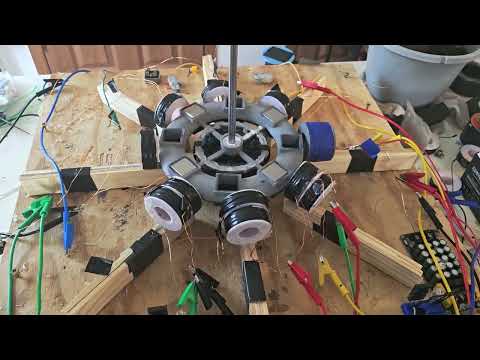 Long-form
2 circuits running a third room still for some growth/expansion.
Papa Bale here with a messy bench update.
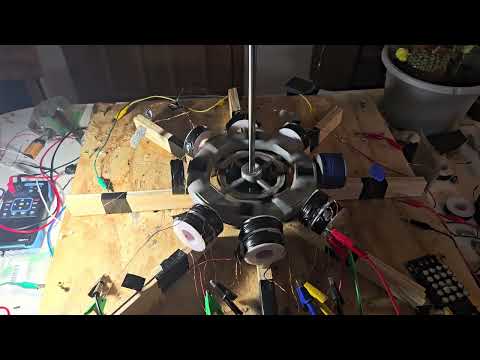 Long-form
M.P.H.'s pulse motor labs EP:2 Skin deep
I fire up two circuits at once, chase meter spikes, and retell the day a three magnet rotor one literally exploded at speed.
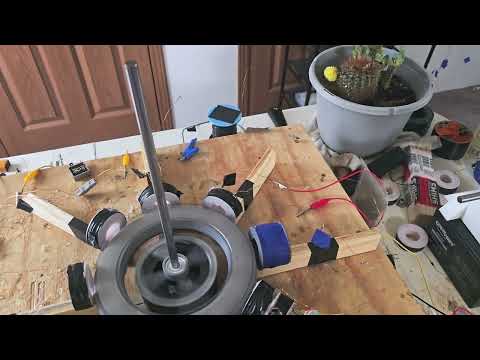 Long-form
Amp Funnel Coil: Pulse Motor Labs EP:1
Eight-magnet eight-coil pulse motor lab — amp funnel coil wiring, pickup coils, and give-and-take battery measurements.
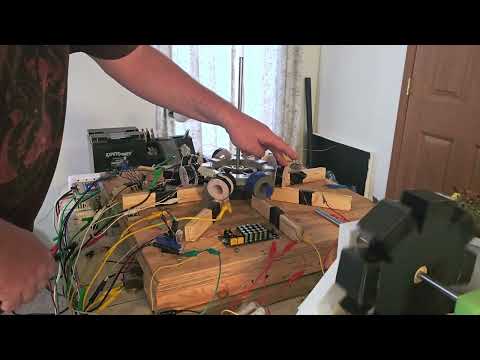 Long-form
MPH pulse motor lab
Real bench time with motor rotor magnets on a pulse motor rotor.
One path · free first
Watch free → subscribe → optional membership
Notes stay free. The full experiment lives on YouTube. Membership is optional when you want Discord and exclusives — not required to learn.
- 2
Subscribe free + turn on alerts
Hit Subscribe, then the 🔔 bell so you catch the next experiment.
Subscribe free + 🔔 - 3
Optional: join for $2.99/mo
Members-only videos, Discord, and live shoutouts — cancel anytime.
Join $2.99/mo
Longer sessions · ad-supported free library
Not done yet? Queue the next long-form run
Queue up the next long-form bench run on YouTube — longer sessions keep the workshop free for everyone.
- 1▶ Watch full on YouTube
Start: Shocking Truth About Pulse Motors
Notes & transcript on site - 2▶ Watch full on YouTube
M.P.H's pulse motor labs Ep:3 Sandbox
Notes & transcript on site - 3▶ Watch full on YouTube
4 parallel drive coils pulse motor generator 25x with 2.08v .7 amps in 55v 1 amp out
Notes & transcript on site - 4▶ Watch full on YouTube
Bifilar Pancake Coil Build for Pulse Motor Generator
Notes & transcript on site