Experiments·Transcript-backed
Counter-Rotating Device: Troubleshooting Resonance & Safety Relay Upgrade
Watch me charge a 5.5V 20F supercap to 4.07V with a bridge rectifier on my counter-rotating pulse motor. I troubleshoot resonance hum, test individual drive circuits, and build a latching relay safety cutoff.
Long-form · Full audio · Best on YouTube
Watch the complete video: Counter-Rotating Device: Troubleshooting Resonance & Safety Relay Upgrade
Watch the full long-form video on YouTube — that's where the full bench audio, runtime, and experiments live.
Preview embed · full runtime is better on YouTube
Prefer the full player? Better audio, runtime, and next-video queue on YouTube.
▶ Open full on YouTubeJump to the discussion · full video on YouTube
Hear it on the bench
Each link opens “Counter-Rotating Device: Troubleshooting Resonance & Safety Relay Upgrade” on YouTube at the first time that topic comes up in the captions. Stay on YouTube for the complete runtime.
See it on the bench · full runtime on YouTube
What to watch for
- ▸Bridge rectifier feeds trifilar 28-gauge pickup into parallel supercaps and hits 4.07 V quickly
- ▸Individual red and black drive circuits run smooth and quiet while green shows resonance hum
- ▸Resonance gets stronger each time the circuit is powered but still charges the caps
- ▸Latching relay plus infrared sensor creates a simple power-cut safety mechanism
- ▸Counter-rotating shaft shows almost no vibration on a solid table
- ▸Future plan: swap to thicker 20-gauge drive coils
Watch the full long-form video on YouTube — that's where the full bench audio, runtime, and experiments live.
Experiment notes (read while you watch)
Notes support the video — for the full-length run with complete bench audio, stay on YouTube.
In this bench session I fire up the counter-rotating device, measure 4.07 V on a parallel 20 F supercap bank through a bridge rectifier, compare drive circuits, chase down resonance hum, and slap together a 12 V latching relay safety cutoff using an infrared receiver and MOSFET.
Key takeaways
- Bridge rectifier feeds trifilar 28-gauge pickup into parallel supercaps and hits 4.07 V quickly
- Individual red and black drive circuits run smooth and quiet while green shows resonance hum
- Resonance gets stronger each time the circuit is powered but still charges the caps
- Latching relay plus infrared sensor creates a simple power-cut safety mechanism
- Counter-rotating shaft shows almost no vibration on a solid table
- Future plan: swap to thicker 20-gauge drive coils
Short bench update on the counter-rotating device. I show real voltage numbers, resonance behavior, and the new safety relay I threw together on a PCB. All measurements straight from the bench—no clean lab readings, just what my meter caught.
Related on this site
- Best Wire Gauge for Pulse Motor Coils (AWG Guide) — Directly referenced when discussing swapping to 20-gauge wire for the drive coils
- Pulse Motor Rotor Design: Magnets, Materials and Balance — Relevant to the balanced shaft and minimal vibration discussion on the counter-rotating device
- Can a Pulse Motor Charge Batteries? What Experiments Show — Matches the supercap charging results shown with the bridge rectifier
- I Finally Got My Pulse Motor Running (Reed Switch) — Similar beginner pulse motor success video in the same series
- Minor Adjustments, Major Results — Pulse Motor Optimization — The troubleshooting and coil change plans align with this optimization video
---
*Generated from video transcript (hash `d7a8bd6910fa…`).*
Full transcript (3,854 chars · en)
Hello, ladies and gentlemen. What's up? It's Papa Bear, and welcome to the channel. So, that's 3.72 volts in the 5.5 volt parallel 20 farad. So, I think that's that's quite a nice chunk of you know, DC electricity right there. All right, let me take these all these off of here now and see if we can't get any more. All right. Let's turn this off so we don't waste the battery. All right. Now, I'm going to show you like uh the drawbacks and benefits uh the way it is set up currently. You saw that we are gathering voltage. It's happening at a pretty fast rate. It's not a lot of coil that we're doing it with, so it's pretty awesome. It's through proximity. Uh we are taking from a 28 gauge strand trifiler strand, and we have them in series connected to this bridge rectifier. Right here, through the bridge rectifier, they then go into two caps that are parallel with one another. We don't have it doing anything else at the current time. But, because they are connected all the coils through proximity to the cap bank. Listen to what happens. Okay, one. That's good. Hear the humming? And more humming, but it'll still work with the humming and then it will still charge those caps even though it's resonating. So, like it steps up each time you turn it on, it steps up resonation, like the hum gets stronger for each circuit. But, when I don't have the cap banks hooked up, I get two drives that'll work just fine, red and black usually, and then the green one will resonate, it will hum. And usually doesn't work very well, do anything good. But, uh this is three 12-V batteries uh saturating that 28-gauge uh strand that is in series and hooked to the bridge rectifier. So, what I'm getting at is that the super caps uh will fill up faster than if there was one or two. And there's three on and it's going to it's going to happen I don't know. I'd like to think it's semi-decent speed. So, we were at 3.7 3. Huh, I want to say we're going to be at 4.5. I'm about to stop it. So. All right. I'm going to have to be right back. I'm going to hook it up now. All right. So, not as much as I thought, but as it's creeping up towards the top. That's awesome right there. 4.07 volts. And we got to remember that 5.5 is the cap. Oh, that's so cool. That is so neat. Yes. And now let's run the black circuit on its own. We'll run the red circuit first. >> See, now these coils in the front here are tri-filer 26, 28, and 32 gauge coils, and I I really want to change it to 20 gauge. Maybe keep it tri-filer, but I don't have any 20 gauge left. So, I'm going to cannibalize some 20 gauge coils. And then have them be the drive. Maybe not have the bridge rectifier set up the way it is. All right, so this is red. This is the red one. Nice and smooth. Quiet. I'm going to do black one. See, now this one functions so much better. I wonder why that is. Mhm. So smooth. I mean, that the light in the back, if it if anything is wobbling or wiggling, it'll it'll bounce up and down. So cool. And you can tell that the shaft solid. I was I was still, you know, questioning it myself, you know, can it be balanced the way it is. There is like no vibration. Literally, like Okay, there's a little rumble right there. Yeah, there's a little bit. Not on the big table, really. Just the Just little wooden one that I built. But it's not like a wobble, really. It's just like it's It's It's natural resonant vibration. So, yeah, this is awesome. And uh I'm working on something for it. I'm going to show you. Be right back. All right, I got a latching relay, 12 volts, and infrared sensor or infrared receiver, MOSFET, and uh PCB board. Uh I want to I'm going to put together a power cut for my machine cuz I'm about to hook it up so it'll go fast. So, I I just want it to be you know, safety safety mechanism. So, there it is. Thank you very much. Peace out. Bye now.
Keep watching · longer sessions
More long-form bench runs
Queue up the next long-form bench run on YouTube — longer sessions keep the workshop free for everyone.
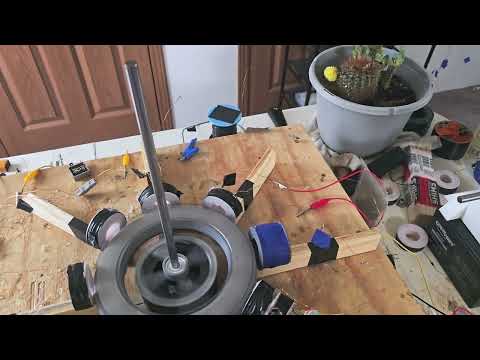 Long-form
Amp Funnel Coil: Pulse Motor Labs EP:1
Eight-magnet eight-coil pulse motor lab — amp funnel coil wiring, pickup coils, and give-and-take battery measurements.
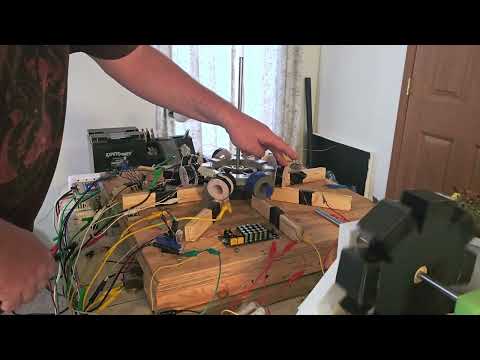
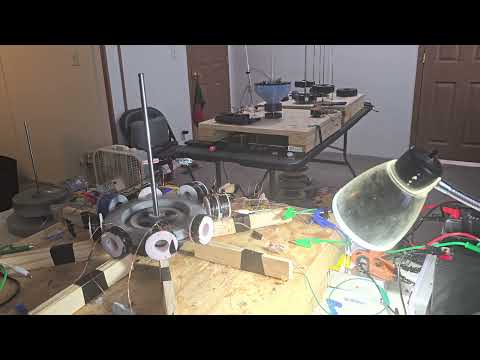 Long-form
8-Magnet Pulse Motor + Induction Coils (Bedini-Style Charge)
Eight-magnet pulse motor at 12V with series induction coils.
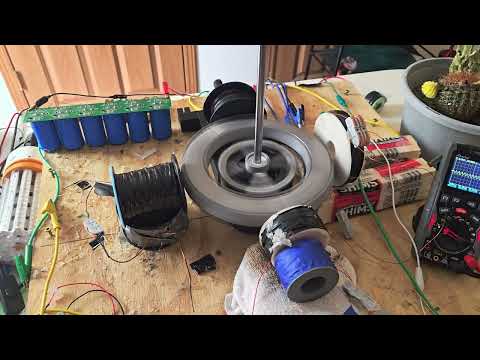 Long-form
8 Neo Cube Magnet Pulse Motor Hits 1300 RPM — Amp Funnel Coil Power Test
I tested an amp funnel coil on a generator setup with eight neo cube magnets.
One path · free first
Watch free → subscribe → optional membership
Notes stay free. The full experiment lives on YouTube. Membership is optional when you want Discord and exclusives — not required to learn.
Watch full-length on YouTube
Open the complete bench run — full audio and runtime. Free path that keeps the workshop online.
- 2
Subscribe free + turn on alerts
Hit Subscribe, then the 🔔 bell so you catch the next experiment.
Subscribe free + 🔔 - 3
Optional: join for $2.99/mo
Members-only videos, Discord, and live shoutouts — cancel anytime.
Join $2.99/mo
Longer sessions · ad-supported free library
Not done yet? Queue the next long-form run
Queue up the next long-form bench run on YouTube — longer sessions keep the workshop free for everyone.
- 1▶ Watch full on YouTube
Start: Shocking Truth About Pulse Motors
Notes & transcript on site - 2▶ Watch full on YouTube
M.P.H.Jr Pulse Motor Labs EP:1 Just scratching the surface
Notes & transcript on site - 3▶ Watch full on YouTube
8 Neo Cube Magnet Pulse Motor Hits 1300 RPM — Amp Funnel Coil Power Test
Notes & transcript on site - 4▶ Watch full on YouTube
Name change, plans for the future, Motor generator start of something cool 😎
Notes & transcript on site