Experiments·Transcript-backed
M.P.H's Turbo Drive Concept for Counter Rotator
Watch me test putting drive coil on this turbo drive concept for a counter rotator setup. From 2.5V startup to capacitor-fed LEDs staying lit after power off, see the mutual inductance and monopole magnet action in real time.
Long-form · Full audio · Best on YouTube
Watch the complete video: M.P.H's Turbo Drive Concept for Counter Rotator
Watch the full long-form video on YouTube — that's where the full bench audio, runtime, and experiments live.
Preview embed · full runtime is better on YouTube
Prefer the full player? Better audio, runtime, and next-video queue on YouTube.
▶ Open full on YouTubeJump to the discussion · full video on YouTube
Hear it on the bench
Each link opens “M.P.H's Turbo Drive Concept for Counter Rotator” on YouTube at the first time that topic comes up in the captions. Stay on YouTube for the complete runtime.
See it on the bench · full runtime on YouTube
What to watch for
- ▸Two and a half volts gets the outer stator spinning with six south-facing monopole magnets inducing into stacked drive coils at 3/4 inch gap.
- ▸Capacitors (4700uF x3 in parallel, roughly 12-14k uF at 25V) keep LEDs glowing after input power is cut, showing stored energy from the induction.
- ▸Mutual inductance between the three drive coils layered over the six pickup coils creates bright LED lighting even at low voltage.
- ▸Adding extra drive coils fed from the caps would act as a turbo drive only while the system is running, not perpetual.
- ▸Power source is required; removing it eventually stops motion per basic physics, though circuits can run for hours on stored energy.
- ▸Slip ring suggested by Brandon at Over Unity Research makes control easy while working toward Bluetooth.
Watch the full long-form video on YouTube — that's where the full bench audio, runtime, and experiments live.
Experiment notes (read while you watch)
Notes support the video — for the full-length run with complete bench audio, stay on YouTube.
Papa Bale experiments with putting drive coil additions on a counter-rotating setup powered by mutual inductance. Starts at 2.5V, ramps to 5V, charges caps to keep LEDs lit after shutdown. Discusses monopole south-facing magnets, slip ring convenience, and why true looping isn't the goal here.
Key takeaways
- Two and a half volts gets the outer stator spinning with six south-facing monopole magnets inducing into stacked drive coils at 3/4 inch gap.
- Capacitors (4700uF x3 in parallel, roughly 12-14k uF at 25V) keep LEDs glowing after input power is cut, showing stored energy from the induction.
- Mutual inductance between the three drive coils layered over the six pickup coils creates bright LED lighting even at low voltage.
- Adding extra drive coils fed from the caps would act as a turbo drive only while the system is running, not perpetual.
- Power source is required; removing it eventually stops motion per basic physics, though circuits can run for hours on stored energy.
- Slip ring suggested by Brandon at Over Unity Research makes control easy while working toward Bluetooth.
In this bench session I played with putting drive coil sections onto my counter rotator idea. Started slow at 2.5 volts, watched the LEDs come on at different thresholds, then cranked it up while the outer stator spun faster and faster. The mutual inductance between the layered coils was massive even at 3/4 inch spacing. Caps charged quick and kept the lights on after I killed the power—yellow LED hung on way longer than the clear one because of its lower voltage threshold. Fun, simple, and a solid reminder that we still need a source. No free lunch, but the turbo drive concept for when the main system is running looks promising. I'll test adding those extra coils next and see if magnetic coupling helps or hurts.
Related on this site
- Pulse Motor vs Bedini Motor: What's the Difference? — Compares conventional pulse motor builds to the Bedini-style circuits mentioned in the transcript
- DIY Magnetic Induction Motor: Hobbyists in 2026 — Directly relates to the mutual inductance and induction charging shown in the video
- Counter-Rotating Device: Troubleshooting Resonance & Safety Relay Upgrade — Companion counter-rotating experiment that shares the same mechanical layout
---
*Generated from video transcript (hash `c3a54e4f9245…`).*
Full transcript (8,805 chars · en)
Hello everybody. What's up? It's Papa Bale and welcome to the channel. Um, we're going through a branding situation. I kind of want to get this one right. Both names are good. Uh, but one's well known and one's just my name. So, we'll figure it out, though. Okay. So, we got two and a half volts going in. I've added uh two LEDs to the end of the six coils, 12vt LEDs, but they're different radiant because you can see that a yellow one's going lighting up and a clear one hasn't really started to light up yet. So, it takes different voltages to get them going. And I started this by spinning the outer stator here. Let's let's put a little bit more voltage in. 3 3.6 there. Look at that. I love being able to control the speed. I love being able to control whether whether or not it's on or off without putting my hand in it. There the clear light is lighting up 3.6. See, and what we're getting is massive induction. Even though the coil is at 3/4 of an inch away, that's still close to that magnet. And we're getting um excuse me, mutual inductance magnetism from the coils being on top of one another like the three drive coils are on top of the six just every other one. So what I'm doing is I'm charging those caps right there in parallel. So, it's uh 25 volts and 1200 well 12,700 capacitance. 12,000 maybe 14,000 something. It's uh 4700* 3. So, I don't know. I lost I lost it right there. But, uh yeah, those lights will stay on for a little bit after it's done moving. because of the capacitance [clears throat] which makes me, you know, can I hook up three more drive coils in a circuit to the caps instead of the LEDs? LEDs seem a little boring, but if I could like um see, but it would only really function when it was on. It wouldn't be like some perpetual motion machine. It would just be, you know, like an additional drive that would last be most functional when it's on, but it would last after you turn it off for 10 seconds. We're about to see how long it'll last for in a minute. I'm going to turn it up though. Four and a half. We're at 80 milliamps right now. 70. We got six magnets on the stator that are south facing inward. So, it's monopole. Look at how bright those light LEDs are getting. I kind of want to turn the light off. So, that outer is getting really fast now. So, I'm going to cut it off. All right. The power is off now and those LEDs are on still. So that's capacitance the capacitors and then one had needs a way higher voltage to even turn on than the other. See the yellow one's still on and the clear one turned off a long time ago. I think that's This is awesome. This is really really cool. I want to say thanks to Brandon at Over Unity Research Channel for suggesting a slip ring. Now I'm I'm working on Bluetooth. I'm working on a couple other things, but the the slip ring has made my day for the the current day. Beautiful. What I'm wondering is that those three caps can't work another drive while it's on. I'm pretty sure they can, but they need to be constantly fed. It's not like and looping them in this, you know, with what I have is just not there's no point to trying to loop it. So, it's not going to be like that. It's not going to be uh for a loop or anything. It's going to be just putting a drive coil here, here, and here. um that'll be run by the coils behind it and that that's where I think there might be an issue with uh magnetic coupling uh the the same that then physics is a problem and not a not a help. Um so I don't know. We're going to see how it reacts. it might react the way that it shouldn't react and in that case I'll remove the coils. So what what should happen in a bad way is that we're drawing from the same power that we are uh I want to say generating. We're not We're just kind of moving it along, you know? We're not really generating any power. We're just kind of switching it up. We're We might be controlling time. Uh kind of a little bit. I mean, like there's this uh there's a couple circuits out there that, you know, will last for a couple hours or an hour or two. Um but I think that's awesome. I think a circuit that'll last that long uh on its own uh just a lick of a just you need like a little bit of source power and you can take the source power away and that's the cool thing but because you take that source power away it will eventually stop. I mean that's what the law is. law is you got to have the source power. If you take it away without properly compensating for it, it may take a day, it may take a month, you know, but it'll eventually just stop on its own accord. Um, I think it's good though that people keep trying. I keep trying. But as you can see, I mean, we're we're tethered tethered down here. We're got a power supply. We're not we're not trying to do um I mean, the only reason these caps are charging so fast to light the lights is because there's power going through the system. uh you know I don't I don't know how else to explain it. Power is kind of necessary. Whatever kind of power it is doesn't really matter what kind of power it is. Just that it needs it needs to be there. Uh show me. That's all I got to say about that. And if I and if it's cool, I'm not going to judge it either way. But you know, show me. I'll be excited as hell if I see something that I like. I usually am. And you know, be be cool. I'm going to be cool. All right. I'm going to turn the power back on since our lights are dimmed. Let's do five in and we'll spin the outer again. Oh, the yellow one's lighting up. Oh, clear ones lit up. That is kind of fun. I mean, it's simple, but it's it's kind of fun. They're bright now. Awesome. Not much flickering because we have the caps, but really neat. I think I think it is super cool. But, uh, yeah, we're going to we're going to work out whether or not we're going to add another drive to this that will, you know, it's for when it's on. It's like a turbo drive, you know. As a matter of fact, I think that's exactly what it's going to end up being kind of because Yeah. Super cool, man. Super cool. It's just that uh you know, they're getting one drive is getting the energy from the other drive through the secondary. So, I just I don't know how that's going to go. a diode might fix it or it might wreck it, you know. And if it's on, it might not be what I think it should be. It might be something totally different if it's on cuz I've never actually got one of these to uh Well, actually, yeah. Like the the thing that I'm talking about I've done a lot. Um, but like having it start have one of my self start uh to selfrunners uh start up like a motor would. I've never had that happen. Um all all those situations there was a battery or substantial cap reservoir involved. Uh now there is like a closed loop that I do. It's called a talk bubble closed loop. It's when the power supply feeds uh well it feeds the motor and then there's a secondary motor which isn't here right now. And this cap bank runs that motor and is fed by basically that power supply. But there's never any power going back this way from this because there's one of these there. And it doesn't go two ways or it shouldn't cuz those are all uh DC caps or electrolyte electrolytic caps. That's one way cap, you know, that's not a it's not it's not bouncing back. But I mean, that's what I know based on what I've set up. Now, there might be other things going on here, like having six of I've done three and six. So, having six of these in here has been really neat uh experience. Three uh is way cheaper though. over here on the power supply. I can get it up to like six, seven volts at like 40 milliamps. It's way more expensive to run six magnets. So, I might take them out and put them somewhere. Want to run it with three. All right. So, real quick, here's here's the circuit. What I want to do is I want to add two jumper wires so that I can get a reading on the coils. Um, now I'm not sure that's exactly going to work out the way I want it to, but I'm going to do one for the emitter, one for the collector, and I'm going to clamp down on those wires and turn it on. I do believe that I will get a reading on what's left after that is run. And that will be that that number minus the number on the power supply is the efficiency that everybody wants me to do a different way. I don't even know how to do efficiency. Uh I don't know if it'll work with this like whatever you guys do cuz all the coils are still on there. So it has to be done through this. And if it can't be done through this then I don't really care. I don't I don't seriously man. I mean Hell yeah. All I know is that it works. Secondary works. And I think I can uh run a turbo drive on this beast. All right. Well, thank you very much. Peace out. Have a wonderful day. [clears throat] Bye now.
Keep watching · longer sessions
More long-form bench runs
Queue up the next long-form bench run on YouTube — longer sessions keep the workshop free for everyone.
 Long-form
Coil Passes in My Pulse Motor Sandbox (Magnet Induction Test)
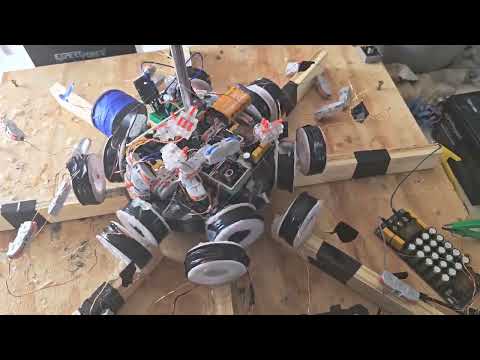
6-magnet rotor vs 8 bifilar stator coils: coil passes from 400 Hz down to 100 Hz at 12–30 V, north/south fields, under 130 mA.
 Long-form
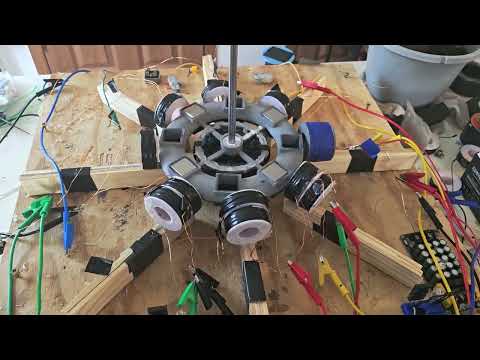
2 circuits running a third room still for some growth/expansion.
Papa Bale here with a messy bench update.
 Long-form
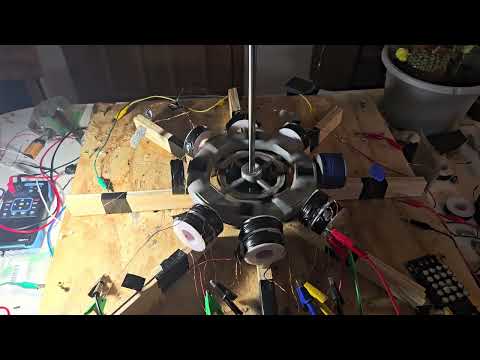
M.P.H.'s pulse motor labs EP:2 Skin deep
I fire up two circuits at once, chase meter spikes, and retell the day a three magnet rotor one literally exploded at speed.
 Long-form
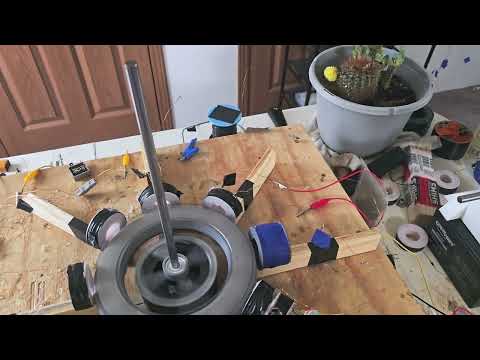
Amp Funnel Coil: Pulse Motor Labs EP:1
Eight-magnet eight-coil pulse motor lab — amp funnel coil wiring, pickup coils, and give-and-take battery measurements.
One path · free first
Watch free → subscribe → optional membership
Notes stay free. The full experiment lives on YouTube. Membership is optional when you want Discord and exclusives — not required to learn.
- 2
Subscribe free + turn on alerts
Hit Subscribe, then the 🔔 bell so you catch the next experiment.
Subscribe free + 🔔 - 3
Optional: join for $2.99/mo
Members-only videos, Discord, and live shoutouts — cancel anytime.
Join $2.99/mo
Longer sessions · ad-supported free library
Not done yet? Queue the next long-form run
Queue up the next long-form bench run on YouTube — longer sessions keep the workshop free for everyone.
- 1▶ Watch full on YouTube
Start: Shocking Truth About Pulse Motors
Notes & transcript on site - 2▶ Watch full on YouTube
2 circuits running a third room still for some growth/expansion.
Notes & transcript on site - 3▶ Watch full on YouTube
M.P.H.'s pulse motor labs EP:2 Skin deep
Notes & transcript on site - 4▶ Watch full on YouTube
Bifilar Pancake Coil Build for Pulse Motor Generator
Notes & transcript on site