Experiments·Transcript-backed
All you should need to build a pulse motor generator and DEMO :)
Papa Bale walks through the simple parts for your first pulse motor build using a motor solenoid, rotor magnets, reed switch, and basic coils. Watch the demo and get the builder checklist.
Long-form · Full audio · Best on YouTube
Watch the complete video: All you should need to build a pulse motor generator and DEMO :)
Watch the full long-form video on YouTube — that's where the full bench audio, runtime, and experiments live.
Preview embed · full runtime is better on YouTube
Prefer the full player? Better audio, runtime, and next-video queue on YouTube.
▶ Open full on YouTubeJump to the discussion · full video on YouTube
Hear it on the bench
Each link opens “All you should need to build a pulse motor generator and DEMO :)” on YouTube at the first time that topic comes up in the captions. Stay on YouTube for the complete runtime.
See it on the bench · full runtime on YouTube
What to watch for
- ▸Start with a marked rotor disc (CD works) and 11 or 12 neodymium magnets placed evenly.
- ▸The coil is the heart; a 12V solenoid or hand-wound 32-gauge coil both work.
- ▸High-frequency reed switch acts as the brains to keep the pulsing going instead of staying on.
- ▸Magnets passing a second coil at speed generate real current — up to 11V AC measured.
- ▸Simple pegboard base with bearings and shaft nipples keeps everything aligned and spinning freely.
- ▸You can light LEDs or measure voltage from a pickup coil with no extra power supply.
Watch the full long-form video on YouTube — that's where the full bench audio, runtime, and experiments live.
Experiment notes (read while you watch)
Notes support the video — for the full-length run with complete bench audio, stay on YouTube.
Papa Bale shows the basic starter kit for a pulse motor: rotor with magnets, coil (homemade or store-bought solenoid), reed switch, power supply, and simple base. He demos a running motor, generation with a pickup coil lighting LEDs, and reaches about 11V AC from one coil.
Key takeaways
- Start with a marked rotor disc (CD works) and 11 or 12 neodymium magnets placed evenly.
- The coil is the heart; a 12V solenoid or hand-wound 32-gauge coil both work.
- High-frequency reed switch acts as the brains to keep the pulsing going instead of staying on.
- Magnets passing a second coil at speed generate real current — up to 11V AC measured.
- Simple pegboard base with bearings and shaft nipples keeps everything aligned and spinning freely.
- You can light LEDs or measure voltage from a pickup coil with no extra power supply.
In this bench session I rounded up the absolute basics for anyone wanting to spin their first pulse motor. We used a simple rotor, a store-bought 12V solenoid as the motor solenoid, a high-frequency reed switch, and a lithium battery. The whole thing runs on a pegboard base with bearings. I also showed how a second homemade coil placed near the spinning magnets lights LEDs and puts out measurable voltage with zero extra wiring. Everything stayed relaxed, measurement-first, and ready for you to copy at home.
Related on this site
- How to Build a Pulse Motor: Parts, Coil Gap, First Spin — Directly expands on the starter parts and first-spin steps shown in the video
- Pulse Motor Rotor Design: Magnets, Materials and Balance — Matches the rotor marking, 11-magnet ring, and balance discussion
- How to Wind Coils for a Pulse Motor (Step by Step) — Covers the hand-winding advice and 32-gauge wire details from the bench
- I Finally Got My Pulse Motor Running (Reed Switch) — Companion demo focusing on the reed switch that keeps the solenoid pulse alive
- Understanding Back EMF in Pulse Motors — Explains the generation effect seen when the magnetic ring spins past the pickup coil
---
*Generated from video transcript (hash `32d3d7c25ea5…`).*
Full transcript (9,945 chars · en)
hello ladies and gentlemen this is Papa Bale and uh I'm just showing you a few basic starter things you would need to make your own pulse motor um first you would start out with your rotor which is this disc the circle and then you would need um on that disc as you can see I have lines drawn out from the center there are 24 lines drawn out from the center but underneath that top disc there's another disc and it's uh I believe 32 degrees 32.72 degrees for each one of these magnets which would make 11 evenly spaced magnets around the edge here and the only reason I made it 11 is because I saw somebody else make one the opposite orientation with 11. so instead of it spinning like a merry-go-round it's fun like the wheel on The Price is Right you get what I'm saying orientation okay um and then here's another concept of a rotor uh there are 12 sets of neodymium magnets 24 lines one every other line anyway um your rotor can be a CD you at least want to get your Cardinal excuse me directions so like on the CD you would want to have at least four magnets [Music] um after you get your route um your rotor situated I always want to call it a router because you know the internet's such a big thing nowadays um yeah you got your Sharpie you got your ruler so you make a little Notch like every 30 degrees or 15 degrees or 5 degrees [Music] um and then you draw the lines if they're you see even numbers should be able to draw it from side to side and it will go perfect um so once you get your your rotor situated and then one more thing a CD won't have a shaft and you're better off just putting that right on the CD motor um removed from whatever CD player you're going to use to make that pulse motor you need a coil um since the coil is the heart of the pulse motor you're going to need a coil and you're going to need a power supply now your power supply can take shape in many many different forms it can be a battery like this lithium ion battery or it can be a you know a 12 volt power supply it doesn't really matter but it goes from the power supply to the coil the coil is always the second thing that gets the first thing that gets hooked up second thing in line power supply coil you have a homemade coil and the red there and then you got store-bought coil in the red that's a 500 n 12 volt um solenoid magnet and this is a solenoid magnet I don't know how many turns are there but if you want to make your own you can either use a tool which would be okay I would love to use a tool sometimes but I find great relaxation and winding the coil by hand you just gotta it doesn't have to be like perfectly uniform and just has to be you know kind of evenly across when you turn it so I mean you can just you can wrap all this side first if you want and then do the middle or you could do both ends and then the middle just as long as it all kind of evens out at the end it'll work um now naturally if you you know you make it like a one solid wrap and then on top of that another solid wrap but I mean just look you can barely see the wire that I'm using you can kind of see it wobbling there 32 gauge if you could rewind that perfectly I would be shocked even if you are using tools um you need connectors to connect your power supply to your coil and then you know if that's the heart the coil is the heart and the Reed switch is the brains which in the rate switch is basically what makes this whole thing work now this is a normally open high frequency read switch it has a indicator light and um it's awesome I mean this thing goes super fast and the read switch has no trouble keeping up with it whereas I had you know kind of and they're good they work the regular weights which is um but eventually they stay on and when they stay on you don't have a pulse motor and it'll stop hahaha you'll see what I mean through some experiment experimentation of your own but I suggest get the high frequency right off the bat and you probably won't have this problem ever maybe you will maybe you won't but these these are sustainable I just I had a lot of problems with the uh mini ones they kind of looked like they should be on a breadboard you know um one thing I like to say in regards to generation energy generation you can put one of the homemade coils right up next to the moving pulse motor and then you can hook via connector that coil up to some Led and when the magnets pass they will light up that led without it being hooked to a power supply a lot of people say this is fake there's no way this can happen and I wasn't sure I was skeptical of myself at first and then you know I'm like wow those lights are turning on they're is is 100 legit when you pass a magnet at high speed across a coil you'll create a current now I got up to uh basically 11 volts ac with this pulse motor off of one coil and no Hardware just coil to multimeter so cool that's almost enough to light a light bulb no no it's not that's 120 volts so in order to light a light bulb I would need capacitors maybe rectifier but that's beside the point we're just talking pulse Motors here all right so basically you need router you need your tools to draw your lines and place your magnets on your router rotor you need your coils either store-bought or homemade 32 gauge wire would be enough I recommend I recommend for this project buying at least a pound if not three pounds to start you'll get hooked on it right away I mean once you find make something that works it's invigorating then you need your Reed switches um I think that's pretty much it oh let me talk about the shaft for a minute no shaft shaft and these nipples of the shaft that I have sticking out of the bottom go into my base which is four by two pegboard with quarter inch holes so these quarter inch poles fit well into quarter inch holes now this has a nipple too let me show you where these nipples are going okay there's a double stacked glued together disc with two bearings one on each disc and the nipple goes right into those bearings and they're very highly lubricated foreign [Music] there we go and those bearings are a quarter inch inner diameter you can see how well that spins I think he's a little lopsided and I might have to redo it but I have a three pulse motor coils hooked up to the Reed switch and the power supply and that's to reduce ampage because if it's just one coil oh see like I have a 24 25 volt power supply and I have two multipliers hooked to it because there's two circuits and those that's 77 volts 75 volts any higher than that and you're going to start throwing magnets and it's not fun well it is kind of fun but you know don't don't tell my girlfriend I said that okay let me get my other rotor foreign let me get this uh generator coil in place all right so let's turn on the power I got two switches for the power look at that solenoid magnet how many turns do you think is in that monster right there I can tell you it's more than seven thousand see I was just pushing a whole amp you know you start pushing like close to five amps and these capacitors will explode there's proof all right let me look underneath here that's pretty good I mean it is a little wobbly there's a little vibration in the pedals but both of these are going faster than you will get any other way see that led is hooked to the little guy it's not even flashing and that's the benefit of having more magnets and a high speed and a high frequency read switch and there's going to magnets are going by so fast that that is not even flashing now you go over here and there's 11. very much more spaced out you can see how those those lights are flashing okay now this may be too much for a tutorial but uh there you have it The High Frequency read switch the indicator light flashes every time uh there's like a close and it's flashing every time a magnet like closes the Gap there and you can't even see it flashing it's how fast it's going but I tell you right now you will need voltage to make this one work anything with a shaft you're going to need volts because you have that extra friction now um the one with the CD you don't need you can I mean I have one coil that I just made it's on a bobbin it's like that big you need you need stuff like that and you can you can do one AAA battery will run that virtually all the same stuff except the CD and a little nubby that the CD goes on in your CD player so you need that whole apparatus and then the magnets on the rotor the permanent magnets and then the Electro solenoid magnets and then if you want to make any lights light up you need a generator coils because you're not hooked up to your power supply and there's no power supply over there on the other side of the table either I mean you know I mean it looks like that led is lighting up from something on the other side of the table but it's just this coil right here and this coil over here is lighting up all those on the breadboard I don't know why it's so hard to like fathom that I'm just really impressed that that light isn't flashing it's freaking solid which which one of these looks like is going faster all right I think we're gonna call it getting a little all right that is off and winding down I'll even cut the switch and we're gonna see that these lights remain on remain flashing at least for a little while that's because the rate of speed the magnets are crossing the coil are still uh good enough and when it gets slow when this one gets slow enough that'll start flashing anyway I think it's really cool and then you know a little bit more advanced stuff because I have a shaft I can add things like this turbine generator which can generate up to 75 volts at full speed I'm thinking we're going to get about 30 volts out of it because full speed is about 3 500 RPM and I guarantee you a 3 500 RPM these magnets are going everywhere because it's only hot glue all right thank you very much have a good day please subscribe
Keep watching · longer sessions
More long-form bench runs
Queue up the next long-form bench run on YouTube — longer sessions keep the workshop free for everyone.
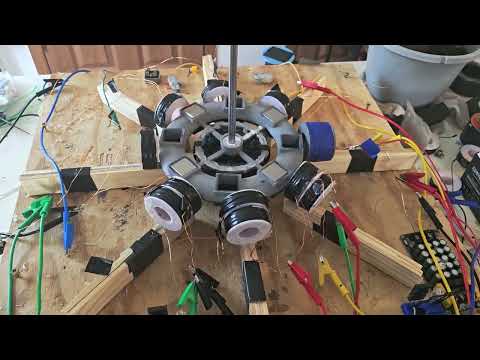 Long-form
2 circuits running a third room still for some growth/expansion.
Papa Bale here with a messy bench update.
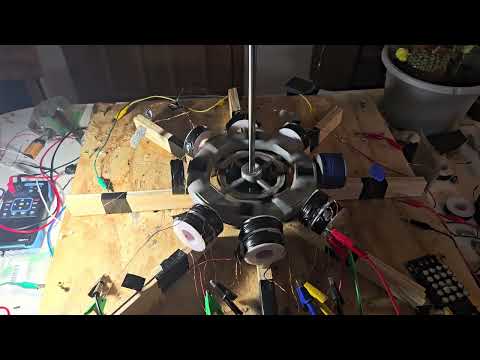 Long-form
M.P.H.'s pulse motor labs EP:2 Skin deep
I fire up two circuits at once, chase meter spikes, and retell the day a three magnet rotor one literally exploded at speed.
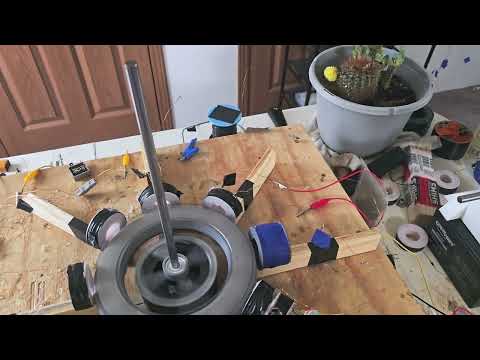 Long-form
Amp Funnel Coil: Pulse Motor Labs EP:1
Eight-magnet eight-coil pulse motor lab — amp funnel coil wiring, pickup coils, and give-and-take battery measurements.
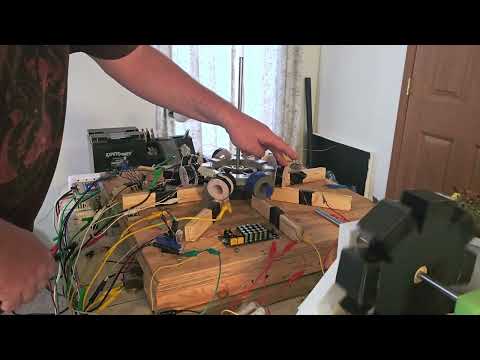 Long-form
MPH pulse motor lab
Real bench time with motor rotor magnets on a pulse motor rotor.
One path · free first
Watch free → subscribe → optional membership
Notes stay free. The full experiment lives on YouTube. Membership is optional when you want Discord and exclusives — not required to learn.
- 2
Subscribe free + turn on alerts
Hit Subscribe, then the 🔔 bell so you catch the next experiment.
Subscribe free + 🔔 - 3
Optional: join for $2.99/mo
Members-only videos, Discord, and live shoutouts — cancel anytime.
Join $2.99/mo
Longer sessions · ad-supported free library
Not done yet? Queue the next long-form run
Queue up the next long-form bench run on YouTube — longer sessions keep the workshop free for everyone.
- 1▶ Watch full on YouTube
Start: Shocking Truth About Pulse Motors
Notes & transcript on site - 2▶ Watch full on YouTube
M.P.H's pulse motor labs Ep:3 Sandbox
Notes & transcript on site - 3▶ Watch full on YouTube
4 parallel drive coils pulse motor generator 25x with 2.08v .7 amps in 55v 1 amp out
Notes & transcript on site - 4▶ Watch full on YouTube
Bifilar Pancake Coil Build for Pulse Motor Generator
Notes & transcript on site