Experiments·Transcript-backed
neodymium rotor magnets: reed switch: 1, 2, 3 Projects
neodymium rotor magnets — Papa Bale shares his workshop projects including a reed switch pulse motor on the Utron with one magnet driving the action. Wa…
Long-form · Full audio · Best on YouTube
Watch the complete video: neodymium rotor magnets: reed switch: 1, 2, 3 Projects
Watch the full long-form video on YouTube — that's where the full bench audio, runtime, and experiments live.
Preview embed · full runtime is better on YouTube
Prefer the full player? Better audio, runtime, and next-video queue on YouTube.
▶ Open full on YouTubeJump to the discussion · full video on YouTube
Hear it on the bench
Each link opens “neodymium rotor magnets: reed switch: 1, 2, 3 Projects” on YouTube at the first time that topic comes up in the captions. Stay on YouTube for the complete runtime.
See it on the bench · full runtime on YouTube
What to watch for
- ▸A single magnet on the bottom disc can drive the three-level rotor when spacing is around half an inch and startup is slow for better coupling.
- ▸Reed switch placement in the north position on a 90° magnet layout needs careful adjustment because small movements drastically change timing.
- ▸Magnetic field lines are favored over direct magnet pull in this build; the Utron uses four neodymium magnets and is currently maglev.
- ▸Too many changing variables (coil resistance, battery voltage, heat) make hitting the exact optimal reed-switch spot difficult but still achievable with patience.
- ▸The Bedini circuit requires a functioning SLA charge battery; limited SLA batteries on hand means balancing the primary and charge side is tricky.
Watch the full long-form video on YouTube — that's where the full bench audio, runtime, and experiments live.
Experiment notes (read while you watch)
Notes support the video — for the full-length run with complete bench audio, stay on YouTube.
In the workshop Papa Bale walks through three active projects including a three-level magnetic disc, a cactus recovery experiment, and especially the Utron rotor running on a reed switch with a Bedini-style circuit. He tests one magnet coupling, magnetic field lines versus direct pull, and the challenges of finding the sweet spot on a 7mm reed switch.
Key takeaways
- A single magnet on the bottom disc can drive the three-level rotor when spacing is around half an inch and startup is slow for better coupling.
- Reed switch placement in the north position on a 90° magnet layout needs careful adjustment because small movements drastically change timing.
- Magnetic field lines are favored over direct magnet pull in this build; the Utron uses four neodymium magnets and is currently maglev.
- Too many changing variables (coil resistance, battery voltage, heat) make hitting the exact optimal reed-switch spot difficult but still achievable with patience.
- The Bedini circuit requires a functioning SLA charge battery; limited SLA batteries on hand means balancing the primary and charge side is tricky.
Papa Bale gives a casual tour of what's on the bench right now. The Utron rotor with four neo magnets is set up for reed switch triggering and a Bedini-style run. He explains the importance of slow startup for coupling, the difference between working with magnetic field lines versus direct pull, and why finding the perfect reed switch position is tricky with so many variables changing. A quick look at the three-level disc project shows one magnet underneath doing most of the work while the cactus experiment gets a cameo too. Lots of sighs, real-talk about patience, and honest workshop chaos.
From the spoken experiment
The following notes stay close to what was said in the video about reed switch:
> Hello, ladies and gentlemen. What's up? It's Papa Bale. Welcome to the channel. Well, that sounded pretty bad. Let me try that one more time. Hello, ladies and gentlemen. What's up? It's Papa Bale and welcome to the channel. Sounding the same, only not. I like it. All right, so we got several projects that I'm like kind of coasting through on a nice medium pace. So, you got your three level discs, right? And you notice that pole in the back. And then what this is supposed to do for those of you who haven't been able to figure it out from what I've been telling you cuz I I don't know. I have some sort of speech disability where people don't understand what I'm saying. And I don't understand what you're saying. So, that's that's hard. That's hard. Anyway. So, as soon as I find some magnets that'll couple properly for the vertical uh I think I have some. I just didn't use them. I thought I…
Builder checklist
- Confirm trigger/sensor timing before chasing higher voltage
- Watch heat on coils and transistors during longer runs
- Record voltage and behavior at each change (one variable at a time)
Related on this site
Related search intent (from Search Console)
People also reach this page for long-tail variants around reed switch motor. The notes stay on what the video actually shows — geometry, timing, and safe tuning — not keyword stuffing.
Related on this site
- Pulse Motor vs Bedini Motor: What's the Difference? — Directly referenced when discussing the Bedini circuit and true Bedini requirements with SLA charge battery
- Best Neodymium Magnets for Pulse Motor Rotors — Four neodymium magnets are used on the Utron rotor and surface area is discussed for coupling
- I Finally Got My Pulse Motor Running (Reed Switch) — Related reed switch success video that matches the current experiment
- Pulse Motor Rotor Design: Magnets, Materials and Balance — Utron rotor balance, 90° magnet placement, and maglev setup are shown
---
*Generated from video transcript (hash `8b5bb99f949d…`).*
Full transcript (8,000 chars · en)
Hello, ladies and gentlemen. What's up? It's Papa Bale. Welcome to the channel. Well, that sounded pretty bad. Let me try that one more time. Hello, ladies and gentlemen. What's up? It's Papa Bale and welcome to the channel. Sounding the same, only not. I like it. All right, so we got several projects that I'm like kind of coasting through on a nice medium pace. So, you got your three level discs, right? And you notice that pole in the back. And then what this is supposed to do for those of you who haven't been able to figure it out from what I've been telling you cuz I I don't know. I have some sort of speech disability where people don't understand what I'm saying. And I don't understand what you're saying. So, that's that's hard. That's hard. Anyway. So, as soon as I find some magnets that'll couple properly for the vertical uh I think I have some. I just didn't use them. I thought I could go smaller. But, surface area is going to matter a lot here. All right. [sighs and gasps] And as you can see and this is a 12-V battery hooked up to this right now, so >> It's all going to spin. But, I I think one or two things. Got to have like 12 magnets on the top of this one and the bottom of this one. And they can be north-south, but they got to you know, it's got to be a strong coupling cuz it's only one one magnet underneath there that's doing all the action. Now, the bottom of this disc has 12 on it. That's why I kind of I kind of feel like if I had 12 on this one and they all were all attracting, it'd be good, but one step at a time. You know, it's kind of working right now. Kind of. So, I mean, just a nice smooth spin. Yeah, see? I'm going to I'm going to I'm going to favor that. When it starts out slow, it's going to have a better opportunity of coupling. Especially at the half inch I have it at. You know, it can get a lot closer than that and work better, but I'm trying to have it work more on magnetic field than the actual like pull of the magnet. And I think there is a difference like uh just terminology-wise. Terminology-wise, yeah. There's a difference in the terminology. All right, here we go. We got the Utron out. I'm going to be running this one on a reed switch. So, you're getting field all the way out to here. The magnet's right there. All right, yeah. So, we're going to hook up three 20-gauge coils, and a 12-V battery, maybe more than one 12-V battery. We might go for the gusto. We're going to probably going to run a Bedini circuit. >> [sighs] >> So, we'll have to balance out the batteries somehow. Oh, no, no. Well, I mean, kind of it's kind of limited cuz I only have two SLA batteries that are functioning right now. Anyway, let's focus on this real quick. >> [sighs] >> So, you got four neodymium square magnets in there, or rectangles. Uh we're going to run it on a reed switch, and one 20-gauge coil. Or we could do three, but you know, we're doing it on a on a reed switch. And the reed switch is a 7-mm reed switch, so I don't know if that's going to be work the way I want it to. And you can't run a true Bedini without the SLA uh charge battery. But I can get the voltage up, no no problem. I have lots of batteries to do that. And uh >> [sighs] >> So, since it's a 90° situation here, we get one magnet at every 90° except we're going to call this south. I'm facing my table right now. That's north. This is south. Yeah. And we're going to put a reed switch in the north slot, and we're going to have it this be its range right here. We're going to be able to maneuver it within that spot cuz I'm sure as soon as you hit like right here or right here, it's going to drastically change uh with the reed switch. And there's a range there of how well it's going to work. And yes, there's probably an optimal point. But I don't know to find that particular point uh unless you have a lot of patience, you're not going to be able to do it by feeling it. You'll get close, but are you going to wait long enough for it to actually sink in, and is the battery going to drop before it does, and all this other stuff, you know, you finding that spot and then staying on that spot, that that situation just doesn't exist. There's too many variables that are always changing. You know what I'm saying? It's just just too much change. And it's not entropy, you know, it's not too much diffusion of it's not too much heat. is too much change. To uh you know, find that exact spot. But, if you can keep the like most of the variables more constant, you can get close. You can get close to getting that magic uh spot, >> [sighs] >> that magic number with the voltage, you know, whatever it is. Whatever you're aiming for. And For the most part, it's very attainable. It's very achievable. I'm not trying to discourage anything or anybody right now. I'm just saying that uh sometimes it is difficult, especially when there are more than a certain number of variables. So, like if especially the coils. You know, coils are always going to be a variable. You build those depending on what you need. And you build them like uh just in time, you know. Brilliant. This is going to be fun to play with. And I hope I hope people like this as much as I do. It's the Utron. It's got four neo in there in there. It's maglev currently. I think it can get going pretty quickly if we get the right components together. Oh, this is a This is the cactus that I used in my uh 4 kHz uh experiment with the piezoelectrics. Look at all that new growth. And it slowed down significantly since I stopped, you know, administering. But and then like when I was doing it, it seems like everything opened up. It's great, man. That's a that is a newborn cactus, but the bottom half does seem appear to be rotted and maybe beyond saving. But there is just like new growth like busting up out of it. It is weirdly cannibalistic for a cactus. Awesome. All right. So, this is the Bedini setup. You got your primary and your charge battery. You got the negative of the charge battery clipped to the positive of the coil. Really cool, man. This thing gets going. It'll get going up to 1,500 easy. And then I I never let it get past that cuz it gets kind of shaky like vib- vibration-wise. And I don't know how much that ceramic bearing can handle, so I just I cut it off when it gets going like that. >> [sighs] >> And I don't know why it like gets going like that. I know it's because of the speed, but the steel bearings that I was using for my one that went like 3,000, uh, I'm not sure if it steel bearings or not, but it was axial flux. It was really, really cool. And uh I just I hope that you know, I can re at least remake that one. Well, this is the rotor right here. Not the exact rotor, but the exact design. I had to reprint it. That one destroyed itself. This one's a little bit, you know, thicker on the walls. It's really, really, really cool. And as long as it's like unabated, this thing will continue to And you know what I mean by that is there's no load on it besides the charge battery. It'll continue to increase in speed at a phenomenal rate. So, yeah, man. And that's that's the way to hook it up. I always hooked it up a different way. Um I took the negative of the charge battery and I put it on the emitter of the circuit, and that is totally not how you build this thing. >> [laughter] >> You know, I was just probably wanting to um put my own influence into it. Like, well, that works, this works, too, kind of thing. And the speed equivalent will never be the same, ever. And if it's based on how fast it goes, you want to build it the way it's supposed to be built, for sure. And that's that's it. Uh we're doing the Bedini. Uh the only thing that's not Bedini about it is the cap bank over here. And that is also part of this. You got the ground for the battery. And you got the ground for the cap bank right here. You hook those two up, you give it a spin, and you're off to the races. Really cool. All right. Thank you very much. Peace out. Bye now.
Keep watching · longer sessions
More long-form bench runs
Queue up the next long-form bench run on YouTube — longer sessions keep the workshop free for everyone.
 Long-form
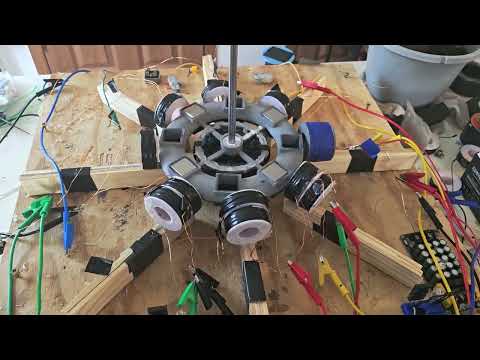
2 circuits running a third room still for some growth/expansion.
Papa Bale here with a messy bench update.
 Long-form
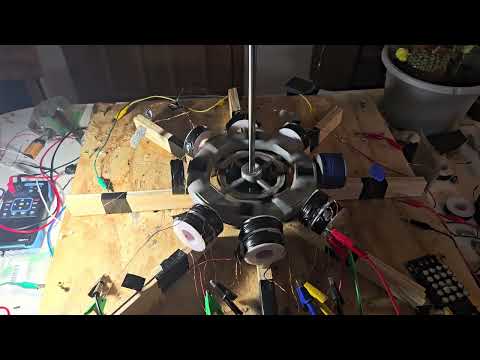
M.P.H.'s pulse motor labs EP:2 Skin deep
I fire up two circuits at once, chase meter spikes, and retell the day a three magnet rotor one literally exploded at speed.
 Long-form
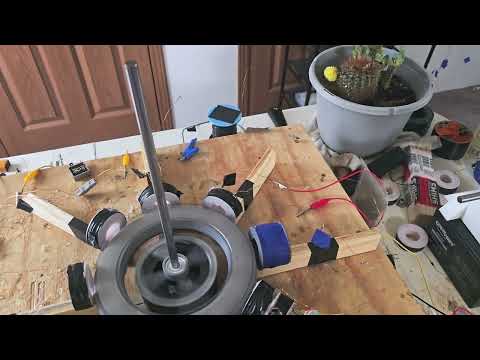
Amp Funnel Coil: Pulse Motor Labs EP:1
Eight-magnet eight-coil pulse motor lab — amp funnel coil wiring, pickup coils, and give-and-take battery measurements.
 Long-form
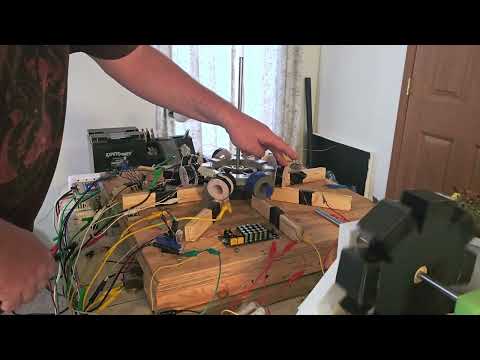
MPH pulse motor lab
Real bench time with motor rotor magnets on a pulse motor rotor.
One path · free first
Watch free → subscribe → optional membership
Notes stay free. The full experiment lives on YouTube. Membership is optional when you want Discord and exclusives — not required to learn.
- 2
Subscribe free + turn on alerts
Hit Subscribe, then the 🔔 bell so you catch the next experiment.
Subscribe free + 🔔 - 3
Optional: join for $2.99/mo
Members-only videos, Discord, and live shoutouts — cancel anytime.
Join $2.99/mo
Longer sessions · ad-supported free library
Not done yet? Queue the next long-form run
Queue up the next long-form bench run on YouTube — longer sessions keep the workshop free for everyone.
- 1▶ Watch full on YouTube
Start: Shocking Truth About Pulse Motors
Notes & transcript on site - 2▶ Watch full on YouTube
2 circuits running a third room still for some growth/expansion.
Notes & transcript on site - 3▶ Watch full on YouTube
M.P.H.'s pulse motor labs EP:2 Skin deep
Notes & transcript on site - 4▶ Watch full on YouTube
Bifilar Pancake Coil Build for Pulse Motor Generator
Notes & transcript on site