Beginner·Transcript-backed
Pulse Motor Tabletop Toy: Papa Bale Explains the Point
Watch Papa Bale spin a 9 in N magnet rotor on his tabletop pulse motor toy. Real measurements: 7.5V 1.2A input, 35W bulb lit, 11-15.4V output from generator coils. Simple fun, not free energy.
Long-form · Full audio · Best on YouTube
Watch the complete video: Pulse Motor Tabletop Toy: Papa Bale Explains the Point
Watch the full long-form video on YouTube — that's where the full bench audio, runtime, and experiments live.
Preview embed · full runtime is better on YouTube
Prefer the full player? Better audio, runtime, and next-video queue on YouTube.
▶ Open full on YouTubeJump to the discussion · full video on YouTube
Hear it on the bench
Each link opens “Pulse Motor Tabletop Toy: Papa Bale Explains the Point” on YouTube at the first time that topic comes up in the captions. Stay on YouTube for the complete runtime.
- ▶ Watch at 5:07two generator coilsprimary
“…coil and there's two generator coils this external coil is the trigger…”
- ▶ Watch at 1:51magnet rotor letlong-tail
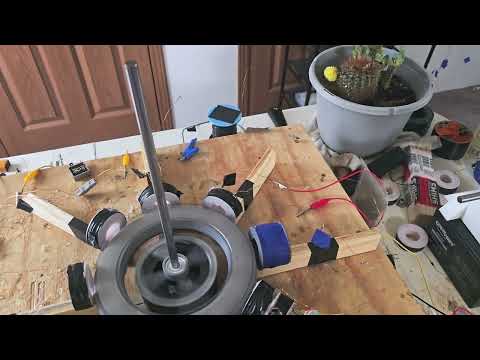
“…modular so um this is a 9 in N magnet rotor let's take a look at the sign w…”
- ▶ Watch at 1:57rotor let takelong-tail
“…rotor let's take a look at the sign w…”
- ▶ Watch at 5:21one coillong-tail
“…coil um I say try it that's what I would say because I've done it both ways…”
See it on the bench · full runtime on YouTube
What to watch for
- ▸9 in N magnet rotor spins and drives both kinetic energy and electricity generation
- ▸Drive coil uses four strands of 26 gauge plus one 32 gauge wire, each 215 turns
- ▸External coil works better as trigger than placing it inside the main coil
- ▸Generator coils (12k and 22k turns) produce 11-15.4V even under load
- ▸It's a fun experiment, not an attempt to break physics or create free energy
- ▸Total copper in external coil is only about 860 turns yet gives strong results
Watch the full long-form video on YouTube — that's where the full bench audio, runtime, and experiments live.
Experiment notes (read while you watch)
Notes support the video — for the full-length run with complete bench audio, stay on YouTube.
Papa Bale shows his modular pulse motor that generates electricity while spinning a magnet rotor. Input is 7.5 volts at 1.2 amps; it lights a 35 watt bulb and produces spikes around 350 with frequency under 100 Hz. He calls it a tabletop toy you can play with and get shocked by if you're not careful.
Key takeaways
- 9 in N magnet rotor spins and drives both kinetic energy and electricity generation
- Drive coil uses four strands of 26 gauge plus one 32 gauge wire, each 215 turns
- External coil works better as trigger than placing it inside the main coil
- Generator coils (12k and 22k turns) produce 11-15.4V even under load
- It's a fun experiment, not an attempt to break physics or create free energy
- Total copper in external coil is only about 860 turns yet gives strong results
Papa Bale here with another look at the pulse motor on the bench. Real measurements only from this run: 7.5 volts, 1.2 amps in, lighting a 35 watt bulb while the magnet rotor keeps turning. Generator side hits 11-15.4 volts under load. Frequency sits at 89.2 Hz with about 350 spikes. Simple, messy, and fun.
Bench notes
- 9 in N magnet rotor
- Mid-size coil ~12,000 turns, larger one 22,000 turns
- Drive coil: 4-filer 26 gauge (215 turns each strand) + 32 gauge strand
- External coil used as trigger (860 turns total)
- AC output even though DC input
This is exactly what the toy does: spins and makes electricity. Grab it wrong and it'll shock you. That's the point.
Join the fun — subscribe and become a member for exclusive bench updates.
Related on this site
- Pulse Motor Rotor Design: Magnets, Materials and Balance — Directly supports the 9 in N magnet rotor discussion and mechanical limits
- How to Wind Coils for a Pulse Motor (Step by Step) — Matches the exact turn counts and multi-strand coil wire details from the bench
- Best Wire Gauge for Pulse Motor Coils (AWG Guide) — Explains why 26 gauge and 32 gauge strands were chosen for drive and trigger
- Understanding Back EMF in Pulse Motors — The AC output and spike readings tie directly to back-EMF behavior shown
---
*Generated from video transcript (hash `273d4a314aef…`).*
Full transcript (3,782 chars · en)
hello ladies and gentlemen Papa Bale here we're just looking at uh my pulse motor and what it does is it generates electricity on one end and kinetic energy on the other um it's more or less designed to generate electricity though this rotor will stop really quick if you like try to make it spin anything more than a very fine copper wire all right so let's start with our voltage we got 7 and a half volts and 1.2 amps going in and we are lighting a 35 watt light bulb with this uh mid size coil it's 11 it's about 12,000 turns and then this coil is 22,000 turns and it's generating quite a bit uh 11 15.4 all right it knows I'm watching it now but but yeah 11 15.4 with a load it's still spinning huh what else can it do I don't know I think that's what it does I think it's pretty good um my setup here is pretty modular so um this is a 9 in N magnet rotor let's take a look at the sign w come in from a 9 in N magnet rotor on this coil so this is what we're reading off of and this is the reading that we're getting yeah that light is bright Skylight it's see here we go it's about three 350 350 spikes it's about right awesome frequency is below 100 it's 89 89.2 we want AC readings cuz this is an AC although the direct input is DC by the time it gets to the other end of this thing it's going to be AC all right be right back wow you know the point of this thing right here this toy and I keep on telling people it's a tabletop toy it generates electricity and if you grab it the wrong way this thing will shock the hell out of you okay that what it does is it's a toy and I play with it to my heart's content so I mean that that's what I'm doing with it I'm I'm in documenting video documentary of all all what find out to the best of my ability that's what I'm doing Simple I think it's awesome I mean so what does it do it spins and it generates electricity um um so let's let's add everything up that's 35 Watts over there not exactly sure how many amps it needs but we're generating or putting in 1.2 amps we got our Drive coil which is a four filer coil of 26 gauge so there's four strands of 26 gauge that are each 215 turns along and then there's a 32 gauge strand at the same length it's also hooked into the drive currently there's an external coil and there's two generator coils this external coil is the trigger coil for the drive this works way better than having it inside the coil um I say try it that's what I would say because I've done it both ways so I know which one is better for what I'm doing and you know one way you'd have to change this entire you didn't need a bigger bobin you need a lot more copper you know it's like come on now this right here is 200 this like 860 turns all together can't beat that not and get these kind of results you know you could probably go less and that would be a way to beat it cuz more is literally man when do you get to the point where the gradient line on the waist chart is freaking ridiculous and I know I know there's not a lot of potential energy here but it's this isn't about potential energy this what I'm doing is not about potential energy it's literally about putting putting your finger in a light socket that's what it is you know the the the energy transmission goes directly from the socket to your finger there's nothing in between it there's there's not six miles of copper in between it you know what I'm saying there's just 860 turns which is really just 215 turns depending on which strand you're touching if you oh man you grab all five wo we zap I don't know why everybody who does this has to want to change the world you know or you know break the law of physics I don't understand that I don't get it I'll never get it dude I don't I'm not trying to do that I'm just having fun so [ __ ]
Keep watching · longer sessions
More long-form bench runs
Queue up the next long-form bench run on YouTube — longer sessions keep the workshop free for everyone.
 Long-form
Build Your Own Pulse Motor – No Soldering Required!
The most beginner-friendly pulse motor tutorial.
 Long-form
Amp Funnel Coil: Pulse Motor Labs EP:1
Eight-magnet eight-coil pulse motor lab — amp funnel coil wiring, pickup coils, and give-and-take battery measurements.
 Long-form
8-Magnet Pulse Motor + Induction Coils (Bedini-Style Charge)
Eight-magnet pulse motor at 12V with series induction coils.
One path · free first
Watch free → subscribe → optional membership
Notes stay free. The full experiment lives on YouTube. Membership is optional when you want Discord and exclusives — not required to learn.
Watch full-length on YouTube
Open the complete bench run — full audio and runtime. Free path that keeps the workshop online.
- 2
Subscribe free + turn on alerts
Hit Subscribe, then the 🔔 bell so you catch the next experiment.
Subscribe free + 🔔 - 3
Optional: join for $2.99/mo
Members-only videos, Discord, and live shoutouts — cancel anytime.
Join $2.99/mo
Longer sessions · ad-supported free library
Not done yet? Queue the next long-form run
Queue up the next long-form bench run on YouTube — longer sessions keep the workshop free for everyone.
- 1▶ Watch full on YouTube
Start: Shocking Truth About Pulse Motors
Notes & transcript on site - 2▶ Watch full on YouTube
M.P.H.Jr Pulse Motor Labs EP:1 Just scratching the surface
Notes & transcript on site - 3▶ Watch full on YouTube
8 Neo Cube Magnet Pulse Motor Hits 1300 RPM — Amp Funnel Coil Power Test
Notes & transcript on site - 4▶ Watch full on YouTube
Name change, plans for the future, Motor generator start of something cool 😎
Notes & transcript on site