Experiments·Transcript-backed
Producing up to 1.5v of self running power.
Producing up to 1.5v of self running power.
Long-form · Full audio · Best on YouTube
Watch the complete video: Producing up to 1.5v of self running power.
Watch the full long-form video on YouTube — that's where the full bench audio, runtime, and experiments live.
Preview embed · full runtime is better on YouTube
Prefer the full player? Better audio, runtime, and next-video queue on YouTube.
▶ Open full on YouTubeExperiment notes (read while you watch)
Notes support the video — for the full-length run with complete bench audio, stay on YouTube.
From the video (spoken content)
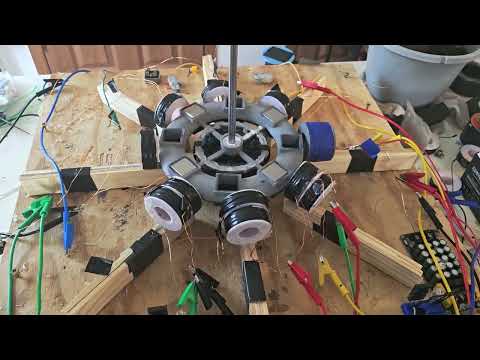
> Hey, what's up everybody? It's Papa Bell. Welcome to the channel. All right. So, I've just been experimenting with you know what is possible and what isn't possible. Uh we start out with what's not possible. And that's perpetual motion, right? Not possible. What is possible? Is that I can gather induction from this coil to run this wheel for maybe not at all. We're going to check out exactly how much induction AC electricity we're going to get off of this coil. So, there's a 20 and an and an 18 gauge strand wrapped in series with these two coils. And then there's a 32 gauge strand that is just…
Full transcript notes
This page is grounded in the automatic captions for this video (4,541 characters, language: en, source: package).
A richer blog rewrite (Papa Bale DIY voice + SEO package) is generated only after the full transcript is processed by the content engine — never from the title alone.
Watch and listen
The embed above is the source of truth. Measurements and claims on this site should match what Papa Bale actually says in the video.
Full transcript (4,541 chars · en)
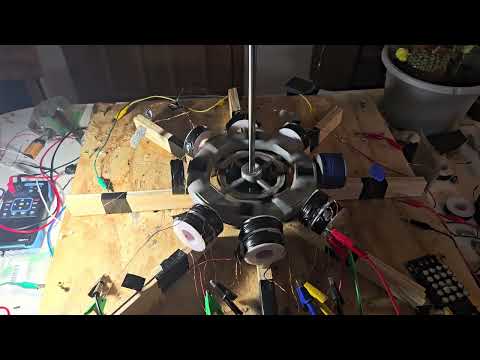
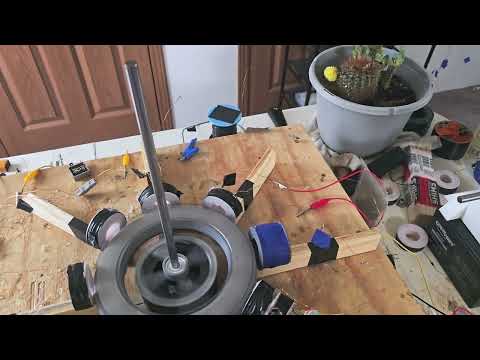
Hey, what's up everybody? It's Papa Bell. Welcome to the channel. All right. So, I've just been experimenting with you know what is possible and what isn't possible. Uh we start out with what's not possible. And that's perpetual motion, right? Not possible. What is possible? Is that I can gather induction from this coil to run this wheel for maybe not at all. We're going to check out exactly how much induction AC electricity we're going to get off of this coil. So, there's a 20 and an and an 18 gauge strand wrapped in series with these two coils. And then there's a 32 gauge strand that is just floating there. And I got it hooked up to this meter over here. And I also have it hooked up to uh this cap bank right here. Now, this wheel is run by that cap bank. It's a it's a linear cap bank and the AC and DC come in this way. And DC comes out this side. Okay. So, let me see where it's hooked up to. Yeah, this end is hooked up. And you can't really see it, but it's like there right there. Yeah, it's hooked up to this cap bank. So, I'm going to spin it real quick, just a little spin. I mean, we get about a tenth of a volt just from that. See, it's like it's not much, so I don't think it'll run it because it's, you know, it's nothing. I mean, I can push it in closer. I mean, we get about 1.62 or 0.162, my bad. Okay. But, uh let's see what it looks like when we put some power into it. We got 24 volts going in. That's awesome. So, there's a volt of AC going into this cap bank. All right. So, now I've taken off the power. We got almost a volt. Almost a volt going [clears throat] into the cap bank to run itself. Because of the breakage here, we got four bridge rectifiers here. This this can work. You just need to be able to generate enough. Look at it go. Look at it go. Will it continue to do that? Not really. But, you see how it jumps up? It goes from like then it'll jump down. You know? But, it it this is how you determine how fast it's going right now. Or, you know, um not the speed but you can relate the speed to the voltage generated. And so do that. Uh and that's what I'm doing right now. Oh, that's so That's so cool. See, because as that gets slower, this is uh lower this is definitely getting slower. You saw how quickly that got up to speed, man. And this thing is going pretty pretty fast with with momentum. All right, we are going to look at these lights now real quick. All right, now you see the lights. They're They're empty, right? They're not on. Spin that wheel, they're still not on. We got about 100 uh almost 2/10 of volt from doing that. Now, I'm going to spin this. Yeah, look at that light. We should see how much we're getting from these two coils. But, it's like uh somewhere around 20 15 20 volts. All right, the this coil is 26 gauge 6,000 turns uh six coils six spools wrapped in series of 1,000 turns. And then there's a 30 gauge coil for a trigger 1,000 turns. So, 7,000 turns of wire right there. And then this one's 14,000 turns of 32 a single strand of 32 14,000 turns. >> [snorts] >> Um Let's going to look at the axle. It's not a big axle. It's kind of tiny. So, yeah, that's quite a bit of wire right there. And it weighs uh 1.25 lb. I'm pretty sure that's what I got on the on the scale. Yeah, right around there. 1 1.25 1.3 So cool. I mean, wow. All right. All right. Got 2 tenths of a volt right there. And and that's because of how close it is. It's within a a half an inch. And that's what's uh keeping time with the motor. It's just a paperclip two paperclips. I think it's ingenious, man. And there's not a of friction here. This this moves very very nicely, very smoothly. Would I remake it? Yeah, I would definitely remake this one and I would make it so that it was more like this. Cuz I just put the magnets in um the edge instead of, you know, like in the edge like this. I put them literally in the edge of that thing, so I don't know. I guess it is an okay way to run it, but one of them popped out, so really got a tape is what's holding that one in right now. So cool. It It would be really really fantastic if that one 32 gauge strand in this coil was enough to make it go really really slow. That would be so cool. >> [sighs] >> I don't know. I might have the wrong configuration of wire here. There's a lot of 20 gauge in this setup and that might be a little too much for a small amount of energy. I mean, I'm not entirely sure. Honestly, I don't I don't know right off the bat. But uh I I think I have something that might work. Anyway, peace out. Bye now.
Keep watching · longer sessions
More long-form bench runs
Queue up the next long-form bench run on YouTube — longer sessions keep the workshop free for everyone.
 Long-form
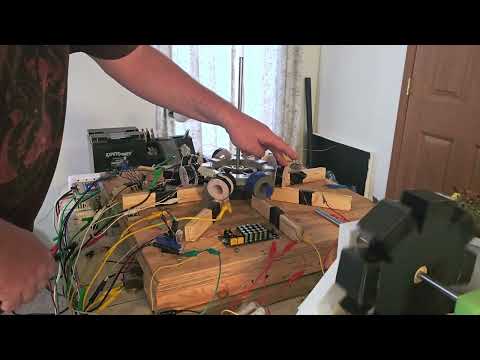
Amp Funnel Coil: Pulse Motor Labs EP:1
Eight-magnet eight-coil pulse motor lab — amp funnel coil wiring, pickup coils, and give-and-take battery measurements.
One path · free first
Watch free → subscribe → optional membership
Notes stay free. The full experiment lives on YouTube. Membership is optional when you want Discord and exclusives — not required to learn.
- 2
Subscribe free + turn on alerts
Hit Subscribe, then the 🔔 bell so you catch the next experiment.
Subscribe free + 🔔 - 3
Optional: join for $2.99/mo
Members-only videos, Discord, and live shoutouts — cancel anytime.
Join $2.99/mo
Longer sessions · ad-supported free library
Not done yet? Queue the next long-form run
Queue up the next long-form bench run on YouTube — longer sessions keep the workshop free for everyone.
- 1▶ Watch full on YouTube
Start: Shocking Truth About Pulse Motors
Notes & transcript on site - 2▶ Watch full on YouTube
M.P.H.Jr Pulse Motor Labs EP:1 Just scratching the surface
Notes & transcript on site - 3▶ Watch full on YouTube
8 Neo Cube Magnet Pulse Motor Hits 1300 RPM — Amp Funnel Coil Power Test
Notes & transcript on site - 4▶ Watch full on YouTube
Name change, plans for the future, Motor generator start of something cool 😎
Notes & transcript on site