Experiments·Transcript-backed
Starter Solenoid Wire Diagram: External vs Bifilar Trigger Coils
Watch Papa Bale test an external trigger coil on a small pulse motor rotor. See real RPM results at 25V, how positioning affects speed, and honest comparison to bifilar setups. No fluff, just bench measurements.
Long-form · Full audio · Best on YouTube
Watch the complete video: Starter Solenoid Wire Diagram: External vs Bifilar Trigger Coils
Watch the full long-form video on YouTube — that's where the full bench audio, runtime, and experiments live.
Preview embed · full runtime is better on YouTube
Prefer the full player? Better audio, runtime, and next-video queue on YouTube.
▶ Open full on YouTubeSee it on the bench · full runtime on YouTube
What to watch for
- ▸External trigger coil lets you adjust position on the fly for better response and higher RPM at lower wattage
- ▸At 25V the motor runs between 2.5 and 5 watts; switching to a single shorter coil jumps draw to 11.75 watts but still hits 1000 RPM
- ▸Bifilar trigger is strong but you cannot tweak timing the same way as a movable external coil
- ▸Rotor uses mag-lev on the outside; kinetic energy focus with no load or battery charging connected in this test
- ▸External trigger gave clean speed increase to 3700–4100 raw count (≈1000+ RPM after dividing by 4)
- ▸Utron project shown briefly also uses the external coil and mag-lev
Watch the full long-form video on YouTube — that's where the full bench audio, runtime, and experiments live.
Experiment notes (read while you watch)
Notes support the video — for the full-length run with complete bench audio, stay on YouTube.
Papa Bale runs a 5.5 inch rotor with four magnets using an external trigger coil at 25 volts. The setup draws 2.5–5 watts and reaches over 1000 RPM. He compares it directly to bifilar trigger performance and shows how slight positioning changes boost speed dramatically.
Key takeaways
- External trigger coil lets you adjust position on the fly for better response and higher RPM at lower wattage
- At 25V the motor runs between 2.5 and 5 watts; switching to a single shorter coil jumps draw to 11.75 watts but still hits 1000 RPM
- Bifilar trigger is strong but you cannot tweak timing the same way as a movable external coil
- Rotor uses mag-lev on the outside; kinetic energy focus with no load or battery charging connected in this test
- External trigger gave clean speed increase to 3700–4100 raw count (≈1000+ RPM after dividing by 4)
- Utron project shown briefly also uses the external coil and mag-lev
Papa Bale tests a compact rotary pulse motor with an external trigger coil. The 5.5 inch rotor with four magnets runs smoothly at 25 volts pulling only 2.5–5 watts. He moves the trigger coil slightly and immediately hears the speed climb, reaching over 1000 RPM.
Bench notes show the external trigger clearly outperforms a fixed bifilar setup for easy timing tweaks. No meters on the output side, just pure kinetic spin. Later he swings the camera to the mag-lev Utron build also running on the same external coil approach.
Related on this site
- Using a Hall Effect Sensor in Your Pulse Motor Build — Directly referenced when discussing hall effect controller as future test
- Counter-Rotating Device: Troubleshooting Resonance & Safety Relay Upgrade — Linked in counter rotating magnets section as related but separate project
- How to Build a Pulse Motor (Parts, Coil Placement & Circuit) — General starter solenoid wire diagram context and beginner help
---
*Generated from video transcript (hash `0010c2bf37f8…`).*
Full transcript (28,543 chars · en)
We'll flip the screen here real good. All right. Got theron mag left. I just decided to put the mag lev on the outside. Works pretty good. Sweet. I'm gonna get this out of here just in case. Hello. Hello. There we go. That up. All right. So, this this is an awesome little rotary here. It's five five by 5.5 in. So, it's not quite 6 in, but when you got four mags in there, huh? The rotor appears to be stuck on the pole. I'm going to need both hands to get that off there. But that's all right. Stuck in the right spot. That's all that matters really. All right. So, like this operates really well at 25 volts about five watts in between 2.5 and 5 watts. All right. So, there it is. Is Is this like the best way uh to run it with like less wattage in? I don't know. And uh it's going pretty slow right now. Uh see 2500 divided by 4. No, it's not going that fast. But if we run with just one of these gray coils instead of all three of these coils, it'll go you'll get 1,000 RPMs for sure. And but it'll be like up around 11.75 watts. We'll be pumping a lot more amperage with the shorter coil. Hello. How's it going? Um, I was thinking about since we're running so good at such, you know, a higher voltage, applying one of these and seeing if we can just jack it up even more. Hello. Hello. So, this will go up to 345 volts uh of DC. So, I don't know. Uh, I'm thinking about hooking that up for sure. So, this is the trigger coil right here. It's It's just an external trigger coil. We can move it around and stuff. You hear that pick up right there? That's awesome. I just moved it a little bit to the to the right and we got awesome awesome speed increase. See, but when you got the bif filer trigger coil, you can't do that really and have it make sense. Oh, let's see. Let's see where we at. That sounds beautiful. Oh yeah, we're almost to a th00and right now. That's sweet. Well, 3700. Let me see if I got that right. Yeah, 3700. And then you divide by four. Hello. Hello. No, that's uh the RPMs and that's you got to divide that number by four. So, it's almost 1,000 RPMs. Oh, that sounds even better. That's so good. Listen to that. Yep. We're above a th00and now. 4,100. Sweet. All right. You divide that by four, you're above a th00and. That's so cool. Now, I'm not really doing anything on the opposite side of this. It's all motion right now. It's all about kinetic energy. and applying voltage to make it spin faster. I haven't hooked up anything to generate with. I mean, it's already generating, but it's like I got no meter reader. There's nothing. I got no BMF connections. I've got nothing on here right now. This is bare bones. The only thing I'm really experimenting with right now is the external trigger, and it's freaking awesome in my opinion. Hello. Hello. Yeah. No, no need for such a high amount of voltage to make these little things spin. Maybe maybe something bigger or something go faster, you know, like I can see 3k volts, something going really really fast. This is only uh let's see where it is now. It's just above a thousand RPMs, I'm pretty sure. Yeah, 20 400 4,000. There we go. That's where we're at. And then divide that by four. So, yeah, like 1,50 RPMs. Good morning, good afternoon everybody. Good evening. How we doing? This is Papa Bell. What's going on? This is awesome, man. This is so cool. You know, I could only get it to go, you know, a thousand maybe. But, you know, just it actually gets hot if you do that for a little bit. All right. So, I've got another project also that I'm working on. I'm move the camera over there in just a second. See? And when it's off center, the coil just a little bit to the into the way that it's it's turning that way, spinning that way. So, you move it this way a little bit and you get a much greater response. And so that's a benefit of the external trigger. You can move it around. That's that's that's a plus. Uh with the bif filer trigger, uh you you're kind of stuck with the drive moving along with the trigger, which isn't bad. I'm I'm saying the bifiler is pretty strong, too, but you can't you're never going to get it like this with at the cost um with the same coils. Just not going to happen. All right, so here's the other project. This is the Utron and I've decided to mag lev it and it's pretty smooth. I'll turn it on real quick. I got it working with the external coil right now. I'm working on a rotor that'll fit in the middle of it, but I need a battery that's non-magnetic. Has no magnetic components to it at all. That's what I need. And I don't I don't know if it exists or do I have to like make it myself. If I get a battery that can fit on this. That's the other thing. It's got to fit on this rotor. And then this rotor goes in the middle of that. But yeah, that's where I'm at right there. Hello. Hello. Look at that baby go, man. That's awesome. Yeah. F. Is that a fan? That's funny. It's a Utron, man. It's not a fan. There's no wind on that. This has got to be one of those things that has the least amount of drag. Uh utron is a shape. Uh it's a shape of two cones uh put together at the fat end and that makes a neutron. And some people debate that that's the shape of the universe uh where the all the us the extent of the usable light is expended and when that boundary gets created it's the shape of a utron. So basically when entropy catches up with the universe there's a boundary that gets created. So like the light of the farthest star reaches as far as it can. There's a usable range. Okay? And the usable range is what I'm talking about. Not everything that goes beyond that cuz it doesn't matter. It really doesn't. Uh, I I got to say that there's like a there's a three-dimensional universe and that's what matters to everybody who lives in it. It It's got to matter, you know, that the the third dimension uh is is cool. I you just if the singularity Let me just put this out there. If the singularity is real, then your body is existing in many places all at once. Cuz that means you got an infinite singularities in inside of you and the amount of space that it takes you to exist in the three-dimensional realm. So you know what I'm saying? You exist in a range of on a spectrum and you know this is a representation in the universe existing on a spectrum. So it's like it blows up from the center, right? And then expands outward and upward. And that's what it would look like. as it expands. I was just, you know, thinking about, you know, quantum stuff and all that and just thinking about the singularity itself, you know, just that point, that spot, you know, where and just not not even a black hole or anything like that. just that point, that dot, whether it be empty or full or whatever it is, you know, that dot and how many of those dots actually are inside of this space that I take up. And when I move, when I walk, that space changes. And everything about my frequency and the way it interacts with my environment is different. every step I take. You can like try to say that and bunch it all into one, you know, constant, but your environment is not a constant. Okay. No, tell me more about it. Oh, that chip, man. Sorry. I I got off I got into a tangent there like uh had to get it all out. You know what I mean? Now, see, you know, yeah, I I I get the ether thing and using the ether. Um because it's like, let me just try and put it this way. You know, I uh this point right here in the middle of that high voltage symbol, there's a transformer in there, and I can't put my finger in the middle of that because there's a transformer there. And that is there's a philosophy that goes behind that and it's uh same place, same time, right? That can't happen. Same place, same time can't happen. Same place, same time can't happen in a three-dimensional universe because there's already something there. But in the ether everything is already there. So you can move that in and out of that space and then you can put something else there cuz it's all already there. It's just in a three-dimensional world. You can't put both of these things there at the same time. So time is real, man. Time is very real. Uh, this is a pulse motor. Uh, and currently it's only hooked up the one way. I'm going to put 25 volts into it. There's no multimeters hooked up to it. Is hooked up solely for my enjoyment and your enjoyment to watch spin. There's no um you know I don't look at that. All right. So the external trigger this is what's timing everything right here. This coil and it's hooked up the same way a bif filer trigger strand would be hooked up. Except the awesome part about this is I can move it around and get a better situation on the timing. So that's awesome. Yeah. And I have always debated the, you know, the benefit of having an external trigger. One, it's cheaper. You can back it out and it'll be even more cheap. You know, as soon as you get it once you get it going real fast, you can move it out. So this is like five watts. Hello. Hello. This is mag lab done itself. So I got four Neos in there. Michigan I've lived everywhere in Michigan. Yeah, I've been in the up, man. Been there and it's awesome up there. Well, I live in lower Michigan now, but uh yeah, man. I I got no complaints about God's country. Even the snow is it's worth it. No man, I just I am not an engineer. If I took an engineering, you know, became an engineer, I could do this. But I'm not an engineer. Yeah. I Yeah. Okay. Um like Yeah, I guess I'm a tinkerer. Like if we were playing a video game, I would definitely be the tinkerer. Tinkerer. Uh this is the pulse motor. It's a DC brushless motor. Um, this is the timing coil, trigger coil, that's my uh setup right there. And here's my power supply. 25 volts in 2 amps. Boom. I think that's pretty good um speed for all the coiling that's here, man. I mean, we got 1,500 turns of 20 and 1,500 turns of 20 over here, and we got like 3,000 turns of 24 over there. And yeah, I'm not There's nothing different here. I'm not trying to alienate myself. I I got enough of that going on already. Yeah, I don't need to do that to myself. All right, here we go. So, let's check take a look at the other one over here. All right, so I decided to mag le this thing and let's turn it on real quick. Now, let me show you the inside of this in just a second. There's the source power for it currently. However, I'll show you the inside. I'll show you what I'm planning on doing with it. A man. And I mean that sincerely, man. All right, we're going to shut this down while I'm over here messing with this. Don't want too much going on. Ah man. And see what happened is I had to super glue the bearings on there and I think but when I you know jostle it off it should be all right. Then I just got to sand the pole down a little bit. Some really fine sandpaper or something. All right. I'm going to thin this up. All right, there it is. I don't know where the rotor went right now, but it's supposed to fit in there. And there's a little magnet that goes in that little hole in the bottom, and it gets mag left in inside here. And then it's uh the in it's supposed to be a kind of rotator in the interior. Wow. Anyway, yeah, it's a counter rotator and electromagnets are supposed to be and the power supply is supposed to be in the center. The demo over here. Okay, the demo is right here. External trigger coil for your enjoyment. short-tempered with me, man. Yo, what up, Mike? How's it going? Oh [ __ ] Sorry. There we go. Oh man. All right, let's see what we got here. Hey. Hey. All right, here we go. I figured out what my problem was. And I I was I've been going really good all day. I haven't done that all day. clip that coil when I spin it. But here we go. Sweet. All right. Yeah, man. Uh, for those of you who do have a mental illness, I'm one of those people, man. I have extreme bipolar and I'm not afraid to admit that. If you don't like it, you can leave. All right? And you know, I do things all the time that I don't mean to do and it sets me back tremendously. I have a really hard life based on those two facts alone. But, you know, this is going really well. I think I mean I have to rework the whole the rotor in the middle because it's a little bit too big. I wish I had a bigger printer and then I'd make a bigger Utron and then I could use my rotor. But now I'm just going to just make a smaller rotor. Yeah. So just out of luck, man. I got it up there. I had to get it off there just to see if it would go faster. And uh I got the external trigger coil on the external coil working right now. And that's 12 volts. So in order to get it to go at least this fast, I'm going to need to have a 12vt battery supply in the center. I don't know if that's going to ever happen, but wow. Oh, I left my uh my uh attack meter over there. Hell yeah. Yeah, man. I was Yeah, that's awesome. Right now, I just watch it spin, bro. Hello. That's all I do with it right now. And that's all I That's all I will ever do is a toy. It's not industrial by any means. It's definitely more in the range of, you know, toy for somebody who likes to play with electronics. But I love it, man. It's great. I think that's going around around 1,200. Straight up, man. That's sweet. All right, let's see what we're working with right now. So, this one is only going that fast. That sounds interesting though. Maybe that that you know I'm looking for a non-magnetic electrical power source. You know, the 9VT that I was using earlier just had too much magnetic pole on the magnets. So, I can either make the magnets smaller or I got to get, you know, a power source with less of a magnetic pole on it. Water sounds like it would be that thing. Yeah, it's just too close quarters for there to be a battery in there. that that is magnetic. And I think everything currently has some sort of pole to it that generates power. Does he know or did he then? Which one is it? Yay! Almost 4,200. Nice. That thing's still spinning. That's awesome. It's got really good bearings. All right. With this particular situation, I'm not trying to generate power at all. So, it doesn't matter. There's going to be nothing to even do with it. I mean, the best it can do is cycle back into itself. And I might set something like that up, but Yeah, I ended up like 14 just chilling out right now. It's still going like 12. That's awesome. Yeah, this one right here is just a a toy. I mean, you can set something up, but when it's finally finished, there's going to be it's all going to be inside of this thing. And the shell is going to spin separately from the rotor in the middle. It should spin the opposite direction. So yeah, I'm down to put more power in, dude. That's that's definitely okay with me. Sky's the limit, man, with the power in. But fif, you know, I I can do I can buy one of these power supplies that'll do like 63 volts with an 8 amp draw on it. And that's the only way I'm getting 50 volts. Yeah, I'm not buying I I I've refused to buy another thing in regards to any of this stuff. I'm going to roll with what I got and if it's not good enough, that's okay with me. I don't I don't really care too much. I mean, I care enough that it's been what I've been doing for like the past two years. Yeah, I'm into it. But I mean, yeah, man. I what everybody like thinks I should be doing. I don't know about all that. And like all the stuff that I need, quote unquote, I don't know about all that. All right. I don't know about all that stuff that I need. I don't know about that stuff. All right. Yeah, that's going to burn a hole in my pocketbook and I just don't give a freaking care about it anyway. Buy it for me. Send it to me in the mail and we'll do it that way, you know. Thank you. Thank you. Thank you. I think it's pretty awesome. Uh, a friend of mine, uh, Hall effect X turned me on to Otis T Car's contraption. And this is just a piece of it, you know. This isn't the contraption itself. This is just a piece of it. And there's six of these things that go around a, you know, a big wheel. And then there's six aluminum plates that are in, you know, shaped like a like that. And they go around just like a wing of a plane. But it's it's done like that to catch the eddiurrens on itself. And you you use the plates to move past the utron, making the utron spin in a counterrotating direction to the main rotor that's spinning, which is the external ring. Uh, and then there might have been one of these in the center, a big one with a a crystal or, you know, some way, some energy source in the center. I think it might have even been as simple as, you know, just a self, you know, generating source made out of a neutron, you know, and anyway, you know, the faster it would spin, the faster those in in the wheel would kind of rotate, further disrupting, you know, what it does is it gets a a magnetic or a grip on time, okay? And it starts to basically unravel it. It time is a is just part of an equation. It's it's so you can exist in three threedimensional space. Uh so you can move in threedimensional space. It's it's all for you, you know. It's not some trick or game or scandal, you know. You don't you don't like pass on because of time. That's not what passes you on. You know, it has nothing to do with it. And you know, we use it as a unit of measurement, I believe. You know, how long something is been around for, but it's it's different than that. That's more of an echo of time than time itself. Time is more about right now than anything else. Heck yeah. I don't know. I like unwinding every once in a while just trying to keep it on the same you know pulse motor wavelength and stuff. I mean this stuff is directly inter interconnected with like time and stuff like that because of how people have tried to manipulate it and I've had um you know I don't do I don't do that. I mean maybe I am doing that but I'm not doing it intentionally. You know what I'm saying? I don't care about that. But it might be happening anyway regardless whether I care about it or not. So yeah, I think it's awesome. I believe it's it's so much an intricate part of our existence that we can't be without it. You know, it it's not something that I don't even think being without it is a thing really. No sir. Let me show you how much this costs. That's 25 volts, 200 milliamps. Not free. So, basically what's been explained to me is that there's a possibility, and you can kind of hear it as it moves, that the magnets here are are gripping time and pulling it with the rotor. That's what the hypothesis was laid before me. And then it was, you know, further uh refined to having the electromagnets on the center part spinning and having uh the stator be the permanent magnets. So I' I've got a few builds like that and that's pretty cool. Does it, you know, change anything? I don't think so. Not that I can immediately tell I'm not any older or younger. Sorry buddy, I can't roll a J. Uh I've made I made this painting one time a long time ago and it was a smiley face, a walking smiley face that was pointing at you and it said have a nice Jay on it. It was pretty cool. Yeah. And if you don't know, I I paint I paint I paint a lot more than I do pulse motors. So, you're probably going to see a lot more of that from me. I just just finished one actually. It's pretty neat. So, the external trigger coil off to the right a little bit is going to be your best bet and have all these lined up at the, you know, the 90° for this motor anyway. you know, and they're all different. I mean, there this is 20 gauge, 20 gauge, and 24 gauge in series, and I'm still pulling, you know, uh 200 milliamps using uh the trigger coil. Now, I was messing around with this earlier today. It's a hall effect sensor, proximity sensor, and it works all right. Works pretty good. Can't complain, you know, but it's not um it wasn't as smooth. I have to mess around mess around with it a little bit to get it to where I like it. Oh, yeah. I just got my car out of the shop and uh I went shopping and I'm broke. So, that's awesome. I got to go to the store, you know? I'm like, "Yes, car's out of the shop going to the store." And I drove around just for like 20 minutes just because I was like, "Oh my god, it's been a while. I miss you. Um, yeah. So, I was uh playing with the same build using my paper clip and it works really well with uh you know single file coils because these are just just 20 gauge. There's nothing else, no buy filer or anything like that. And so the only time I can ever use them is when they're in series or when they're when you got an external trigger of some kind external either hall effect read switch or coil like this. So cool. All right. So, I got to bring in that rotor just a little bit. And then I got to make my uh I got to print my own bobbins. There it is. And they fit right on those pegs. But those pegs will obviously be a different size. See, there's one right there. It's on there now. But I got to bring it in like a a little bit, you know, like an inch. Not an inch, like a centime. Not even a centimeter, you know, like a little bit. I just got to make it so it fits. And it's it was so close. Like so unbelievably close, but it it was just a little bit too tight. And that's just how it breaks down, man. That when you're eyeballing stuff, that's how it breaks down. You either make it the first time or you make it the second time. And I mean, I measured it, but you know, it's on a mag leav and it's bouncy and yeah, it needs to be just a fraction of an inch smaller on all dimensions. I don't even know what that means, man. That is a looks like an ignorant person's way of saying I don't even know man. I I can't I can't bring myself to that level. What does that mean? Yeah. Why don't you roll one? Bring it to me. Let me judge it. We'll go from there. Anyway, um I'm this is going to be I'm I'm going to be few and far between. I'm moving all this stuff out of here and I'm giving a lot of it away. Uh and I'm going to keep what I want to work on and that'll be that. Seriously, I need to clean up this place a little bit. So, that's what's going to happen. Uh, and then this be that. And I'll probably end up just putting it on this side. This is a pulse motor uh with an external trigger. It runs on about five watts. What's up, Pat? Feeling lonely. Hi. I said, "Are you feeling lonely?" What does that mean? English, please. Absolutely. We're 25 volts in. We're 5 watts in basically. You're from Brazil. Ah, welcome Brazil. Still hello. Hello. Hello. Hello. Yeah. I don't know, man. Oh, yeah. Why don't I put that in there just to show you guys Okay. And now there's a magnet that goes in the bottom of this and the bottom of this and they repel each other and it mag leaves in the center there right about there. So it's really close to like being able to do it but you can't use that power source. And then this then the cap goes on. And yes, it will spin itself basically to the extent of that 9volt battery or another power supply and nobody will even notice that it's like I mean they'll notice that it's moving. It'll look like it's moving by itself, but it's it's not. It's kind of rotating um the rotor in the middle. I tell everybody that too. I'll break it down like exactly the way it work it works. You know, this is how it works. Yeah. I had a an adopted brother from Brazil. His name is Louise. Hello. Hello. All right. So, there's our voltage in 25 volts. 2 amps. That's moving quite nicely I would say because we can always I can't increase the voltage right now but um I get a you know a 63vt power supply and we can go from there but that that's as high as I can go right now. 25. Actually, the other one goes 31, but that's still not 50. Now, this one right here goes from like 7775 up to 345. So, I want to hook this up. Hello. Hello. Welcome. I'm going to turn that down because this light was getting hot. Thank you. Thank you. All right. So, I think for my next one, I'm going to have this hooked up and we're going to try pushing like 75 volts through this system. What am I doing? I don't know. I haven't decided yet really. It's just a motor right now with an external trigger coil. So, but I'm thinking about upping the voltage that I'm running through it to about 75 volts. Nice. So, they're not it's not that bad. That's Hell yeah, man. I just I'm like I was, you know, thinking to myself, how would I get to 50 volts with what I have, you know, like cuz I blew out my other power supply and I had to throw it out. But this will work. Hell yeah. Now, if we want to see that, I would have to hook up my tripod, and I could do that, but uh I'm not banking on that transistor being able to handle it, but we'll we'll see what happens. And I'll have one left after that. Oh, yeah. All right, I need to go get my uh screwdriver. Touch of Joe. All right, man. And this uh forgot how hard those were to read. The in out in out is so small on this thing. in. Okay, I'm going to confiscate the wires from this comparator circuit. All right. Maybe I got the wrong screwdriver head here cuz it feels like it's screwed in all the way. But it isn't clamping down. So something's not there. Okay, I was just Well, that's what you get for confiscating commandeering wires from another project. That was too big. Just take these then. Annoying. This is the most odd thing. And it's so tiny. I can't I can't see that. I'll be right back. We're going to do a a meter reading on this to make sure we got the voltage right. All right, here we go. Yep. 73 75. Nice. Now we got that hooked up. We can either put this in the system or leave it out. I'm going to try it with it out first. That's awesome. See? All right. I got to show you a few things that I just found out, man. Wow, that light was bright. All right. So, we'll start by turning it on. That's how much amps we're drawing. That's our light bulb, dude. Wow. That's amazing. I can't leave it running like that for very long, though. That's so cool. I need to get my attack meter. Where' I put it? So this is 73 volts in uh no it's just a it's a five by uh 5.5 almost 6 inch rotor. Uh, it's got four neos in it. It's not very heavy. That's so cool. I don't know if that's real though. I mean, it's just a one of these things. The voltage is real, but you know, it is pulling like 4 amps to get there. Yeah, man. This this little thing is awesome. Running this big thing up here. Oh my goodness. What does it do? Well, it takes the DC from the buck converter, takes the AC from the wall, changes it to DC, and then run it through that. And it takes the DC and amperage from this and changes it into voltage. Nice. I didn't think I was going to be able to get to 50 volts. My cat's chewing on the cord indeed. uh the converter no needs 9.5 volts to turn on. Man, he keeps trying to bite the cord. I think that little bit might have shook him. Stop, Tigs. He's really trying to get it. I might have to be done for in a minute if he keeps trying to do that. Um, it needs a minimum of 9.5 and then whatever amperage it needs to turn that 9.5 into 7. There's really no like increase in power here. It's just a conversion. So, uh, yeah. So, it depends on how high you turn it up. So if it's 9 volt 9.5, you'll draw about two amps and you'll get the but I I usually put about 9.7 and draw about in between 3.1 and 2.7 amps and it's in between 70 and 75 volts. Oh, the power supply here. Yeah, I like that. But this this thing does the you know transformer high voltage transformer and I can turn it up, man. It's It's only at 75 volts right now. And yeah, there's a screw in here like you can turn the screw and it will stop at 75 no matter what put into it. So, I like that screw. Awesome. Awesome. I like this stuff, too. But I don't I don't think the rotor this rotor is going to end up going much faster. It's about I got it going about 1,600. I don't know. I just feel like there's something about it that's going to cap it at around 1,600. And it's stuck on the pole right now. I'm going to have to get it off. So it's not it's not mag living because it's stuck on the pole. What's up, Chuck Norris? You don't sleep, you wait. No sir, that look free to you? But when all that comes out the other side is like pure pure DC um voltage instead of amperage. All right. Well, that's awesome. Thank you. Thank you all very much for coming in. I appreciate it. going to be taking off though. So, thank you very much. Peace out. Have a wonderful day. Please subscribe. Bye now.
Keep watching · longer sessions
More long-form bench runs
Queue up the next long-form bench run on YouTube — longer sessions keep the workshop free for everyone.
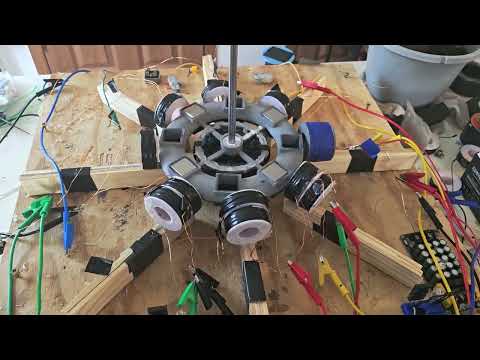 Long-form
2 circuits running a third room still for some growth/expansion.
Papa Bale here with a messy bench update.
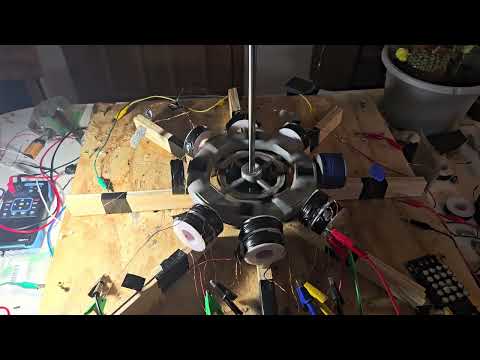 Long-form
M.P.H.'s pulse motor labs EP:2 Skin deep
I fire up two circuits at once, chase meter spikes, and retell the day a three magnet rotor one literally exploded at speed.
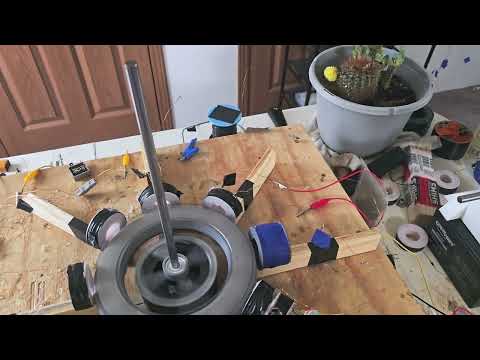 Long-form
Amp Funnel Coil: Pulse Motor Labs EP:1
Eight-magnet eight-coil pulse motor lab — amp funnel coil wiring, pickup coils, and give-and-take battery measurements.
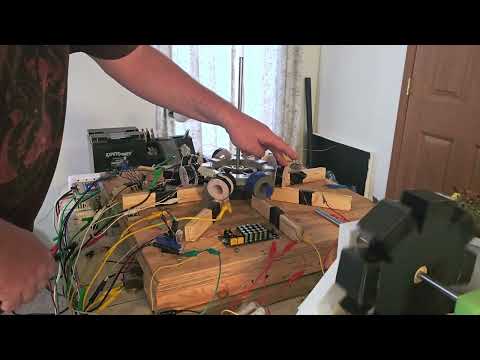 Long-form
MPH pulse motor lab
Real bench time with motor rotor magnets on a pulse motor rotor.
One path · free first
Watch free → subscribe → optional membership
Notes stay free. The full experiment lives on YouTube. Membership is optional when you want Discord and exclusives — not required to learn.
- 2
Subscribe free + turn on alerts
Hit Subscribe, then the 🔔 bell so you catch the next experiment.
Subscribe free + 🔔 - 3
Optional: join for $2.99/mo
Members-only videos, Discord, and live shoutouts — cancel anytime.
Join $2.99/mo
Longer sessions · ad-supported free library
Not done yet? Queue the next long-form run
Queue up the next long-form bench run on YouTube — longer sessions keep the workshop free for everyone.
- 1▶ Watch full on YouTube
Start: Shocking Truth About Pulse Motors
Notes & transcript on site - 2▶ Watch full on YouTube
2 circuits running a third room still for some growth/expansion.
Notes & transcript on site - 3▶ Watch full on YouTube
M.P.H.'s pulse motor labs EP:2 Skin deep
Notes & transcript on site - 4▶ Watch full on YouTube
Bifilar Pancake Coil Build for Pulse Motor Generator
Notes & transcript on site