Experiments·Transcript-backed
More Solid State Experiments – 2 Frequencies
Watch Papa Bale capture a clean coil sine wave across the middle pickup while switching the bottom drive coil off. Real bench readings from two frequencies, magnetic induction, and what happens when the wheel power is off.
Long-form · Full audio · Best on YouTube
Watch the complete video: More Solid State Experiments – 2 Frequencies
Watch the full long-form video on YouTube — that's where the full bench audio, runtime, and experiments live.
Preview embed · full runtime is better on YouTube
Prefer the full player? Better audio, runtime, and next-video queue on YouTube.
▶ Open full on YouTubeJump to the discussion · full video on YouTube
Hear it on the bench
Each link opens “More Solid State Experiments – 2 Frequencies” on YouTube at the first time that topic comes up in the captions. Stay on YouTube for the complete runtime.
- ▶ Watch at 3:34coil sine wave acrossprimary
“…coil sine wave across the board like at…”
- ▶ Watch at 4:24coil off yes sirlong-tail
“…Now I'm going to turn the bottom coil off. Yes, sir. And see there's our straight…”
- ▶ Watch at 3:27coil okaylong-tail
“…coil. Okay. So, that middle coil is where…”
- ▶ Watch at 3:34coil sinelong-tail
“…coil sine wave across the board like at…”
- ▶ Watch at 4:24coil offlong-tail
“…Now I'm going to turn the bottom coil off.…”
- ▶ Watch at 6:40coil evenlong-tail
“…So through the trigger coil even we're…”
- ▶ Watch at 6:49coil whichlong-tail
“…through the trigger coil which is awesome with no power going…”
See it on the bench · full runtime on YouTube
What to watch for
- ▸Middle coil delivers clean 950–1000 Hz sine wave once bottom coil is switched off
- ▸Trigger coil still passes a small pulse variation through magnetic induction with no power applied
- ▸Top coil runs at 426 Hz while bottom bass frequency sits around 220 Hz
- ▸Iron core visibly bounces at low frequency on the bottom coil
- ▸Combined top and bottom coils create a mixed waveform on the middle pickup
- ▸Wheel keeps producing some output from spin even after its power supply is cut
Watch the full long-form video on YouTube — that's where the full bench audio, runtime, and experiments live.
Experiment notes (read while you watch)
Notes support the video — for the full-length run with complete bench audio, stay on YouTube.
I swapped the rotor magnets for a big bottom drive coil, fired up the signal generator on the top coil, and watched the middle coil on the scope. We saw a steady coil sine wave across at 1.2 kHz, then mixed waves, and what happens when the wheel power and bottom coil are turned off.
Key takeaways
- Middle coil delivers clean 950–1000 Hz sine wave once bottom coil is switched off
- Trigger coil still passes a small pulse variation through magnetic induction with no power applied
- Top coil runs at 426 Hz while bottom bass frequency sits around 220 Hz
- Iron core visibly bounces at low frequency on the bottom coil
- Combined top and bottom coils create a mixed waveform on the middle pickup
- Wheel keeps producing some output from spin even after its power supply is cut
Papa Bale here in the workshop. Took the solid-state rig apart, replaced the spinning magnets with a big drive coil on the bottom, and started feeding it from three power supplies at 12 V. The trigger coil is doing the pulsing while the dual-drive board only has one side hooked up right now.
I gave the wheel a spin and the iron core in the bottom coil starts bouncing up and down at low frequency. On the scope we see a bass frequency around 220 Hz coming off that big coil. Once it speeds up the mechanical noise disappears.
Then I flipped on the top coil from the signal generator. Suddenly we get a steady sine wave on the middle coil. The top coil sine wave across the board sits at about 1.2 kHz, mixing with the lower wave to make a wild combined pattern. I turned the amplitude down a bit so we could see it clearly.
Even after the wheel power is off we still pick up a little something from the residual spin. Then I said 'coil off yes sir' and killed the bottom coil. The scope snaps to a clean straight sine wave from the little middle coil at roughly 950–1000 Hz. At 426 Hz from the top coil we saw roughly 406 on the scope with a slight variation riding through the trigger coil from pure magnetic induction. No power on the bottom, just induction doing the work. Pretty cool.
Related on this site
- Reading Oscilloscope Output on a Pulse Motor — Directly supports the scope readings and waveform discussion in the experiment
- DIY Magnetic Induction Motor: Hobbyists in 2026 — Matches the magnetic induction effect observed through the trigger coil with no power
- Understanding Back EMF in Pulse Motors — Related to the residual output seen after wheel power is turned off
---
*Generated from video transcript (hash `8d9512ce1005…`).*
Full transcript (2,833 chars · en)
Hello ladies and gentlemen. What's up? It's Papa Bale and welcome to the channel. So in this experiment, we're going to be looking at our our oscilloscope. Um, so I've taken the solid state out and I've replaced what the magnets do with this big coil on the bottom. Nice. All right. So, currently we're at three power supplies into this beast at 12 volts. All right. So, I'm going to turn Oh, let's go around the other side real quick and I'll show you what's pulsing the bottom coil of the signal generator or the solid state over there. This trigger coil right here is pulsing. Hey, Tigs. There's the dual drive. We only got one drive hooked up of the dual drive right now. We got two of those power supplies hooked up to the um solid state. I'm going to show you what's up with that in just a second. All right. So, I'm going to spin the wheel here. >> And at a low frequency, the iron core bounces up and down in the middle of that coil on the bottom. But anyway, here's our bass frequency coming off of that big coil. About 220 hertz. Yeah, look at that. All right. So, that's coming off of the trigger coil, the transistor, and once it gets going fast enough, it'll stop making all the noise. Now, watch this. Hold on. Boom. Let me turn the top coil on. We got both. Hold on just a second. All right. So, we've got that. Now, we've got a steady sine wave come coming from the signal generator from the top coil. Okay. So, that middle coil is where we're getting our reading from. The top coil sine wave across the board like at 1.2K across the board, top and bottom. And then that mixed with that other wave. Woo! That's awesome. Anyway, I'm going to turn it down a little bit. So, this is the power for the wheel. Just let you know what's going into this power for the wheel. And we get we get, you know, something off of that spin even now when the power's off. See, now the wheel power is off. Now I'm going to turn the bottom coil off. Yes, sir. And see there's our straight sine wave from the little coil. About 1,00 950. Oh, that's even better. There we go. All right, let me show you what we got on there. At 426 hertz from the top coil, this is what we're looking at. It's like 406 it looks like. Wow, that's weird. So through the trigger coil even we're getting a slight v variation in the wave like uh like a little pulse through the trigger coil which is awesome with no power going into the uh so it's just from the magnetic induction Let me give it one more spin. All right. Whoa. Whoa. So cool. All right. Thank you very much. Peace out. Have a wonderful day. And what we've seen here is the combination of the two um coils, the one on the top and the one on the bottom. And their effect individually and simultaneously on the coil in the middle. So, thank you very much. Peace out. Have a wonderful day. Bye now.
Keep watching · longer sessions
More long-form bench runs
Queue up the next long-form bench run on YouTube — longer sessions keep the workshop free for everyone.
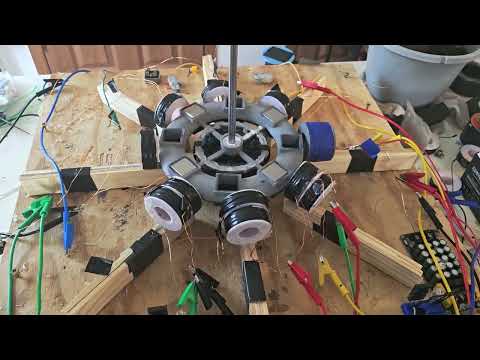 Long-form
2 circuits running a third room still for some growth/expansion.
Papa Bale here with a messy bench update.
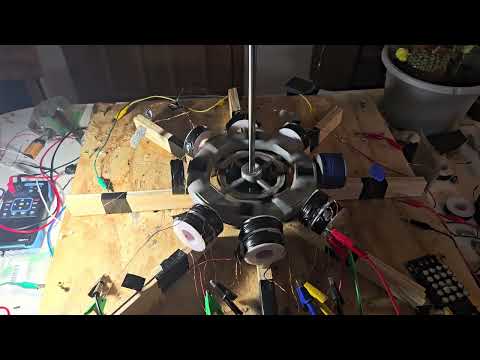 Long-form
M.P.H.'s pulse motor labs EP:2 Skin deep
I fire up two circuits at once, chase meter spikes, and retell the day a three magnet rotor one literally exploded at speed.
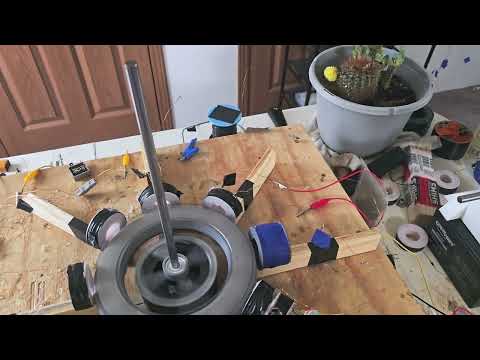 Long-form
Amp Funnel Coil: Pulse Motor Labs EP:1
Eight-magnet eight-coil pulse motor lab — amp funnel coil wiring, pickup coils, and give-and-take battery measurements.
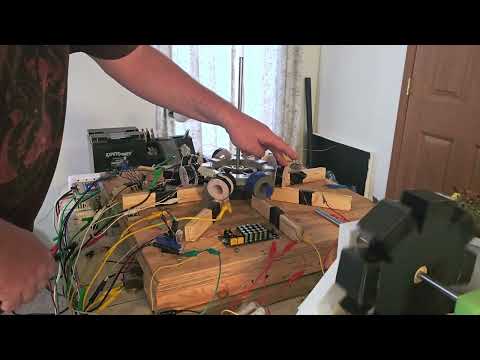 Long-form
MPH pulse motor lab
Real bench time with motor rotor magnets on a pulse motor rotor.
One path · free first
Watch free → subscribe → optional membership
Notes stay free. The full experiment lives on YouTube. Membership is optional when you want Discord and exclusives — not required to learn.
- 2
Subscribe free + turn on alerts
Hit Subscribe, then the 🔔 bell so you catch the next experiment.
Subscribe free + 🔔 - 3
Optional: join for $2.99/mo
Members-only videos, Discord, and live shoutouts — cancel anytime.
Join $2.99/mo
Longer sessions · ad-supported free library
Not done yet? Queue the next long-form run
Queue up the next long-form bench run on YouTube — longer sessions keep the workshop free for everyone.
- 1▶ Watch full on YouTube
Start: Shocking Truth About Pulse Motors
Notes & transcript on site - 2▶ Watch full on YouTube
2 circuits running a third room still for some growth/expansion.
Notes & transcript on site - 3▶ Watch full on YouTube
M.P.H.'s pulse motor labs EP:2 Skin deep
Notes & transcript on site - 4▶ Watch full on YouTube
Bifilar Pancake Coil Build for Pulse Motor Generator
Notes & transcript on site