Optimization·Transcript-backed
These Donut Magnets Spin for 8+ Minutes With One Flick
Watch these donut magnets float and spin on a magnetic pole with almost no input. I got over 8 minutes from one wrist flick and explain why three more donut magnets coming could change everything. Pure DIY experiment, no motors.
Long-form · Full audio · Best on YouTube
Watch the complete video: These Donut Magnets Spin for 8+ Minutes With One Flick
Watch the full long-form video on YouTube — that's where the full bench audio, runtime, and experiments live.
Preview embed · full runtime is better on YouTube
Prefer the full player? Better audio, runtime, and next-video queue on YouTube.
▶ Open full on YouTubeJump to the discussion · full video on YouTube
Hear it on the bench
Each link opens “These Donut Magnets Spin for 8+ Minutes With One Flick” on YouTube at the first time that topic comes up in the captions. Stay on YouTube for the complete runtime.
See it on the bench · full runtime on YouTube
What to watch for
- ▸A single wrist flick produced 8 minutes 34 seconds of spin on a heavy disc using these donut magnets
- ▸Magnets on the outer ring are all north-facing and provide both lift and the latching suction that keeps the top disc stable
- ▸The current three-magnet setup wobbles; adding the three more donut magnets coming should create a balanced five- and six-point star pattern
- ▸No bearings are used because a quarter-inch pole leaves no room; friction on the pole becomes the main drag once the discs latch
- ▸The setup shows clear exponential gain over normal friction — a flick that would normally stop in two rotations now runs for hundreds
Watch the full long-form video on YouTube — that's where the full bench audio, runtime, and experiments live.
Experiment notes (read while you watch)
Notes support the video — for the full-length run with complete bench audio, stay on YouTube.
In this workshop session I’m playing with these donut magnets on a simple pole setup. One flick sends the top disc spinning for minutes. I talk about the wobble, the latching effect between magnets, and why I’ve got three more donut magnets coming to try and balance it into a six-point star.
Key takeaways
- A single wrist flick produced 8 minutes 34 seconds of spin on a heavy disc using these donut magnets
- Magnets on the outer ring are all north-facing and provide both lift and the latching suction that keeps the top disc stable
- The current three-magnet setup wobbles; adding the three more donut magnets coming should create a balanced five- and six-point star pattern
- No bearings are used because a quarter-inch pole leaves no room; friction on the pole becomes the main drag once the discs latch
- The setup shows clear exponential gain over normal friction — a flick that would normally stop in two rotations now runs for hundreds
I’m back in the workshop messing with these donut magnets again. Everything’s floating on a simple pole, no motors, no fancy bearings. Just pure magnetic interaction and one good flick. The results surprised me — one spin lasted over eight minutes. I’ve got three more donut magnets coming and I’m curious what a full six-point pattern will do.
Bench notes
I used a heavy top disc sitting on a lower magnetic disc. The outer ring has three donut magnets, all north up, pushing the top one away while also creating a latching suction when the top magnets pass between the bottom ones. No glue — the poles themselves hold everything. The quarter-inch pole has zero room for bearings so the only friction is the pole itself once the discs latch magnetically.
I measured one run at exactly 8 minutes 34 seconds after whipping both sides hard. A lighter flick still gave hundreds of rotations instead of the two or three you’d expect from that much mass. When the top disc latched down the wobble dropped and it kept going even longer. That’s the part that makes me want the next three magnets.
Support the workshop
If you’re into this kind of low-energy magnetic motion, come hang out. Every little bit helps me buy the next batch of parts.
- ▶ Watch on YouTube
- Subscribe free
- Join as member — $2.99/mo — exclusive videos, Discord, live shoutouts
Related on this site
- Magnetic Levitation with Six Donut Magnets — Directly related levitation experiment using similar donut magnet count and pole setup
- 7+ Minutes of Motion: Magnetic Disc Spinning With Just a Wrist Flick — Shows almost identical long spin time from one flick using these donut magnets
- Pulse Motor Rotor Design: Magnets, Materials and Balance — Covers magnet placement and balance issues that the three more donut magnets coming aim to solve
- Donut Magnets — Outside Poles & Motion — Companion video focusing on outside pole orientation of the same donut magnets
---
*Generated from video transcript (hash `6ac45476fee4…`).*
Full transcript (6,791 chars · en)
Okay. Welcome, ladies and gentlemen. Uh I'm doing some experiments with my new setup here. And everything's going surprisingly far considering how much energy I'm putting into it. I don't have any motors. No motors. I'm not I'm not trying to uh You know, if I'm going to make a motor I'm going to make a motor. I'm not going to I mean, that that would be cool. I'd love to do that. And you know, I'm I'm kind of doing it. See that motor down there? And these two cords sticking out of here? We spin this and those two wires are going to produce electricity, voltage. Like I'm doing right now. But we're not doing that right now. We're doing uh just motion. Un-automated motion. But what I really want to show you guys is not not that. This. This is what I want to show you. I'm going to put this on top of that. And we'll see what happens. I think I might have to adjust I mean, if it works at all, when I put it on there, I'm going to adjust uh all those little mounts to be a fine point. I mean, it's it's pretty close right now, but it's not it's not dead on. And then I'm going to I got three more of these donut magnets coming, so that'll be a good six point. And five point star and a six point star combined, we'll see how that works. Now, I'm going to show you how much energy I put into making this spin. You saw that, right? But, I mean, this stuff that I'm using, you're not going to find it anywhere. It's not in a microwave. You know what I'm saying? I mean, that that's cool and all to have pre-built stuff that works really well. See, now that disc might be a little heavy. But, you can see it's it's floating on the disc below it. It's also being pushed up by the three magnets on the outside cuz they're let's say they're all north facing. Okay, that was very lackluster with the with this setup here. And I think it's because it's so much heavier than it was before. All right, we're going to put the 8-in down for a minute. We're going to pick up this one. I think You know, I don't even know if the magnets were right. So, I might have I'm going to do that one again. See now, that one's kind of lopsided like this magnet over here is weaker than the other two. Now, I'm not going for uh you know, distance here. I'm going to see how little I can put into it and how much I can get out of it. You know, like this disc plainly laying on top of that disc down there on that pole over there. I got this disc to spin for 8 minutes and 34 seconds. That's good, but that's that's not what I'm trying to do right now. Okay, we're going to put this back on. Do this for another minute or so. All right. Yeah, see? Magnets were wrong. See, no glue required. Cuz these poles are magnetic. Um, you know, like aluminum wouldn't work. All right, just one little flick right there. We'll see. It's going to wobble a lot. I'm thinking that when I get the other three, this wobble will balance out. Am I looking for like will it go forever? No. I'm looking for it to go forever. I'm looking for it to I need to find a way to see how many times it goes around every time I use it. So, I might, you know, work on setting that up. And then we'll see. Like if I just like that with my finger and it goes around 250 times. I'd say that is It's not free. It's not perpetual motion. But it is definitely exponential gain on the amount of energy put into the equation. Or I could be totally wrong. There's an equation that I don't Yeah, there's a lot that I don't know. So I mean I know every rotation there's a little bit of energy lost. But in any any other situation or circumstance, if I flick this disc like that, it would go two spins and it would be done. Maybe two spins. Cuz it's so heavy. Now, there's no bearings either cuz the bearing I tried bearings, bearings don't fit in a quarter-inch hole with a quarter-inch pole, you know? There's no room for a bearing. You couldn't even clamp it in there cuz there's no space. All right, we're about to wrap this up. You saw that second spin that I did and it was just a little And I guess since it wobbled less, it went farther. I really got to try and stabilize that. And what's cool about these is, you know, technically, when the magnet passes over the area between two other magnets on the disc below, there should be a lot of suction there. But I just think they're too close together for it to really have an effect. But, if I can show you, you push on it and it'll latch like that. Now, let's see here. With it latched, it won't wobble as much. You got the same little flick. But now the two discs are together. And there's a lot more friction on the pole in the middle. Look at that. Look at that. Wow. It just didn't want to stop. And I could see how that that would be perpetuated, wink wink, if we had three more of these magnets. All right. That's all I want to look at in this video. Thanks for joining. And we'll keep you up-to-date on how close we get to making a breakthrough. I mean, this is this is a pretty good situation here. We're trying. I mean, when I got 8 minutes and 34 seconds, I whipped it like with I gripped both sides and I just whipped it. So, it was going like really fast in the beginning. And it just took a while to die down. But, I still I think 8 minutes and 34 seconds is a long time for something just to die down. Pretty good. Now, I was thinking about having it be pulsed. See, I have I have six electromagnets right there that are really weak. They're 25 ends. And I have this to get them all lit up at the same time, but I don't have the means to tell it what to do. You know, I don't I don't have the knowledge. I I have I have a What is it? A bearded breaded breaded board? Over here somewhere. Just a mini one. I got male to male, male to female, female to female um wires to you know, plug everything in. But I just I don't know how to make them pulse. I mean, I have a infrared. But I I need to know how to make them respond. Um I have transmitters and receivers. So, like you put the transmitter on the disc and receiver on the pole on the outside. And every time the disc goes around, the receiver registers that. And that's that would be how I would keep track of how many spins. And you know, the same thing same transmitter can hit other receivers that are hooked to these magnets. Like a receiver per magnet. But, it's just the other half of it that I just have no knowledge about, but I'm willing to learn. If I can learn that, man, that that would have opened a whole 'nother can of worms. See, if I could uh get these discs to cyclotron instead of like steel balls, I have two uh steel balls. They're in there somewhere. Oh, I do have two more magnets. [ __ ] yeah. Oh, pardon my French, but [ __ ] yeah. They're big ones, too. 250-pounders. But, thank you. All right, good night.
Keep watching · longer sessions
More long-form bench runs
Queue up the next long-form bench run on YouTube — longer sessions keep the workshop free for everyone.
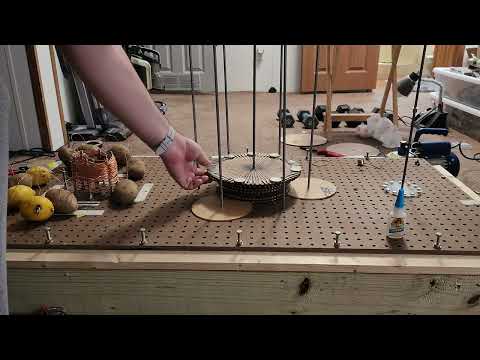 Long-form
Less Is More — Clockwise vs Counterclockwise
Comparing clockwise and counterclockwise rotation efficiency under the less-is-more design principle.
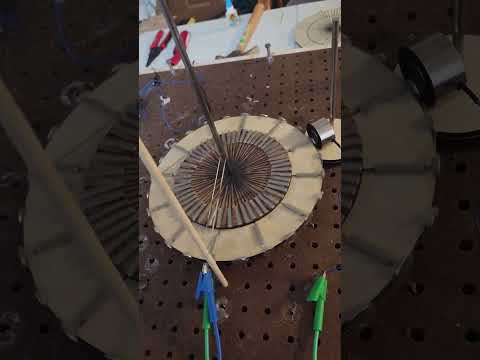 Long-form
250N Solenoid Upgrade: Dramatic Speed Response & Voltage Tests
Papa Bale installs a 250N solenoid magnet and the results are immediate.
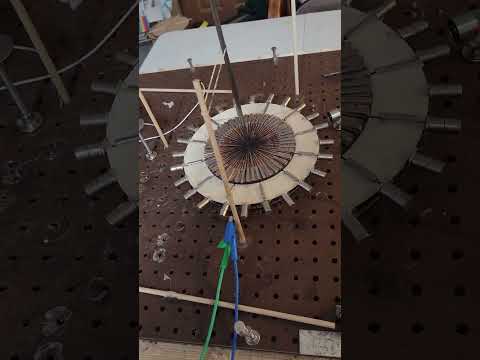 Long-form
Minor Adjustments, Major Results — Pulse Motor Optimization
Small tweaks make a huge difference — adjusting magnet height, reed switch positioning, and coil proximity transformed this pulse motor…
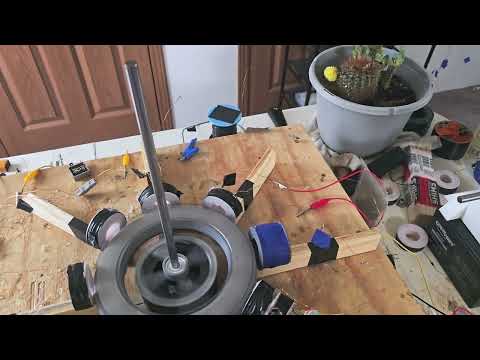 Long-form
Amp Funnel Coil: Pulse Motor Labs EP:1
Eight-magnet eight-coil pulse motor lab — amp funnel coil wiring, pickup coils, and give-and-take battery measurements.
One path · free first
Watch free → subscribe → optional membership
Notes stay free. The full experiment lives on YouTube. Membership is optional when you want Discord and exclusives — not required to learn.
Watch full-length on YouTube
Open the complete bench run — full audio and runtime. Free path that keeps the workshop online.
- 2
Subscribe free + turn on alerts
Hit Subscribe, then the 🔔 bell so you catch the next experiment.
Subscribe free + 🔔 - 3
Optional: join for $2.99/mo
Members-only videos, Discord, and live shoutouts — cancel anytime.
Join $2.99/mo
Longer sessions · ad-supported free library
Not done yet? Queue the next long-form run
Queue up the next long-form bench run on YouTube — longer sessions keep the workshop free for everyone.
- 1▶ Watch full on YouTube
Start: Shocking Truth About Pulse Motors
Notes & transcript on site - 2▶ Watch full on YouTube
M.P.H.Jr Pulse Motor Labs EP:1 Just scratching the surface
Notes & transcript on site - 3▶ Watch full on YouTube
8 Neo Cube Magnet Pulse Motor Hits 1300 RPM — Amp Funnel Coil Power Test
Notes & transcript on site - 4▶ Watch full on YouTube
Name change, plans for the future, Motor generator start of something cool 😎
Notes & transcript on site