Experiments·
4 Bifilar Coil Pulse Motor Generator
Watch me fire up this 4 bifilar coil pulse motor generator on a 12V system. Real bench tests, battery charging, flywheel spin-down, and what actually happens with the coil pack. No hype, just measurements.
Long-form · Full audio · Best on YouTube
Watch the complete video: 4 Bifilar Coil Pulse Motor Generator
Watch the full long-form video on YouTube — that's where the full bench audio, runtime, and experiments live.
See it on the bench · full runtime on YouTube
What to watch for
- ▸Small bifilar coils on 12 V system reach higher speeds than some larger coils
- ▸Parallel 12 V battery configuration delivers roughly 48 V equivalent to the coil pack
- ▸Flywheel action keeps rotor spinning over 7 minutes of useful rotation after power off
- ▸Basic SSG-style wiring without resistors or extra diodes still produces measurable charging
- ▸Inductance testing done in both series and parallel on the dual-drive coils
- ▸Total build cost stays low once you have a 3D printer and basic wire spools
Watch the full long-form video on YouTube — that's where the full bench audio, runtime, and experiments live.
Experiment notes
Papa Bale spins up a compact 4-coil pulse motor/generator built around bifilar windings. Running on 12 V with parallel battery banks, it charges batteries, shows strong flywheel effect, and demonstrates simple SSG-style generation. Measurements include voltage climb, slow de-gen, and long spin-down times.
Key takeaways
- Small bifilar coils on 12 V system reach higher speeds than some larger coils
- Parallel 12 V battery configuration delivers roughly 48 V equivalent to the coil pack
- Flywheel action keeps rotor spinning over 7 minutes of useful rotation after power off
- Basic SSG-style wiring without resistors or extra diodes still produces measurable charging
- Inductance testing done in both series and parallel on the dual-drive coils
- Total build cost stays low once you have a 3D printer and basic wire spools
Papa Bale here in the workshop. I fired up this little 4 bifilar coil pulse motor generator today and the results surprised me. On a 12 V setup it hit speeds I usually only see on higher voltage rigs. The coil pack sits close together so the fields interact and self-trigger nicely. We watched two batteries climb in voltage while a third provided the drive. After I killed the power the rotor kept turning for a solid 7–10 minutes thanks to the flywheel effect from the heavy outer magnets and hollow 15 % infill rotor on a 5/8 bearing. I also measured inductance in series and parallel on the dual-drive coils and caught the slow de-gen curve on the meter. It’s messy, it’s real, and it proves you don’t need a huge budget or perfect parts to get something spinning and charging.
Related on this site
- How to Wind Coils for a Pulse Motor (Step by Step) — Directly supports bifilar coil winding and coil pack discussion from the bench
- Bedini Motor & SSG Circuit Guide (Beginner Bedini Explained) — Explains the SSG stem-cell wiring style used in the 4 bifilar coil pulse motor generator
- Can a Pulse Motor Charge Batteries? What Experiments Show — Matches the real-time battery voltage climb observed in the experiment
---
*Generated from video transcript (hash `f8585b90cea8…`).*
Full transcript
Hello ladies and gentlemen. What's up? It's Papa Bale and welcome to the channel. So, I got my I'm going to call it uh the generator. We're just It's a It's a DC brushless motor that generates electricity. Most of it's based off Bendini Badini. We got uh K energy store SSG gen mode. K energy.store SSG mode. Then we got this one, two, I like to call it the 123. It's virtually a Badini SSG stem cell. So, it's without the resistance, without the dodes, just your basic connections and your generator clip with your diode on it. In this case, I have a reverse diode on the negative or the ground. Don't know if that's going to do anything, but we'll see. Uh, currently I'm charging these two batteries. All right. So, we're doing that. Got a lot of switches to turn on here. So, I'll turn on this one, which will activate one of the coils. And the rest of the switches are over on the other side. We'll turn on this one. Oh, yeah. And we'll turn on the main two, the 180s. Well, they're both got 180 orientations, but I like to consider this like the front where I'm standing. So, just those coils being close to each other are uh we'll set set them up, you know, they'll set each other off. That's awesome. So, it's a little squeaky. We're about There it goes. That's the SSG, but it's got it's got like 800 ohms on it. They both do got about 800 ohms. So, these two are generating. That was at 20 and that was at 18. We saw that, right? Our If we didn't see it, we'll stick around here for a little bit. Got our light going. Got two batteries. Jenning. Look at the speed on that thing, man. I feel like I don't get this type of speed from bigger coils for some reason. Maybe it's cuz I'm on a 12vt system and that it's kind of breaching a 24vt system with some of the coils that I've made. So you need to put in a little bit more voltage for them to run appropriately. That's awesome. All right, so 23. This one's still at 21, but it'll be at 22. 22. See, with it going that fast, you get a little bit more from the little coils. It's still a slow ride going up, but uh you just need a little bit more time, that's all. Look at that. That is so phenomenal, dude. That's awesome. Just those baby coils right there. They're all parallel. So, we got about uh 48 volts parallel going in. So, that's 12 volts. Four 12volt batteries are basically on this thing right now. But you get your since two of them are power supplies, you get the battery gen straight up. And that's just that's awesome. Now I've turned the one off and the one's still on. So that one's up to 24 and this one's down to 21. Nice. All right, I'm going to cut this the the way that it's wired. I would I would rewire it. I'm not going to probably do that. Uh maybe if I fill in the gaps here and put a few more coils on there, I'll rewire it so it makes sense. But right now, I got one of the batteries jetting on this side when they're both over there. So that's that having to walk all the way around and turn that switch off is something that I'd rather redo. And now that all the power's off, you can see that this is definitely got flywheel action, flywheel capabilities. Very cool, man. I think it's great. So, this will spin literally for 10 minutes before it stops. It'll spin probably for 7 and 1/2 minutes of useful spin. Then it'll keep spinning. Now, I just found my uh touch pad for my uh tester, and I'm going to test the inductance of my dual drive uh in series and parallel. So, that's going to be fun. But I mean, just look at that. That is like it's still moving it pretty much. This is the de the degen rate right here. 82.82 81. It's going down real slowly, but it's going down. [Music] So cool. Not that it's going down, but that it's going down slowly. That means that there is some somewhat of a flywheel application there. I think flywheels are awesome. All the weight is on the outside of this thing. Okay. And then the the center of it is pretty hollow. Uh it's like 15% print. Then it's on a 5/8 bearing uh with the quarter inch center hole. Really cool. Right at about this speed, it starts to shake a lot like the table does. But when it gets above this and below it, it's fine. But just right at that speed, it's like it's like I think one of these magnets is a little loose. That's why the duct tape's on it. See, we're still rolling, man. 60 59. Anyway, I think that's cool when it's, you know, you can still get some, you know, AC generation out of it and use some bridge rectifiers and caps and you can use that energy. You can use the energy that it's making right now. You can use it to light a light bulb. And really, that's what it was all about back in the day is who could light the light bulb the best. So, I mean, light bulbs are still a big deal. I didn't even think that they were like a big deal because everybody can do it. Like, but that's the point, man. Everybody can do it. That's the freaking point. That's the purpose. Everybody can do this. You don't need $5,000 to build one of these. You don't need You need about 50 bucks. You need to buy two spools of wire, a packet of bobbins, or you can print your bobbins. I mean, if you're starting from scratch and you don't even have your 3D printer yet, yeah, you're probably going to spend about a grand to do all this. That's buying the printer, buying all the stuff you need for the printer. Um, any mistakes that you're going to make with your printer, you're going to make them initially. Um, you you're and what I'm saying is is that your projection rate will get better as the time goes on. Most more than likely, you'll have a few snafoos, but uh should be all good. But yeah, man. Once you have everything you need, it should shouldn't cost you more than the two spools of copper um to make different style coils. And that's it. That's really all you should need. You got your rotor and then the variable becomes the coil. Um, I'm going to stick around 12 volts for right now, but uh, yeah, if I ever, you know, have enough money to mess around with a bunch of batteries, I will probably up the Annie a little bit and try to like see what I can do with either 24 or 48. Uh, I've done some 24 tests and they're pretty cool using these T energy batteries. Um, as you can see, this one got a little hot. Uh, I think it's cuz I left it plugged in, uh, charging it. I forget what it was, but it was like, uh, or I tried to close loop something without diodes. I forget, but yeah, man, they'll get hot. But anyway, the point is I've hooked two of these together and done 24 volts before uh when the table was on the outside of the room. But yeah. All right. So, that's it. Thank you very much, ladies and gentlemen. Peace out. Have a wonderful night, wonderful day. Please subscribe. Bye now.
Keep watching · longer sessions
More long-form bench runs
Queue up the next long-form bench run on YouTube — longer sessions keep the workshop free for everyone.
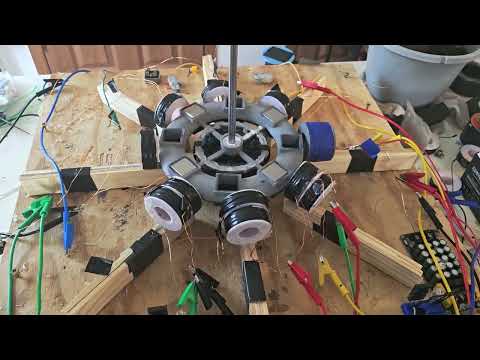 Long-form
2 circuits running a third room still for some growth/expansion.
Papa Bale here with a messy bench update.
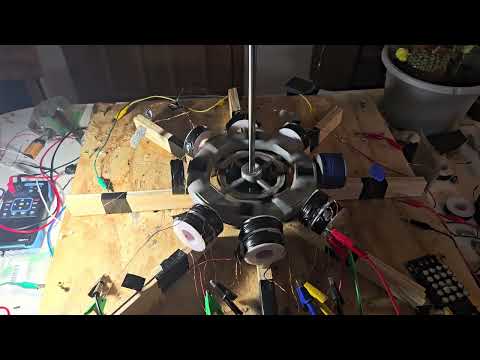 Long-form
M.P.H.'s pulse motor labs EP:2 Skin deep
I fire up two circuits at once, chase meter spikes, and retell the day a three magnet rotor one literally exploded at speed.
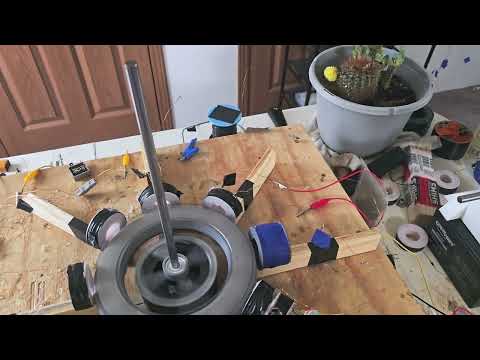 Long-form
Amp Funnel Coil: Pulse Motor Labs EP:1
Eight-magnet eight-coil pulse motor lab — amp funnel coil wiring, pickup coils, and give-and-take battery measurements.
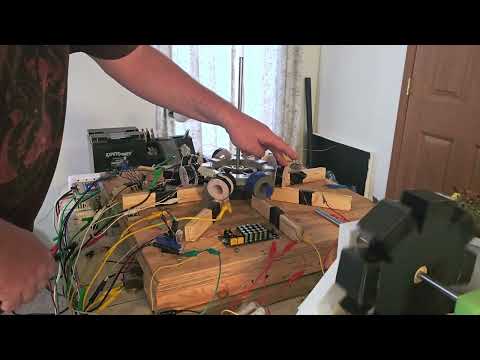 Long-form
MPH pulse motor lab
Real bench time with motor rotor magnets on a pulse motor rotor.
One path · free first
Watch free → subscribe → optional membership
Notes stay free. The full experiment lives on YouTube. Membership is optional when you want Discord and exclusives — not required to learn.
- 2
Subscribe free + turn on alerts
Hit Subscribe, then the 🔔 bell so you catch the next experiment.
Subscribe free + 🔔