Experiments·Transcript-backed
Bedini Does Spike: Speed Increases Through Induction
Watch me run a three magnet system 120 degree rotor with a coil positive end clipped to cap banks. See how the Bedini does spike effect charges caps and drives speed up even as voltage drops. Real bench results, no battery needed.
Long-form · Full audio · Best on YouTube
Watch the complete video: Bedini Does Spike: Speed Increases Through Induction
Watch the full long-form video on YouTube — that's where the full bench audio, runtime, and experiments live.
Preview embed · full runtime is better on YouTube
Prefer the full player? Better audio, runtime, and next-video queue on YouTube.
▶ Open full on YouTubeJump to the discussion · full video on YouTube
Hear it on the bench
Each link opens “Bedini Does Spike: Speed Increases Through Induction” on YouTube at the first time that topic comes up in the captions. Stay on YouTube for the complete runtime.
See it on the bench · full runtime on YouTube
What to watch for
- ▸Speed kept increasing even as cap bank voltage dropped below 10V
- ▸The three magnet system 120 degree rotor hit nearly 3900 RPM (1300 x 3)
- ▸Coil positive end had the main cap bank, small cap bank, and power supply clipped together
- ▸Induction from the spinning magnets fills the caps and makes the motor go faster
- ▸No battery or constant power supply needed once running
- ▸The Bedini does spike goes directly to the cap bank clipped at the coil positive end
Watch the full long-form video on YouTube — that's where the full bench audio, runtime, and experiments live.
Experiment notes (read while you watch)
Notes support the video — for the full-length run with complete bench audio, stay on YouTube.
I hooked up a cap bank to the coil positive end on my three magnet system 120 setup and watched the speed climb while the main caps discharged. The Bedini does spike keeps feeding energy back, pushing RPM higher with induction alone.
Key takeaways
- Speed kept increasing even as cap bank voltage dropped below 10V
- The three magnet system 120 degree rotor hit nearly 3900 RPM (1300 x 3)
- Coil positive end had the main cap bank, small cap bank, and power supply clipped together
- Induction from the spinning magnets fills the caps and makes the motor go faster
- No battery or constant power supply needed once running
- The Bedini does spike goes directly to the cap bank clipped at the coil positive end
I fired up the three magnet system and let the cap bank charge to 13V before pulling the plug. What happened next surprised me—the rotor kept picking up speed while the voltage sagged. That's the kind of thing that makes you snort and laugh at the bench.
We monitored the multimeter and the little cap bank in the back. The presence of that extra capacitance clipped right to the coil seemed to help everything. I heard the transition as it accelerated past 1000 RPM and just kept climbing.
The coil is 1.5 pounds of 32 gauge wire with about a quarter underneath the wheel. The field reaches out, so even the offset part gets some action. I jiggled the resistor once and it throttled right up—almost 1300 on the meter, which works out to 3900 when you account for the three magnets.
When the Bedini does spike, that energy heads straight into the cap bank. I love how forgiving this setup is. You don't need micron-level precision; just hook things up right and it runs.
I unclipped the grounds to shut it down and watched the little cap bank continue to climb from the coasting induction. Pretty neat to get these results without a battery sitting there the whole time.
Related on this site
- Pulse Motor vs Bedini Motor: What's the Difference? — Compares the Bedini spike behavior shown in the experiment with standard pulse motor operation
- How to Maximize RPM on Your Pulse Motor — Builder can use the three magnet system 120 speed results and coil positive end wiring tips to push their own RPM higher
- Understanding Back EMF in Pulse Motors — Explains the induction and spike charging the caps that drove the observed speed increase
---
*Generated from video transcript (hash `13993394b8d2…`).*
Full transcript (5,862 chars · en)
So, we got 12 volts in the cap bank now. I'm about ready to pull the plug here. I'm going to let it get 13, maybe. On the multimeter there in the middle. Maybe 1250. We'll see what's up. So, I'm going to come on shut it off. So, cuz I'm just charging the cap bank right now. It's going pretty fast. Give it a little bit more. Cuz that's basically what we're doing. So, the value is 13 and about a an amp to force charge the cap bank. All right. Now, I'm going to shut it off. It's going to start to go down. But, the value of this little cap bank in the back is going to go up. So, I think all in all, since they're all being put into the same place, which is the coil, I'm going to monitor the speed. I think the the presence of that cap bank and it being hooked up to the same place is >> [snorts] >> a good good thing, good sign. Yeah, it's starting to pick up. Huh. Oh, let me try and uh There it goes. Anybody heard that transition? There it goes. Yeah, it's going up pretty steadily right now. It's currently not maglev, so it won't reach astronomical speeds, but Oh, we're at 1,000. It's a three magnet system, 120°. Yeah, see it keeps on getting faster and faster even though the voltage in the cap bank is going down. There's got to be a reason for that. Either it's sinking into the resistance that's right here. Yeah, I had to cut that back, man. That was uh a little nerve-racking. Oh. Wow. Dude, but that's so like just phenomenal, man. I mean, it's like you don't really All I can say is that the induction as it goes faster, it fills those caps up, and the higher those caps are, the faster the whole thing goes. Because it's it's clipped right here to the to the coil. And then in order for it to get to ground, it has to go through the this. I just think it's it's awesome. Because it's not coming from a power supply. Right? And it's not coming from a battery. Definitely no battery. Just this cap bank and that cap bank. And I'm pretty sure uh as long as there's enough capacitance, the values can vary. She variants and ranges. That's what I like working with, okay? I mean, I don't the exact micronicallyn sector uh wherever whatever's going on, man. I mean, that's it's it's definitely necessary for for a lot of things, but for this, I don't I don't think. I don't think so. I think this is very forgiving as long as you know what's what and what's what. You know, I just jiggled the resistor right there and then there's the probably one of these connectors is a little, you know, open. And it just throttled right up. All the way up to a like almost uh you know, 1,300. Right? Almost to like uh 3,900. 100 3,900 and then you divide by three. The 1,300. Perfect. See, and it's even charging it up now, as far as I can recall, just from it coasting past that coil. Or it's got to be the little cap bank, but it's not hooked directly up >> [cough and clears throat] >> to the to the big cap bank, so I don't know what's going on with that. I know that when the Bedini does a spike, that spike goes directly to the cap bank. I also know that cap bank is clipped to the to the uh beginning of the coil, positive end of the coil. You got three things clipped to the positive end. You got the cap bank, you got the little cap bank, and you got the power supply. The power supply is off most of the time. Um literally, this this thing will charge up in 2 minutes flat. Doesn't matter where it's at, pretty much. I mean, it's not like I let it get very low. But uh yeah, I think it's great. And I'm not sure why it increases in speed like that, but um you know, it gets to the point where it should be you know, you would think that it would start losing speed because it's lost so much voltage across the cap bank right here. And it just keeps increasing in speed and everything it has to do with the other cap bank being hooked up to this coil. Anyway, that's uh 1 and 1/2 lbs of 32 gauge. And it's it's a I don't know how far off set it is. It's like a quarter quarter of it's underneath the wheel here. So, there's a big 3/4 of it that's not directly being affected. I mean, it's probably being affected more so towards the center because of the way that the the field operates. You know, it goes out a little ways. All right, so There, that's about to go out. All right, so we'll spin it up. You can If you can hear it, it's chirping. That's a good sign. That means we're going to get speed. That means we're going to get induction. And that means that we might have the effect. So, this is just uh reading. It's a bounce back from the cap bank. It's the cap bank is at 1080 and it's saying 10 10 4. 0 amps. And saying 0 amps is probably something splashing back to the So, see how it's going down, you know, it's going down. Maybe it hasn't reached the potential yet. It's crazy, man. It is going so fast. All right. And if you can hear it, it is revving up. But, we've dipped below 10 volts. We are now at 9.9. >> 3,000 Wow, dude. 9.5 volts 100 1,111 Just put Round it off. Boom! Man, that is so cool. With less than 10 volts. Wow, man. Man, that is so neat. And then I don't know, man. It's just so easy for me. Um well, I just to unplug it, you know, like this. Other people would like maybe build a mechanical switch or crank or something like that. And I love seeing all that stuff. Makes me like want to do other things. But, you know, I'm uh unclip the clips. Yeah, I just disconnected both grounds from eating both cat banks and everything is shutting off. And then all this spinach is going to increase I don't even know. I maybe I'm wrong about that. I think the little cat bank is increasing, but I don't have a multimeter hooked up to it right now. Anyway, I think that's really cool. I I It's awesome for me. I feel confident not using a battery or a power supply and having awesome results. That's great. All right. Peace out.
Keep watching · longer sessions
More long-form bench runs
Queue up the next long-form bench run on YouTube — longer sessions keep the workshop free for everyone.
 Long-form
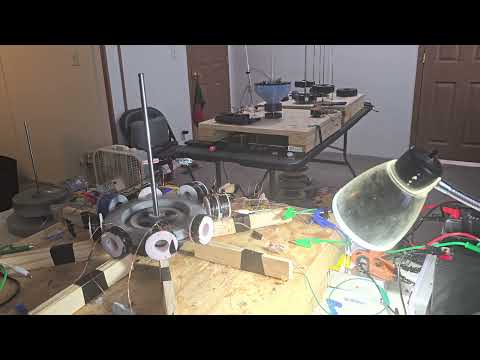
8-Magnet Pulse Motor + Induction Coils (Bedini-Style Charge)
Eight-magnet pulse motor at 12V with series induction coils.
 Long-form
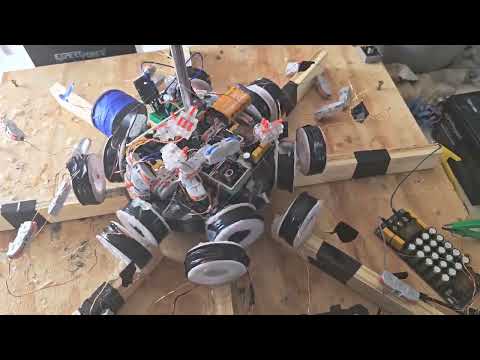
Coil Passes in My Pulse Motor Sandbox (Magnet Induction Test)
6-magnet rotor vs 8 bifilar stator coils: coil passes from 400 Hz down to 100 Hz at 12–30 V, north/south fields, under 130 mA.
 Long-form
Bedini SSG With First Induction Coil and Big Coil Waveform
Watch me run a Bedini SSG with the first induction coil placed under the drive coil and wired in series to the big coil.
 Long-form
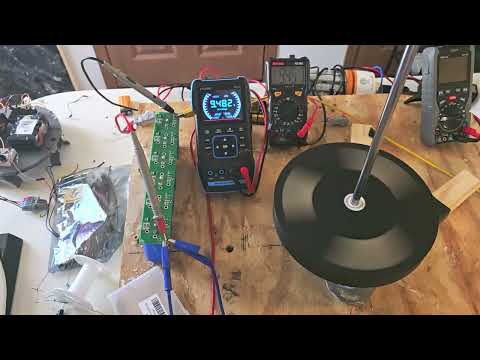
Bedini Output Onto Coil: Running Standard Bedini Experiments
Bedini output hooked onto the coil with cap banks — standard Bedini bench experiment, real results.
One path · free first
Watch free → subscribe → optional membership
Notes stay free. The full experiment lives on YouTube. Membership is optional when you want Discord and exclusives — not required to learn.
- 2
Subscribe free + turn on alerts
Hit Subscribe, then the 🔔 bell so you catch the next experiment.
Subscribe free + 🔔 - 3
Optional: join for $2.99/mo
Members-only videos, Discord, and live shoutouts — cancel anytime.
Join $2.99/mo
Longer sessions · ad-supported free library
Not done yet? Queue the next long-form run
Queue up the next long-form bench run on YouTube — longer sessions keep the workshop free for everyone.
- 1▶ Watch full on YouTube
Start: Shocking Truth About Pulse Motors
Notes & transcript on site - 2▶ Watch full on YouTube
2 circuits running a third room still for some growth/expansion.
Notes & transcript on site - 3▶ Watch full on YouTube
M.P.H.'s pulse motor labs EP:2 Skin deep
Notes & transcript on site - 4▶ Watch full on YouTube
Bifilar Pancake Coil Build for Pulse Motor Generator
Notes & transcript on site