Experiments·Transcript-backed
Bedini Output Onto Coil Test
Watch me hook the Bedini output onto the coil and test what happens with the cap banks. Real bench results on running standard Bedini setup, coil behavior, and why it slows or speeds up. Curious DIY pulse motor tests only.
Long-form · Full audio · Best on YouTube
Watch the complete video: Bedini Output Onto Coil Test
Watch the full long-form video on YouTube — that's where the full bench audio, runtime, and experiments live.
Preview embed · full runtime is better on YouTube
Prefer the full player? Better audio, runtime, and next-video queue on YouTube.
▶ Open full on YouTubeJump to the discussion · full video on YouTube
Hear it on the bench
Each link opens “Bedini Output Onto Coil Test” on YouTube at the first time that topic comes up in the captions. Stay on YouTube for the complete runtime.
- ▶ Watch at 12:21bedini output ontoprimary
“…the Bedini output onto the coil.…”
- ▶ Watch at 13:47running standard bedinilong-tail
“…Cuz if you're running a standard Bedini, you need a charge…”
- ▶ Watch at 1:25bedini outputlong-tail
“…That's the Bedini output.…”
- ▶ Watch at 1:38coil. seelong-tail
“…from the core by the coil. See, so I think part of this is like…”
See it on the bench · full runtime on YouTube
What to watch for
- ▸Connecting the Bedini output to the cap bank or coil slows the rotor significantly
- ▸Leaving the Bedini output disconnected lets the wheel reach 1300+ RPM on 7.3V
- ▸Power supply charges the cap banks then gets disconnected so only caps run the wheel
- ▸Removing grounds from both cap banks is how I stop the motor
- ▸Hooking Bedini output to a battery might behave differently than to the coil or caps
- ▸The coil draws from multiple cap banks and power supply
Watch the full long-form video on YouTube — that's where the full bench audio, runtime, and experiments live.
Experiment notes (read while you watch)
Notes support the video — for the full-length run with complete bench audio, stay on YouTube.
I hooked the Bedini output directly onto the coil instead of the cap bank and compared speeds. The wheel runs way faster with the output disconnected. When connected it stalls and slows down. Charged caps to around 9-11V with a power supply and watched the light bulb light up while spinning fast.
Key takeaways
- Connecting the Bedini output to the cap bank or coil slows the rotor significantly
- Leaving the Bedini output disconnected lets the wheel reach 1300+ RPM on 7.3V
- Power supply charges the cap banks then gets disconnected so only caps run the wheel
- Removing grounds from both cap banks is how I stop the motor
- Hooking Bedini output to a battery might behave differently than to the coil or caps
- The coil draws from multiple cap banks and power supply
Short bench test of the Bedini output onto the coil. I had two cap banks – 10F at 11V and a big 500F bank around 16V from six 2.7V supercaps. The coil pulls from them and the power supply. When I connected the Bedini output clip it dragged the speed down to a snail's pace. Unhooked it and the wheel screamed up past 1300 RPM easy. I tried clipping it back on and it stalled again. Charged everything up, cut the power supply, removed the emitter grounds to stop it. Light bulb lit even at high speed. Curious what would happen if the output went to a battery instead.
Related on this site
- Bedini Motor & SSG Circuit Guide (Beginner Bedini Explained) — Directly referenced for running standard bedini with charge and primary battery
- Pulse Motor vs Bedini Motor: What's the Difference? — Contrasts classic Bedini setup with the capacitor-only running shown in the test
- How to Maximize RPM on Your Pulse Motor — The free-running speed when Bedini output is disconnected directly relates to RPM maximization
- Understanding Back EMF in Pulse Motors — The induction and bounce-back voltage mentioned in the come-down matches back-EMF discussion
---
*Generated from video transcript (hash `66ae96f3e2bf…`).*
Full transcript (6,777 chars · en)
Hey, what's up everybody? It's Papa Bale and welcome to the channel. So, I I briefly touched on this like maybe in a short uh about how I get it to go really fast on the caps. Now, let's go to the max voltage that's going through these things. You got 11 volts 10 farad in the back. Those two blue ones right there. And you got 16 or so uh so it's 2.7 uh times six. Awesome. And that's 500 farad right there. So, this one's pretty big. That one is decent size in the back. It's only two in the back. Well, it's kind of swapping back and forth as to which one it's drawing from cuz they're all hooked up to the same place and that's the coil. All right. Now, I'm about to let it rip and So, you see this this connection right here with the clip to this blue That's the Bedini output. Okay, and that's currently hooked up to the positive of the cap bank, which is then being drawn from from the core by the coil. See, so I think part of this is like having it be connected there would be shortish [snorts] like shorting it out. Um I think that maybe if I hooked up one of these batteries to it as an as an input having the output from this being input to one of the batteries. Oh man, I think it would be great. But here, watch this. See how we're leveling out and we're getting slower as it goes on, right? You hear that, right? It's like on two completely different levels. I've now the Bedini output is not hooked up to anything and it's going like super duper more fast. It's going way faster than it was a second ago. This will be up to 1,000 easy. Easy, way above 1,000. Like 1,300. And that's on you know, like seven 7.3 volts. Yeah, look at that. >> See, I wonder what would happen if I clipped it back on there. Like right now. Like would it spark up? Would it It wouldn't shock me cuz I'm holding the clip, you know? It might might dazzle dazzle me. So, it's stalling it. It's stall It's stalling it. And it's still spending. But it now there's not enough That's pretty cool, man. It's going to drop down to that like snail's pace that it was at before. So, it just re- re- you know, corrects >> [snorts] >> um what I broke. So, let's go through the connections that are on the coil. Um we got power supply goes into the coil. We've got the small cap bank goes into the coil. We've got the large cap bank goes into the coil. And it draws from them respectively. So, as soon as this goes above the highest cap bank, >> See, and the amps go way up cuz you're filling up the Look at how fast this goes up. I mean Oh. That was weird, man. It was up to like 8 amps. I hope nothing blew right there. That would be bad luck. I don't know caps blew because the voltage is still below the the highest the lowest still below the lowest. Um maybe the transistor, but I don't think so. It'd be It'd be doing something way different. So there, the cap is full now basically. So I'm going to cut out cut off the power here which was like, you know, right on par with uh the voltage. Cut it off. And I got a bounce back. You got like uh the the voltage of this and that just read on here. It's like I need either an average of both or the the highest one I or the lowest one actually. So the the big cap bank here is the low one. Here, let's see if we can get a quick quick reading. Yeah, 9.4. So, it's like right on par with what's going on here. And this one reads below it, but it's definitely picking up a reading from from the cap banks over here. Cuz it's all the way off, you know, and there's no amps being drawn. So, you know, I I don't know what to tell you other than how I've explained it. It's uh It's dead It's what I use when Like, see this This meter's dead. It's about to shut off in 3 seconds. This power supply uh plus 20, so like right around 9 volts right now in this cap bank. Simple simple to me, you know. Anyway, this is really sweet. And I charged it up. But, watch this. Oh, yeah. That That's That's That's the light bulb is lit. That's what I was looking for, to see if the light bulb was lit up, and it is. So, even though it's going super duper fast, I I don't think it's meant to be run this way. >> All right, I'm going to cut it off. How I cut it off is I remove the grounds of both cap banks. So, I remove their connection to the emitter. Uh and that's that'll send that'll send her down. Oh, man, it's so cool how I I I I feel like and I know that there's like bikes out there and you know scooters or whatever that use the same principle here with the only caps principle. And you know, it's not only caps. I use I use the power supply to charge them up. But I I only run the wheel except for that brief moment when they're charging. Um yeah. It's cool. And that's uh the come down, you know, that's the induction suggestion. Pretty pretty cool, man. It's all really really neat. And I'm just so happy that the you know It's And I'm [snorts] sure that's exactly how it works with the Bedini output. If you hook it up to itself, you're going to get that effect that slows everything down. But I was wondering if I hooked it up to the batteries, hook that output up to the batteries if it would function more like it's not hooked up, you know? Cuz it goes really fast when it's not hooked up. >> [laughter] >> But that's because that positive node right there is the only place that I ever wanted to connect it. I'm thinking, just because I'm I like the longer videos, we're going to put the Bedini output onto the coil. Let's do it. Let's do it real quick. I think it's going to do the same thing as if it were connected to the cap bank. I'm going to give it a couple seconds here. I'm going to give it like, you know, 30 seconds. About 8.2 volts in the cap banks. >> That's pretty good. I'm not complaining. I think that hooking it to the coil is exactly what needs to be done. If you're going to hook it up at all. To itself, that is. Cuz if you're running a standard Bedini, you need a charge battery and a primary battery. You don't need that, but that What I mean is the schematic calls for that. So I guess you do need it, right? See if it it's not continuing to increase in speed. So watch. All right, we're going to remove this clip. See, it's got like a power to it, like a rev. And I think that's because I don't know. I think it it backtracks. Or maybe it doesn't backtrack. Maybe it gets lost in that wire. When I say lost, I don't mean destroyed. I mean it's lost. You could have used it, but you didn't use it. So it's You have to use it when you build it again in the future. >> Your next build, you know, that that's where it is. And I'm lucky because I get to do all that next build stuff uh in real time. All right. Well, thank you very much, ladies and gentlemen. Peace out. Have a wonderful night. Hope everybody's good. I'm out.
Keep watching · longer sessions
More long-form bench runs
Queue up the next long-form bench run on YouTube — longer sessions keep the workshop free for everyone.
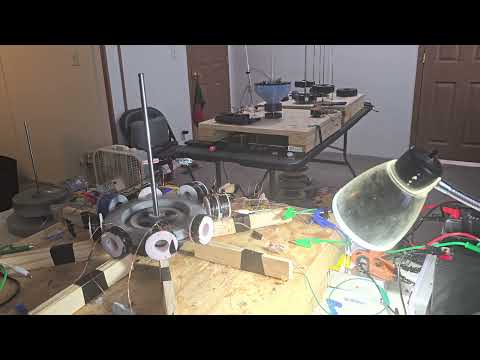 Long-form
8-Magnet Pulse Motor + Induction Coils (Bedini-Style Charge)
Eight-magnet pulse motor at 12V with series induction coils.
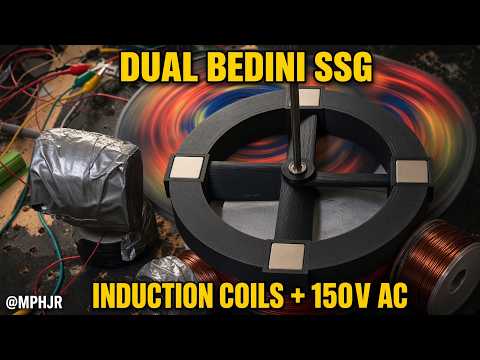 Long-form
Bedini SSG With First Induction Coil and Big Coil Waveform
Watch me run a Bedini SSG with the first induction coil placed under the drive coil and wired in series to the big coil.
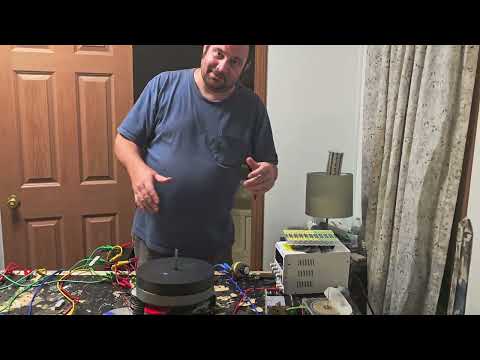 Long-form
Double SSG SSG GEN Closed Single Loop
Closed-loop double SSG on one battery — bifilar coils, pot tweak, live meter readings.
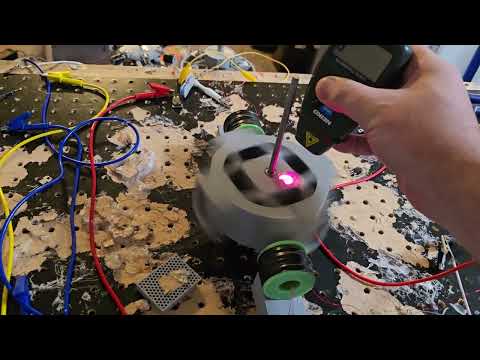 Long-form
Two Bedini Circuits Running a 9-Mag Rotor and 4-Mag Rotor at 600 RPMs
Two Bedini circuits on a pulse motor: 9-magnet rotor and 4-magnet Celtic cross, both around 600 RPM.
One path · free first
Watch free → subscribe → optional membership
Notes stay free. The full experiment lives on YouTube. Membership is optional when you want Discord and exclusives — not required to learn.
- 2
Subscribe free + turn on alerts
Hit Subscribe, then the 🔔 bell so you catch the next experiment.
Subscribe free + 🔔 - 3
Optional: join for $2.99/mo
Members-only videos, Discord, and live shoutouts — cancel anytime.
Join $2.99/mo
Longer sessions · ad-supported free library
Not done yet? Queue the next long-form run
Queue up the next long-form bench run on YouTube — longer sessions keep the workshop free for everyone.
- 1▶ Watch full on YouTube
Start: Shocking Truth About Pulse Motors
Notes & transcript on site - 2▶ Watch full on YouTube
2 circuits running a third room still for some growth/expansion.
Notes & transcript on site - 3▶ Watch full on YouTube
M.P.H.'s pulse motor labs EP:2 Skin deep
Notes & transcript on site - 4▶ Watch full on YouTube
Bifilar Pancake Coil Build for Pulse Motor Generator
Notes & transcript on site