Beginner·Transcript-backed
ac gauge readings: Build Your Own Pulse Motor – No Solderin
Watch me spin a pulse motor using just a single battery and a stack of hand-wound coils. Real scope readings, messy bench notes, and what actually happe…
Long-form · Full audio · Best on YouTube
Watch the complete video: ac gauge readings: Build Your Own Pulse Motor – No Solderin
Watch the full long-form video on YouTube — that's where the full bench audio, runtime, and experiments live.
Preview embed · full runtime is better on YouTube
Prefer the full player? Better audio, runtime, and next-video queue on YouTube.
▶ Open full on YouTubeJump to the discussion · full video on YouTube
Hear it on the bench
Each link opens “ac gauge readings: Build Your Own Pulse Motor – No Solderin” on YouTube at the first time that topic comes up in the captions. Stay on YouTube for the complete runtime.
See it on the bench · full runtime on YouTube
What to watch for
- ▸A single battery is enough to run and generate from this pulse motor setup
- ▸Solid iron cores dramatically increase voltage output on the heavier gauge coil
- ▸Nine magnets on the rotor create a dense, spiky waveform instead of a clean sine
- ▸Series wiring of multiple coils (26, 20, 32 gauge) smooths operation and stacks turns
- ▸Back-EMF spikes hit 520–560 V on the scope with no load
- ▸The whole build uses no soldering – just hook-up wire and clips
Watch the full long-form video on YouTube — that's where the full bench audio, runtime, and experiments live.
Experiment notes (read while you watch)
Notes support the video — for the full-length run with complete bench audio, stay on YouTube.
Papa Bale hooks up three coils in series on a single battery, spins the 9-magnet rotor, and captures wild voltage spikes on the scope. 500–560 V peaks from a simple setup with 12k, 22k, and 750-turn coils on iron cores.
Key takeaways
- A single battery is enough to run and generate from this pulse motor setup
- Solid iron cores dramatically increase voltage output on the heavier gauge coil
- Nine magnets on the rotor create a dense, spiky waveform instead of a clean sine
- Series wiring of multiple coils (26, 20, 32 gauge) smooths operation and stacks turns
- Back-EMF spikes hit 520–560 V on the scope with no load
- The whole build uses no soldering – just hook-up wire and clips
Short bench session with a single battery driving a multi-coil pulse motor. Got 560 V spikes on the scope and a smooth rotor thanks to series wiring. Iron core on the 20-gauge coil made the biggest difference. Classic messy Papa Bale experiment.
From the spoken experiment
The following notes stay close to what was said in the video about ac gauge readings:
> yo what's up everybody this is Papa Bale and welcome to the channel um I'm trying something a little different than I've been doing uh lately I've been I hooked these three coils in series we're going to use that as our generator battery kind of thing or can you describe the coils so we have uh 12,000 turns of 32 here 22,000 turns of 32 here and we have I think 750 turns of 20 gauge and then that's a solid iron core this is a solid iron core all right which helps the 20 gauge do voltage a lot helps it a lot without that it wouldn't generate much voltage at all all right so here we go 20 volts here we go actually let's get some uh readings up here that's we going to [Music] do scope reading for the black here this this black coils all right here we go heck yeah because we got nine magnets on the rotor we got a lot more waves and a standard sine wave form nice there we go look at that you…
Builder checklist
- Confirm trigger/sensor timing before chasing higher voltage
- Watch heat on coils and transistors during longer runs
- Record voltage and behavior at each change (one variable at a time)
Related on this site
Related on this site
- Reading Oscilloscope Output on a Pulse Motor — Directly matches the scope section and 500-560 V spikes shown in transcript
- How to Wind Coils for a Pulse Motor (Step by Step) — Covers the exact turn counts (12k, 22k, 750 turns) and gauges used
- Understanding Back EMF in Pulse Motors — Explains the 520-560 V spikes captured on the black coil
- The Bedini SSG Circuit: A Complete Guide for Beginners — Setup described is a stripped-down Bedini-style series coil arrangement
- Can a Pulse Motor Charge Batteries? What Experiments Show — Addresses whether the single-battery spikes can charge another battery
- I Finally Got My Pulse Motor Running (Reed Switch) — Similar successful running test, different trigger method
---
*Generated from video transcript (hash `80d96d093c8d…`).*
Full transcript (1,466 chars · en)
yo what's up everybody this is Papa Bale and welcome to the channel um I'm trying something a little different than I've been doing uh lately I've been I hooked these three coils in series we're going to use that as our generator battery kind of thing or can you describe the coils so we have uh 12,000 turns of 32 here 22,000 turns of 32 here and we have I think 750 turns of 20 gauge and then that's a solid iron core this is a solid iron core all right which helps the 20 gauge do voltage a lot helps it a lot without that it wouldn't generate much voltage at all all right so here we go 20 volts here we go actually let's get some uh readings up here that's we going to [Music] do scope reading for the black here this this black coils all right here we go heck yeah because we got nine magnets on the rotor we got a lot more waves and a standard sine wave form nice there we go look at that you got [Music] 500 520 uh volt spikes going 560 look at that thing go man it's awesome all right so I've got four strands here hooked in series so it's it's 860 turns of 26 gauge and the single strand right here but it's in series so it does the 215 uh turn over and over again I like it it's very smooth and then over here we've got a 20 into a 20 it's a series circuit as well so it's two 20s a 26 and a 32 so it's a little different on the other side all right we're at 600 thank you very much hell yeah peace out have a good night thank you very much that's so cool
Keep watching · longer sessions
More long-form bench runs
Queue up the next long-form bench run on YouTube — longer sessions keep the workshop free for everyone.
 Long-form
Shocking Truth About Pulse Motors – What You've Been Missing!
Papa Bale cuts through misinformation to reveal core principles most hobbyists overlook: coil timing, back-EMF recovery, and fundamentals.
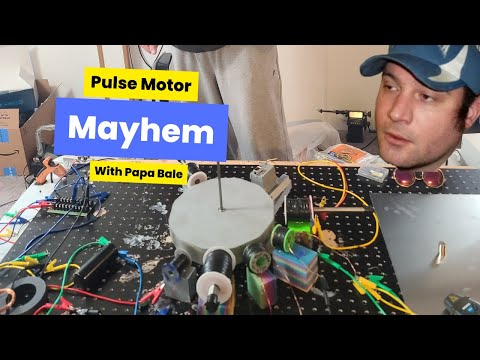 Long-form
Pulse Motor Tabletop Toy: Papa Bale Explains the Point
A simple tabletop toy becomes the perfect vehicle for explaining the real point of pulse motor experiments.
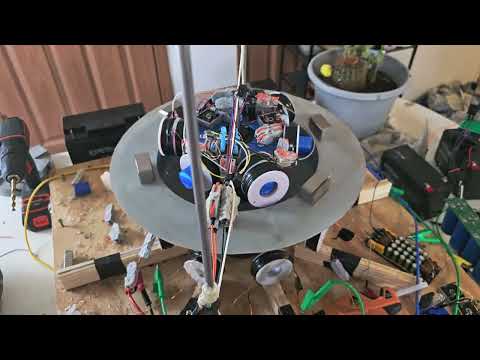 Long-form
Turbo Drive Concept for Counter Rotator
Putting a drive coil on a counter-rotator: 2.5V start, capacitor-fed LEDs, mutual inductance on the bench.
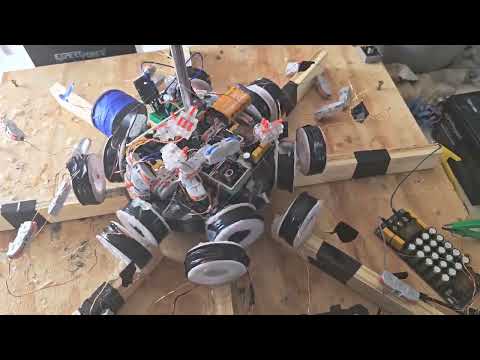 Long-form
Coil Passes in My Pulse Motor Sandbox (Magnet Induction Test)
6-magnet rotor vs 8 bifilar stator coils: coil passes from 400 Hz down to 100 Hz at 12–30 V, north/south fields, under 130 mA.
One path · free first
Watch free → subscribe → optional membership
Notes stay free. The full experiment lives on YouTube. Membership is optional when you want Discord and exclusives — not required to learn.
- 2
Subscribe free + turn on alerts
Hit Subscribe, then the 🔔 bell so you catch the next experiment.
Subscribe free + 🔔 - 3
Optional: join for $2.99/mo
Members-only videos, Discord, and live shoutouts — cancel anytime.
Join $2.99/mo
Longer sessions · ad-supported free library
Not done yet? Queue the next long-form run
Queue up the next long-form bench run on YouTube — longer sessions keep the workshop free for everyone.
- 1▶ Watch full on YouTube
Start: Shocking Truth About Pulse Motors
Notes & transcript on site - 2▶ Watch full on YouTube
M.P.H's pulse motor labs Ep:3 Sandbox
Notes & transcript on site - 3▶ Watch full on YouTube
4 parallel drive coils pulse motor generator 25x with 2.08v .7 amps in 55v 1 amp out
Notes & transcript on site - 4▶ Watch full on YouTube
Bifilar Pancake Coil Build for Pulse Motor Generator
Notes & transcript on site